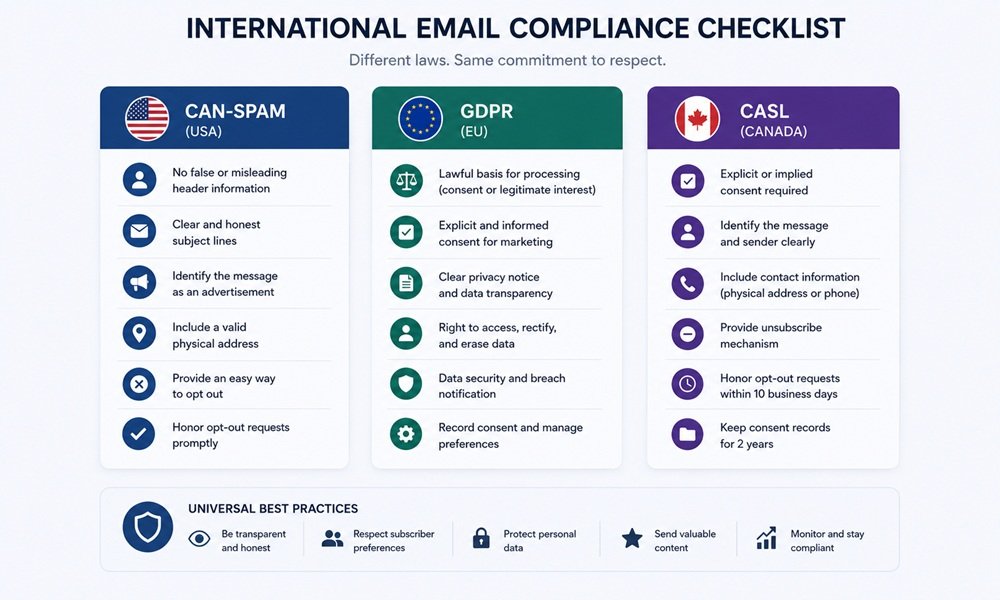
The moment your email program crosses borders, a single set of rules no longer suffices. The US, EU, and Canada govern commercial email under fundamentally different frameworks, and reaching recipients in multiple regions means complying with multiple laws at once. This article provides a practical compliance overview for international email across these three major regimes. It is general educational information, not legal advice.
Three regimes, three philosophies
The three major email laws differ most fundamentally in their consent model — whether you need permission before emailing.
CAN-SPAM (United States) is an
opt-out regime. You may send commercial email without prior consent, provided you meet requirements: accurate header and sender information, non-deceptive subject lines, identification as an advertisement, a valid physical postal address, a clear opt-out mechanism, and prompt honoring of opt-outs (within 10 business days). The bar to start sending is low; the obligations are around honesty and honoring opt-outs.
GDPR (European Union) is generally an
opt-in regime for marketing to individuals. It typically requires a lawful basis (often consent) before sending marketing email to EU residents, with consent that’s freely given, specific, informed, and unambiguous. GDPR also grants broad data rights (access, deletion, etc.) over personal data. The bar to start is high — you generally need permission first — and the data-handling obligations are extensive.
CASL (Canada) is also an
opt-in regime and among the strictest — generally requiring consent (express or, in limited cases, implied) before sending commercial electronic messages to Canadian recipients, with specific identification and unsubscribe requirements and significant penalties.
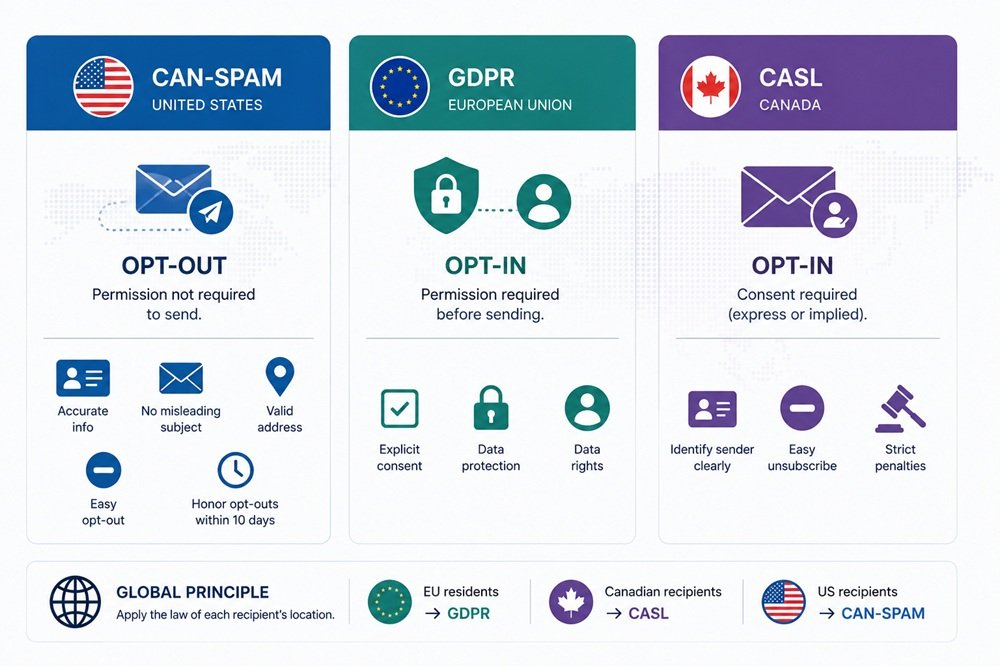
The critical principle for international email:
apply the law of each recipient’s location. EU residents get GDPR protections, Canadians get CASL, US recipients get CAN-SPAM — so a multi-region program must apply each regime to the right recipients, or apply the strictest standard across all to ensure compliance everywhere.
Common questions
What’s the core difference between these three laws?
The consent model. CAN-SPAM (US) is opt-out — you can send without prior consent if you honor opt-outs and meet requirements. GDPR (EU) and CASL (Canada) are opt-in — you generally need consent before sending marketing email. This is the fundamental divide: under CAN-SPAM you may email first and let people opt out; under GDPR and CASL you generally need permission first. For international email, this means the same message that’s compliant to a US recipient may be non-compliant to an EU or Canadian recipient without prior consent.
Which law applies to my international email?
The law of each recipient’s location. EU residents are protected by GDPR, Canadian recipients by CASL, US recipients by CAN-SPAM — so you apply each regime to the appropriate recipients based on where they are. For a multi-region program, this means either segmenting by region and applying each region’s rules, or applying the strictest applicable standard across your whole program to ensure compliance everywhere. Knowing where your recipients are located is therefore essential — you can’t apply the right law without knowing the recipient’s region.
Can I email EU residents without prior consent?
Generally no — GDPR typically requires a lawful basis (often consent) before sending marketing email to EU residents, with consent that’s freely given, specific, informed, and unambiguous. Unlike CAN-SPAM’s opt-out approach, GDPR generally requires permission first for marketing to individuals. There are nuances and limited bases beyond consent, but the safe general position is that marketing email to EU residents needs prior consent. This is a key trap for US marketers accustomed to opt-out — the US approach doesn’t transfer to the EU. Consult counsel for your specifics.
What makes CASL so strict?
CASL generally requires consent (express or, in limited circumstances, implied) before sending commercial electronic messages to Canadian recipients, imposes specific sender-identification and unsubscribe requirements, and carries significant penalties for violations. Its combination of an opt-in default, detailed requirements, and substantial penalties makes it among the strictest commercial email regimes. For marketers, CASL means Canadian recipients generally need prior consent and careful compliance with its identification and unsubscribe rules — you can’t treat Canada like the US opt-out environment.
How do I handle a list with recipients in multiple regions?
Two main approaches. Segment by region and apply each region’s rules to its recipients (US recipients under CAN-SPAM, EU under GDPR, Canada under CASL) — precise but operationally complex. Or apply the strictest applicable standard across your whole program (effectively, opt-in and the most demanding requirements for everyone) — simpler to operate and compliant everywhere, though it forgoes the looser US approach for US recipients. Many international programs adopt the strictest-standard approach for simplicity and safety. Either way, knowing recipient locations is essential. Consult counsel on the right approach for your situation.
What’s a practical compliance checklist for international email?
Generally: know where each recipient is located; obtain appropriate consent for opt-in regions (EU, Canada) before sending; for all email, include accurate sender identification and a valid physical address; provide a clear, functioning unsubscribe mechanism and honor opt-outs promptly; maintain records of consent and provenance; suppress opt-outs and honor data rights (access, deletion) where applicable; and source data compliantly with documented provenance. This is a general framework, not exhaustive legal guidance — the specifics vary by regime and situation, so build your actual checklist with qualified counsel.
What are the penalties for getting international email compliance wrong?
Significant across all three regimes. CAN-SPAM violations can carry penalties exceeding $50,000 per email. GDPR penalties can be very substantial (a percentage of global revenue for serious violations). CASL carries significant penalties as well. Beyond fines, non-compliance damages sender reputation and brand trust. The penalties, especially under GDPR and CASL, make international email compliance a serious matter — the cost of compliance is trivial next to the potential cost of violations across these regimes. This underscores treating international compliance as a structural requirement with legal guidance.
How this applies to your business
Know where your recipients are located, because you can’t apply the right law without it. The fundamental principle of international email compliance is applying each recipient’s local regime — GDPR for EU residents, CASL for Canadians, CAN-SPAM for US recipients. This requires knowing each recipient’s region, making location data essential to compliance. Build location awareness into your data and segmentation so you can apply the correct rules to the correct recipients, or identify which recipients trigger the stricter opt-in regimes.
Consider applying the strictest standard across your whole program for simplicity and safety. Rather than the operational complexity of segmenting by region and applying each regime separately, many international programs apply the strictest applicable requirements (effectively opt-in with the most demanding obligations) to everyone — compliant everywhere and simpler to operate. This forgoes the looser US opt-out approach for US recipients, but the simplicity and safety often justify it for programs spanning multiple regions. Weigh this against region-specific segmentation for your situation.
Treat international email compliance as a structural requirement with legal guidance, given the serious penalties. The differences between opt-out (US) and opt-in (EU, Canada) regimes, the substantial penalties, and the data-rights obligations make international compliance a genuine legal matter, not a checklist to wing. This article is general educational information, not legal advice — build your actual compliance approach, consent practices, and data handling with qualified counsel familiar with the regimes your recipients span. The cost of doing this right is trivial next to the cost of getting it wrong.
Iscope Digital’s
Email Marketing service builds compliance into international email programs by design, with location-aware segmentation and consent handling, within the framework your counsel establishes. For the US foundation, see
Is B2C email marketing still legal in the US?, and for the consent quality these regimes demand,
What is opt-in consumer data and how do you verify it?