PPC produces a blizzard of metrics, and three of the most important — CAC, CPC, and CPL — are often confused or weighted wrongly. Optimizing for the wrong one leads you to cheap clicks that never become customers. This article defines all three, explains how they relate, and clarifies which should actually drive your PPC decisions.
The three metrics and how they relate
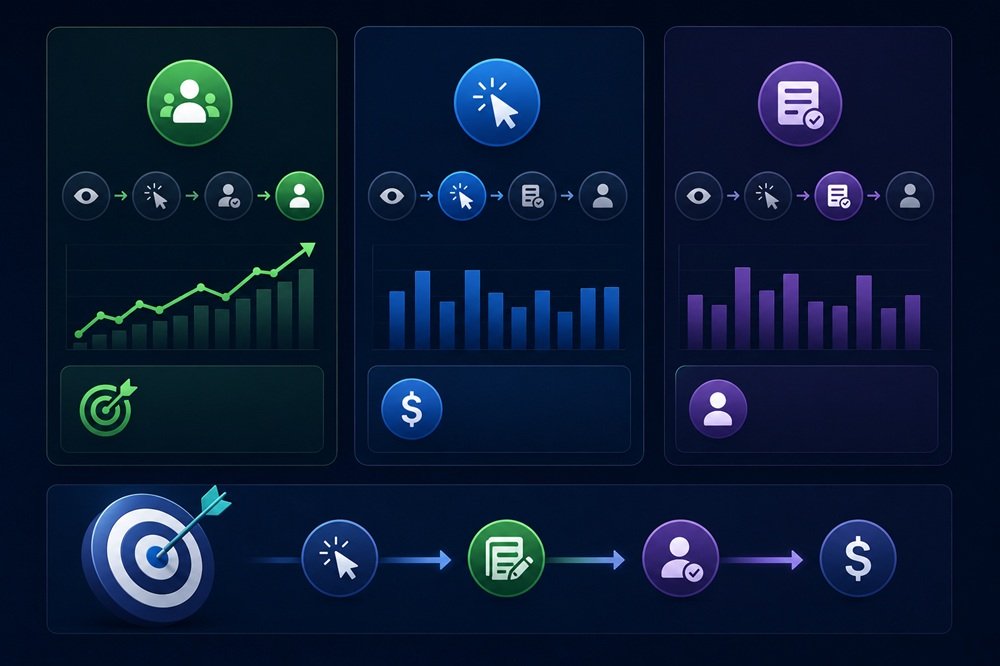
CPC, CPL, and CAC measure cost at three progressively deeper points in the funnel.
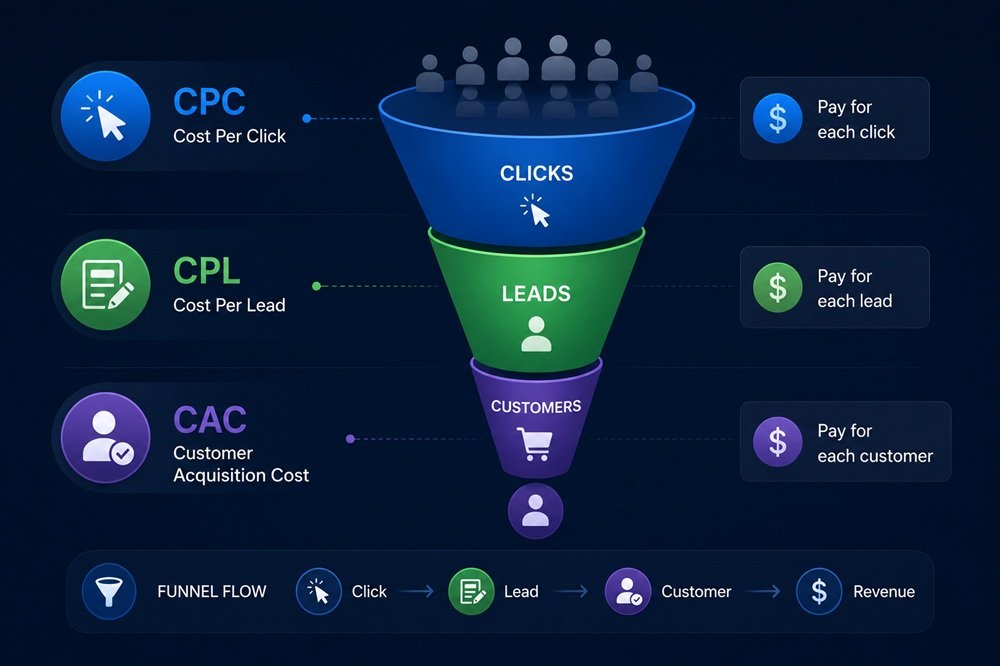 CPC (Cost Per Click)
 is what you pay for each click on your ad — the most surface-level metric, measuring the cost of getting someone to your site. A low CPC means cheap traffic, but cheap traffic that doesn’t convert is worthless. CPC is an input cost, not an outcome.
CPL (Cost Per Lead) is what you pay for each lead generated — total spend divided by leads captured. It’s deeper than CPC (it accounts for whether clicks convert to leads) but still upstream of revenue. A low CPL with poor lead quality still doesn’t produce customers.
CAC (Customer Acquisition Cost) is what you pay to acquire an actual paying customer — total spend divided by customers acquired. It’s the deepest and most meaningful, because it measures cost against the outcome that matters: customers and revenue. CAC accounts for the entire funnel — clicks that become leads that become customers.
The relationship is a funnel: clicks (CPC) become leads (CPL) become customers (CAC). The metrics get more meaningful as they go deeper, because they account for more of what actually matters. The common mistake is optimizing for the shallow metrics (cheap clicks, cheap leads) while ignoring whether they produce customers at an acceptable CAC. The deepest metric you can reliably measure should anchor your decisions.
Common questions
What’s the difference between CPC, CPL, and CAC?
They measure cost at progressively deeper funnel points. CPC is cost per click (getting someone to your site). CPL is cost per lead (a click that became a captured lead). CAC is cost per acquired customer (a lead that became a paying customer). Each is deeper and more meaningful than the last because it accounts for more of the funnel. CPC measures traffic cost, CPL measures lead-generation cost, and CAC measures the cost of the outcome that actually matters — customers and revenue.
Which metric should drive my PPC decisions?
The deepest one you can reliably measure — ideally CAC, because it measures cost against the outcome that matters (customers and revenue). Optimizing for CAC ensures your PPC produces customers at an acceptable cost, not just cheap clicks or leads that don’t convert. CPC and CPL are useful diagnostic inputs, but anchoring decisions to them risks optimizing for cheap traffic or cheap leads that never become customers. If you can measure CAC (through to actual customers), let it drive decisions; CPC and CPL inform the path but shouldn’t be the goal.
Why is optimizing for low CPC a trap?
Because cheap clicks that don’t convert are worthless. A low CPC means inexpensive traffic, but if that traffic doesn’t become leads and customers, you’ve optimized for cost without regard to value — paying little for clicks that produce nothing. Low CPC can even correlate with low-quality traffic (cheap clicks from poorly-targeted audiences). CPC is an input cost, not an outcome; minimizing it in isolation can mean buying lots of worthless clicks. Evaluate CPC in context of whether the clicks convert, not as a goal itself.
Is a low CPL always good?
No — low CPL with poor lead quality still fails to produce customers. CPL is deeper than CPC (it accounts for click-to-lead conversion) but still upstream of revenue, so a low cost per lead means little if those leads don’t convert to customers. Optimizing for low CPL can incentivize generating many cheap, low-quality leads — looking efficient on a lead-cost basis while producing no revenue. CPL matters, but only alongside lead quality and ultimately CAC. A low CPL is good only if the leads convert to customers at acceptable CAC.
How do these metrics connect to ROI?
Through CAC versus customer value. The ultimate question is whether your customer acquisition cost (CAC) is acceptable relative to what a customer is worth (customer lifetime value). PPC is profitable when CAC is comfortably below customer value; unprofitable when CAC exceeds it. CPC and CPL feed into CAC (cheaper, higher-converting clicks and leads lower CAC), but ROI is fundamentally about CAC versus customer value. This is why CAC should anchor decisions — it’s the metric that connects directly to whether your PPC investment produces profitable customer acquisition.
What if I can’t easily measure CAC?
Measure as deep as you reliably can, and use leading indicators for the rest. If full CAC measurement is difficult (long sales cycles, attribution challenges), measure CPL and lead quality (MQL-to-SQL conversion) as the best available proxies, and work toward better CAC attribution over time through CRM integration and tracking. The goal is to get as close to the customer-acquisition outcome as your measurement allows, rather than defaulting to shallow CPC because it’s easy. Improving your ability to measure deeper (toward CAC) is itself a worthwhile investment for PPC decision-making.
How do I use all three metrics together?
Use CPC and CPL as diagnostic inputs and CAC as the anchor. CPC tells you about traffic cost and quality; CPL tells you about lead-generation efficiency; CAC tells you whether it all produces customers profitably. When CAC is too high, the shallower metrics help diagnose where — high CPC (expensive traffic), high CPL (poor click-to-lead conversion), or poor lead-to-customer conversion. Using them together — CAC as the goal, CPC and CPL as diagnostics — lets you optimize toward profitable customer acquisition while understanding which part of the funnel needs work.
How this applies to your business
Anchor your PPC decisions to CAC, the deepest metric that connects to the outcome that matters — customers and revenue. Optimizing for CAC ensures your PPC produces customers at an acceptable cost rather than cheap clicks or leads that never convert. CPC and CPL are valuable diagnostics, but making them the goal risks the classic trap of optimizing for cheap traffic or cheap leads that produce no revenue. If you can measure through to customers, let CAC drive decisions.
Avoid the cheap-click and cheap-lead traps. A low CPC or CPL looks efficient but means nothing if the clicks and leads don’t become customers — you can optimize these shallow metrics while your PPC produces no actual business. Always evaluate CPC and CPL in the context of whether they lead to customers at acceptable CAC, not as goals in themselves. The cheapest clicks and leads are often the least valuable; optimizing for them is optimizing for the wrong thing.
Invest in measuring as deep as you can toward CAC, and use the shallower metrics diagnostically. If full CAC measurement is hard, measure CPL and lead quality as proxies while working toward better attribution. When CAC is too high, use CPC and CPL to diagnose where the funnel is failing. The combination — CAC as the anchor, CPC and CPL as diagnostics — drives PPC toward profitable customer acquisition while revealing which part of the funnel needs improvement.
Iscope Digital’s
PPC Management service optimizes toward CAC and customer value, not vanity metrics like cheap clicks. For the lead-cost benchmarks that feed into CAC, see
Cost per lead (CPL) for B2B in 2026, and for budgeting PPC against these metrics,
How much should B2B companies spend on Google Ads to see results?