“What’s the right Google Ads budget?” is among the most common B2B marketing questions, and the most common answer — “it depends” — frustrates everyone. But there’s real structure behind it: budget requirements are driven by your market’s costs and your goals, not by arbitrary numbers. This article explains how to think about B2B Google Ads budgets and what it actually takes to see results.
What actually determines the right budget
The right Google Ads budget isn’t a fixed figure — it’s derived from the economics of your specific market and goals. Several factors set it.
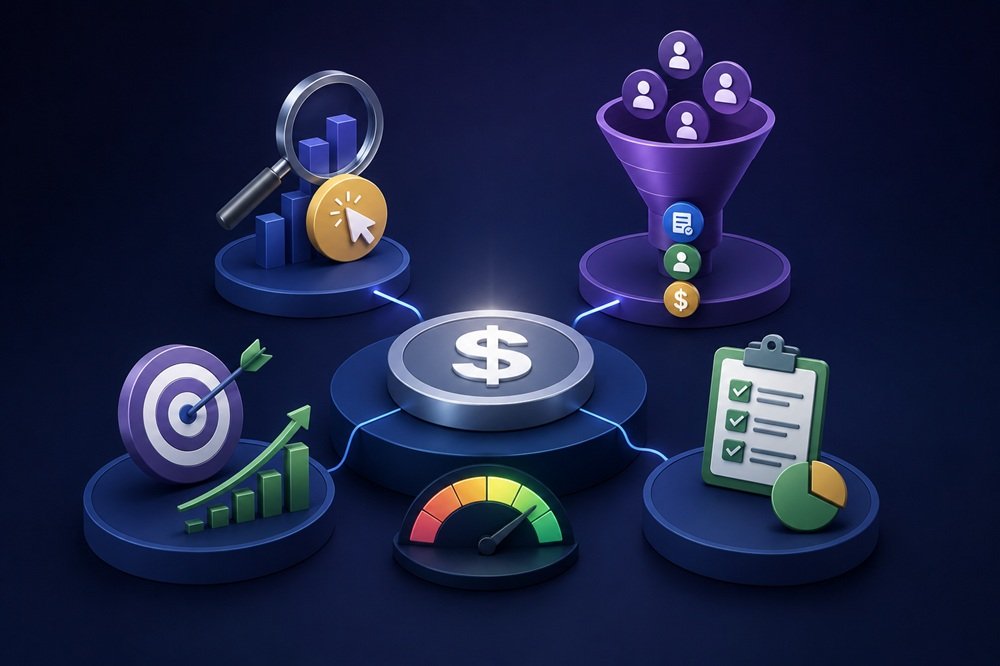 Your market’s cost per click.
 B2B keywords vary enormously in cost — competitive, high-value B2B terms can be expensive per click, while niche terms cost less. Your budget must accommodate your market’s actual CPC to generate meaningful click volume.
Your conversion funnel. Budget needs depend on how clicks convert to leads and customers. If it takes many clicks to produce a lead, and several leads to produce a customer, your budget must support enough clicks to reach your customer goals through that funnel.
Your goals. The volume of leads or customers you want directly scales the budget — modest goals need less; aggressive growth needs more.
The minimum threshold for meaningful data. This is critical and often missed: there’s a floor below which Google Ads can’t produce statistically meaningful results or optimize effectively. Spending too little spreads budget so thin that campaigns can’t gather enough data to optimize, producing noise rather than results. Below the threshold, you’re not “testing cheaply” — you’re wasting money on data too sparse to act on.
So the right budget is whatever supports enough click and conversion volume, given your market’s costs and funnel, to reach your goals and exceed the minimum threshold for meaningful optimization. It’s calculated from these inputs, not chosen arbitrarily.
Common questions
Is there a minimum Google Ads budget to see results?
Yes — there’s a threshold below which campaigns can’t gather enough data to optimize or produce meaningful results. The exact floor depends on your market’s CPC and conversion rates (expensive keywords and low conversion rates raise the minimum), but the principle holds: too little spend spreads budget so thin that campaigns produce noise rather than actionable results. Below the threshold, you’re not testing economically — you’re wasting money on data too sparse to optimize. Determine your minimum based on your market’s costs and the volume needed for meaningful data.
How do I calculate the budget I need?
Work backward from your goals through your funnel. Estimate your target number of customers or leads, then work back through your conversion rates: how many leads per customer, how many clicks per lead, and your cost per click. This gives the click volume and spend needed to hit your goal. For example, if reaching your customer goal requires a certain number of leads, which requires a certain number of clicks at your market’s CPC, that CPC times the clicks is your budget. Calculating from goals through the funnel produces a grounded budget, not a guess.
Why does B2B Google Ads cost more than B2C?
Higher keyword costs and longer funnels. B2B keywords are often competitive and expensive per click because B2B customers are valuable and many companies bid for them. B2B also typically has longer, multi-touch sales funnels, so more clicks and leads are needed per customer than in transactional B2C. Both factors raise the budget needed for results. The higher costs are justified when B2B customer values are correspondingly high — you can afford expensive clicks when each customer is worth a lot — but they do mean B2B Google Ads generally requires more budget than B2C for comparable customer volume.
What happens if I underfund my campaigns?
They underperform disproportionately — not just proportionally less, but qualitatively worse. Below the minimum threshold, budget spreads too thin to gather meaningful data, so campaigns can’t optimize and produce noisy, unreliable results rather than a smaller version of good results. Underfunding also limits the testing and learning that improve performance over time. The common mistake is treating a too-small budget as a cautious test, when it’s actually a setup for failure — the campaign can’t generate the data to work. Fund above the threshold or don’t start.
How long before the budget produces results?
Results build over time as campaigns gather data and optimize, on a timeline shaped by your sales cycle. Early on, you’re gathering data and the algorithm is learning; meaningful optimization takes time and sufficient volume. And because B2B sales cycles are often long, the revenue from PPC-generated leads lags by the sales-cycle length. So budget produces clicks and leads relatively quickly but customers and revenue on the sales-cycle timeline. Plan to fund campaigns long enough to gather data, optimize, and let leads convert through your sales cycle — premature judgment misreads campaigns still ramping.
Should I start small and scale up?
Start at or above the minimum threshold for meaningful data, then scale — don’t start below the threshold. Starting too small to gather meaningful data isn’t cautious scaling; it’s wasting money on un-optimizable campaigns. Begin with enough budget to exceed the threshold and generate actionable data, prove the economics work (acceptable CAC), then scale up as you confirm profitable performance. The right approach is “start above the floor, then scale what works,” not “start tiny and hope.” Scaling proven campaigns is smart; starting below the data threshold is self-defeating.
How do I know if my budget is working?
Measure toward CAC and customer value, not just clicks and leads. The budget is working if it produces customers at an acceptable customer acquisition cost relative to customer value — that’s the test of whether the spend is profitable. Track through the funnel: clicks, leads, lead quality, and ultimately customers and CAC. A budget producing cheap clicks but no profitable customers isn’t working regardless of click volume. Judge the budget by whether it produces profitable customer acquisition, using your sales-cycle timeline to allow leads to convert before final judgment.
How this applies to your business
Calculate your budget from your goals through your funnel, not from arbitrary numbers. Work backward from your target customers or leads through your conversion rates and your market’s cost per click to determine the click volume and spend required. This grounds your budget in your actual economics — your market’s costs, your funnel, your goals — rather than guessing. A budget calculated this way is defensible and realistic; one chosen arbitrarily is likely too low to work or misaligned with your goals.
Fund above the minimum threshold for meaningful data, or don’t start. There’s a floor below which campaigns can’t gather enough data to optimize and produce noise rather than results — and spending below it isn’t a cautious test, it’s wasted money on un-optimizable campaigns. Determine your threshold based on your market’s CPC and conversion rates, and ensure your budget exceeds it. Underfunding is one of the most common and costly B2B PPC mistakes; it sets campaigns up to fail rather than to start small.
Judge the budget by profitable customer acquisition, on your sales-cycle timeline. Measure toward CAC and customer value — the budget is working if it produces customers at an acceptable cost relative to their worth, not if it produces cheap clicks. Allow the sales-cycle time for leads to convert before final judgment, since B2B revenue from PPC lags. Funding adequately, measuring toward CAC, and allowing the proper timeline together give your B2B Google Ads the conditions to actually produce results.
Iscope Digital’s
PPC Management service sizes budgets from your funnel and goals, ensuring spend exceeds the threshold for meaningful optimization. For choosing the metrics to judge the budget by, see
CAC vs CPC vs CPL, and for the timeline to expect,
How long does B2B PPC take to deliver results?