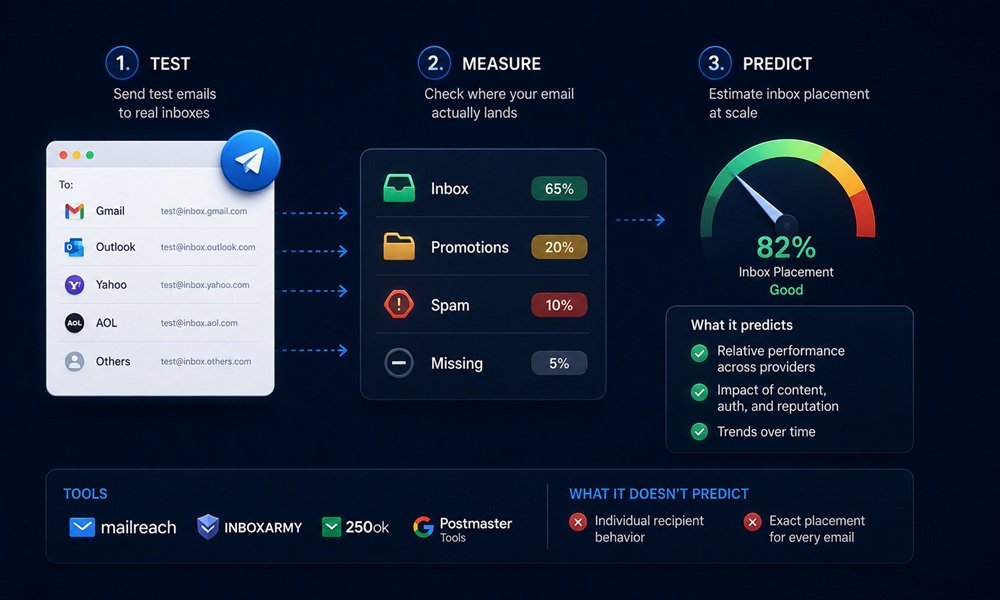
If open rate is unreliable and you can’t directly see whether your email reaches inboxes, how do you actually know your deliverability? Inbox placement testing is the answer — a method for measuring where your email lands across mailbox providers before and during real campaigns. This article explains how inbox placement testing works, what it measures, and what it can and can’t predict.
What inbox placement testing measures
Inbox placement testing determines where your email actually lands — inbox, spam folder, or blocked — across major mailbox providers (Gmail, Outlook, Yahoo, and others). Because you can’t see into recipients’ inboxes directly, and open rates don’t reliably indicate placement, testing fills the gap by measuring placement against a set of test accounts you can observe.
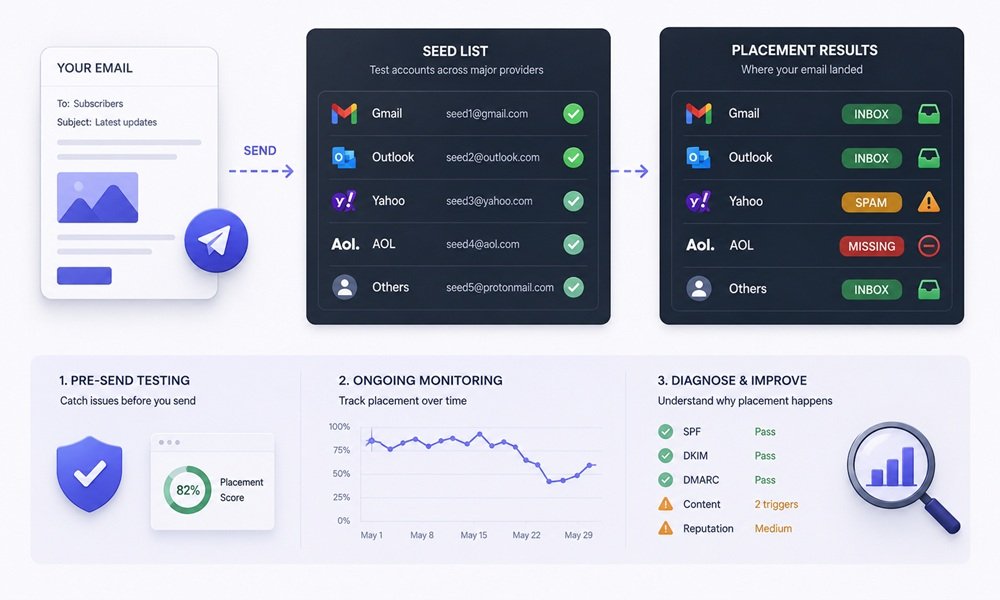
The core method uses
seed lists — sets of test email accounts across major providers that the testing tool controls and monitors. You send your campaign (or a test of it) to the seed list, and the tool reports where the message landed at each provider: inbox, spam, or missing. This gives you a placement picture across the providers your real recipients use, revealing deliverability problems that engagement metrics would only hint at.
Testing serves two purposes.
Pre-send testing checks placement before a campaign goes out, catching problems while they’re cheap to fix.
Ongoing monitoring tracks placement over time, detecting reputation or content changes that shift your placement before they damage a full campaign.
Beyond placement itself, good testing tools also surface contributing factors — authentication results, spam-filter triggers, reputation indicators — helping diagnose
why placement is what it is, not just where mail landed. This makes testing both a measurement and a diagnostic tool.
Common questions
How does inbox placement testing work?
It uses seed lists — sets of test accounts across major mailbox providers that the testing tool controls and monitors. You send your campaign or a test to the seed list, and the tool reports where the message landed at each provider: inbox, spam folder, or missing. Since you can’t observe real recipients’ inboxes directly, the seed accounts act as observable proxies, giving you a placement picture across the providers your audience uses. The tool monitors these accounts and aggregates the results into a placement report.
Why can’t I just use open rates to gauge deliverability?
Because open rates are unreliable (privacy features inflate them) and indirect (a low open rate could mean poor placement
or weak subject lines — you can’t tell which). Inbox placement testing directly measures where mail lands, distinguishing a deliverability problem (email in spam) from an engagement problem (email in inbox but not opened). Open rates conflate these and have been compromised by privacy changes; placement testing isolates the deliverability question with direct measurement. It tells you what open rates can’t: whether your email is actually reaching inboxes.
What does inbox placement testing predict?
It indicates how your email is likely landing for real recipients on the tested providers, based on the seed accounts’ results — a strong signal of your actual placement. It predicts deliverability problems (if seeds show spam placement, real recipients likely experience similar), letting you fix issues before or during campaigns. However, it’s a representative sample, not a perfect mirror of every recipient’s experience — placement can vary by individual reputation factors. Treat it as a reliable indicator and early-warning system, not an exact guarantee of every recipient’s placement.
What are the limitations of seed-list testing?
Seed accounts are proxies, not your actual recipients, so they approximate rather than perfectly mirror real-world placement, which can vary by recipient-specific factors. Seed lists also can’t capture every provider or configuration your real audience uses. And placement can differ between seed accounts and engaged real recipients (whose engagement history affects their personal placement). So treat seed-list results as a strong representative indicator with some margin — excellent for detecting problems and trends, but not an exact account-by-account prediction. Combine it with real-world signals (bounces, complaints, engagement) for the full picture.
When should I run inbox placement tests?
Both before significant sends and on an ongoing basis. Pre-send testing checks placement before a campaign deploys, catching problems while they’re cheap to fix (finding spam placement on a test is far better than on your full audience). Ongoing monitoring tracks placement over time, detecting reputation or content shifts before they damage campaigns. For important campaigns and any time you’ve changed sending infrastructure, content patterns, or after deliverability concerns, testing is especially valuable. Regular monitoring plus pre-send checks for major campaigns is the strong practice.
What do I do if testing shows poor placement?
Diagnose and address the cause the test reveals. Good testing tools surface contributing factors — authentication failures, spam-filter triggers, reputation issues — pointing toward the fix. Poor placement usually traces to sender reputation (list quality, engagement, sending behavior), authentication problems (SPF, DKIM, DMARC), or content triggers. Address the specific cause: clean the list and improve engagement for reputation issues, fix authentication for auth failures, adjust content for trigger issues. Testing both detects the problem and, through its diagnostic data, points toward the remedy — so use the diagnostic detail, not just the placement verdict.
Is inbox placement testing worth the cost?
For any serious email program, generally yes. Deliverability is foundational — if email doesn’t reach inboxes, nothing downstream matters — and placement testing is the only reliable way to measure it directly, especially with open rates compromised. The cost of testing is small relative to the cost of a campaign that silently lands in spam, or a slow reputation decline caught too late. For high-volume senders and anyone for whom email is an important channel, the visibility testing provides into the foundation of the program justifies its cost.
How this applies to your business
Use inbox placement testing as your reliable deliverability measurement, since open rates can’t tell you where your email lands. Testing directly measures placement across providers, distinguishing deliverability problems (email in spam) from engagement problems (email in inbox but unopened) — a distinction open rates conflate and that’s essential for diagnosing email issues correctly. For a channel as foundational as email, having direct visibility into whether your mail reaches inboxes is worth the testing investment.
Test both before major sends and on an ongoing basis. Pre-send testing catches placement problems while they’re cheap to fix — far better to find spam placement on a test than on your full audience. Ongoing monitoring detects reputation and content shifts before they damage campaigns. This combination — routine monitoring plus pre-send checks for important campaigns — gives you early warning of deliverability problems and confidence that major sends will land, protecting both individual campaigns and your long-term sender reputation.
Use the diagnostic detail, not just the placement verdict. Good testing tools surface why placement is what it is — authentication results, spam triggers, reputation indicators — pointing toward the fix. When testing shows poor placement, the diagnostic data tells you whether to address reputation, authentication, or content. Treating testing as a diagnostic tool rather than just a pass/fail check lets you fix the actual cause of placement problems, turning the test from a warning into actionable guidance.
Iscope Digital’s
Email Marketing service includes inbox placement testing and ongoing monitoring as part of deliverability engineering. For why placement matters above all other email metrics, see
What is email deliverability?, and for diagnosing the open-rate declines testing helps explain,
How to fix declining email open rates.