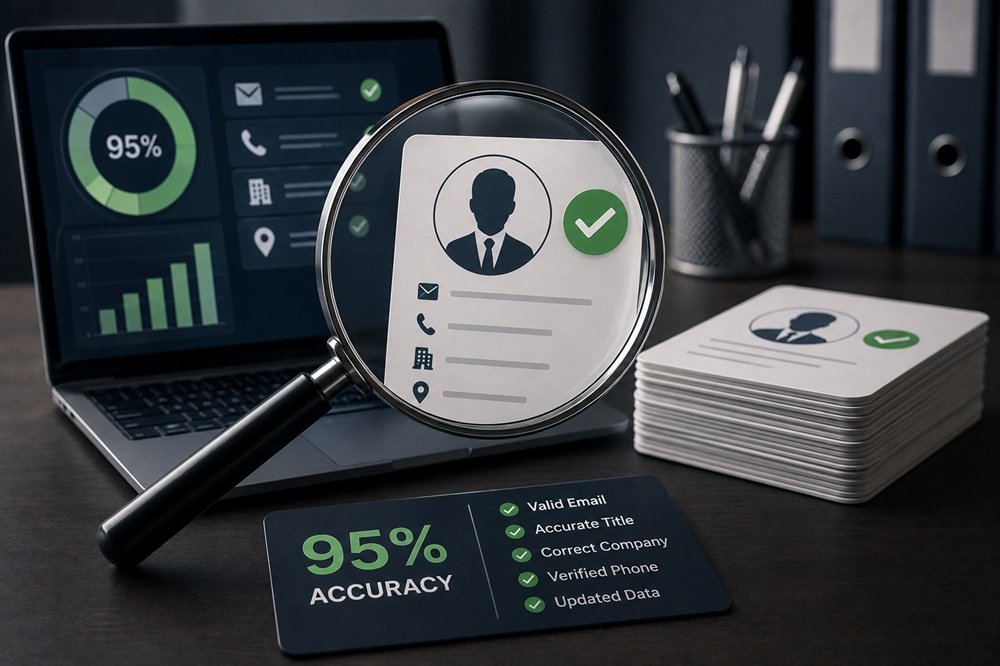
Every B2B data provider claims high accuracy — 90%, 95%, even 98%. But “accuracy” is one of the most slippery terms in the data industry, because providers measure it differently and rarely define what they’re counting. This article explains what accuracy claims actually mean, how to interpret them, and how to verify a provider’s real accuracy before you buy.
What “accuracy” actually measures
When a B2B data provider claims “95% accuracy,” they could mean several different things — and the difference matters enormously.
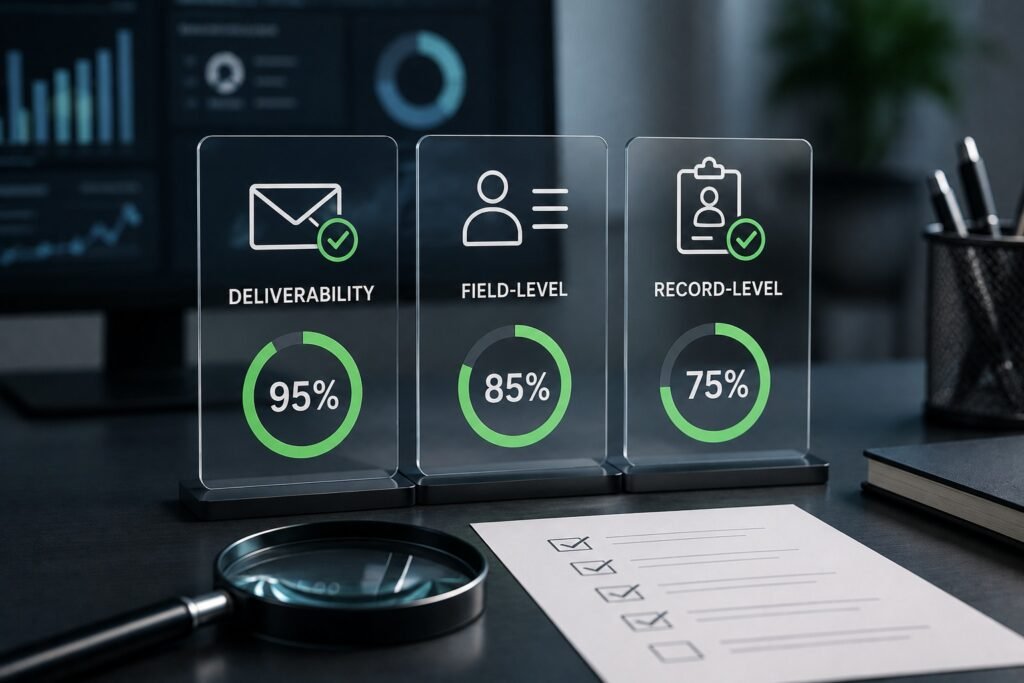 Deliverability accuracy
 measures what percentage of email addresses will successfully deliver (not bounce). This is the most common meaning and the easiest to verify, but it’s also the least demanding — an email can deliver to a valid mailbox that belongs to someone who left the company two years ago.
Field-level accuracy measures whether each data field is correct — is the job title current, is the company name right, is the phone number working. This is more demanding and more useful, but harder to verify and rarely what providers mean by a headline accuracy number.
Record-level accuracy measures whether the entire record is correct — right person, right current role, right company, valid contact details. This is the most demanding standard and the most honest, but almost no provider claims record-level accuracy because it’s lower than the deliverability number that markets better.
The gap between these is large. A list can be 95% deliverable but only 75% record-accurate, because deliverable-but-outdated records inflate the deliverability number. When a provider quotes accuracy, the critical question is:
accuracy of what?
Common questions
How accurate is B2B contact data?
There is no universal B2B contact-data accuracy rate. Current 2026 benchmarks show that accuracy varies significantly by field, provider, geography, and methodology. Some providers report email deliverability above 95%, while independent tests show much wider variation across email, phone, company, and job-title data. The important question is not simply whether a vendor claims 95% accuracy, but
95% accuracy of what, measured how, and when?
What does “95% accuracy” actually mean?
A claim of 95% accuracy could mean that 95 out of 100 email addresses were deliverable, that 95% of company records matched reality, or that 95% of sampled records passed the vendor’s internal verification process. These are very different measurements. Some vendors explicitly define accuracy as email deliverability, while others include company, title, phone, or identity matching. Without the methodology, the percentage is difficult to compare.
Does 95% email accuracy mean 95% of the entire contact record is accurate?
No. An email address can be valid while the person’s job title, employer, phone number, or department is outdated. For example, a contact might still have a working company email but have moved from VP of Sales to a different role. Email deliverability therefore measures only one aspect of record quality. Current testing shows meaningful differences between email, company, title, and phone accuracy.
What is a good accuracy rate for B2B contact data?
For critical fields,
90%+ accuracy is a reasonable quality target, while 95%+ verified email deliverability can represent strong performance. Direct-dial phone accuracy is typically harder to achieve than email accuracy. One 2026 benchmark found verified email coverage around 70–80% for single-source databases and substantially higher coverage using multiple providers, while another provider’s independent test reported 95.2% email deliverability but 84% title accuracy.
Why is phone accuracy usually lower than email accuracy?
Phone data is harder to validate because a number can be active but belong to the wrong person, route through a company system, or fail to connect even when the number itself is valid. “Phone accuracy” and “phone connect rate” are therefore different metrics. A 2026 test reported 83%+ correct assignment for one provider’s mobile numbers but a 68% direct-dial connect rate in an independent test.
How does data freshness affect B2B contact accuracy?
Accuracy is temporary because contact information changes continuously. A record that was accurate when verified can become outdated when someone changes jobs, moves companies, or changes responsibilities. One 2026 industry report estimates average B2B database decay at roughly 22–25% annually, illustrating why a point-in-time accuracy claim should not be interpreted as a permanent guarantee.
How should buyers test a vendor’s “95% accuracy” claim?
Request a representative sample and independently verify it. Ideally, use
300–500 real records from your own target market, rather than accepting hand-picked sample contacts. Measure email deliverability, current employer, job-title accuracy, phone validity, company match, and missing fields separately. Testing identical records across vendors provides a much more useful comparison than comparing their advertised accuracy percentages.
What questions should you ask a B2B data vendor about its accuracy rate?
Ask:
- What exactly does your accuracy percentage measure?
- Which fields are included?
- When was the data last verified?
- What sample size was used?
- Was the test conducted internally or independently?
- Was the sample representative of the entire database?
- How do you verify email, phone, employer, and job title separately?
- What happens when a record is incorrect?
- Do you provide replacements or credits?
- How quickly does the data get refreshed?
The best vendor is not necessarily the one claiming the highest percentage. It is the one that can
define the metric, show the methodology, provide a representative sample, and stand behind the result.
How this applies to your business
The practical discipline is to interrogate accuracy claims rather than accept them. Before any significant data purchase, ask the provider to define exactly what their accuracy number measures, request a representative sample, and verify that sample independently. A 15-minute spot-check of 50 sample records tells you more than any marketing claim.
Set realistic expectations internally too. No B2B list is 100% accurate, and any list degrades from the moment it’s delivered. Budget for refresh and hygiene as ongoing costs, not one-time purchases. The total cost of B2B data isn’t the purchase price — it’s the purchase plus the maintenance required to keep it accurate enough to use.
Finally, match your accuracy requirements to your use case. A high-volume awareness campaign tolerates more inaccuracy than a small, high-value executive outreach where every record must be right. Don’t overpay for record-level precision you don’t need, and don’t under-invest in accuracy for campaigns where it’s critical.
Iscope Digital’s
B2B Email & Postal Data service maintains 95% average deliverability accuracy across the weekly-refreshed
Bizline Direct database, with representative samples available before any purchase. For more on keeping accuracy high over time, see
How often should B2B databases be refreshed? and on sourcing quality,
Where does B2B contact data come from?