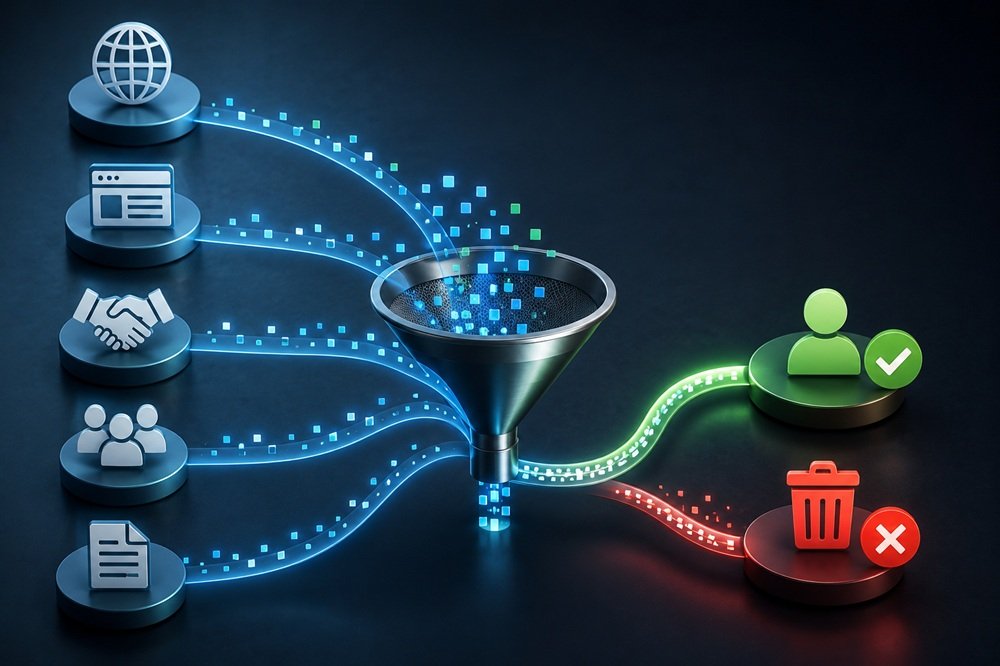
Behind every B2B contact list is a sourcing methodology — and that methodology determines the data’s quality, legality, and accuracy. Yet most data buyers never ask where the records come from. This article explains the legitimate sources of B2B contact data, the questionable ones, and how to tell the difference before you buy.
The legitimate sources of B2B data
Quality B2B data is assembled from several primary sources, combined and verified.
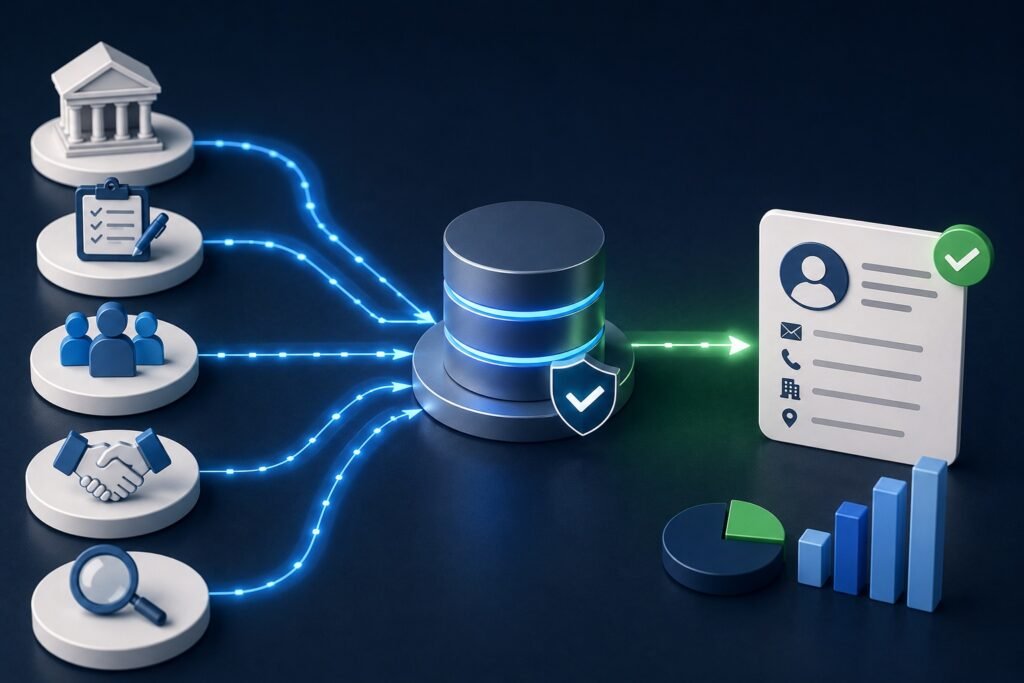
Public business filings and registries — government business registrations, SEC filings, professional licensing boards, and similar public records provide a verified foundation of company and, in many cases, executive information.
Primary research and direct collection — data providers that call companies, verify details, and collect information directly produce the freshest, most accurate records. This is labor-intensive and expensive but produces the highest quality.
Opt-in and self-reported sources — business contacts who provide their information through registrations, content downloads, event sign-ups, and subscriptions. When properly consented, this is high-quality data with clear provenance.
Licensed data partnerships — agreements with publishers, associations, and other data holders who have legitimately collected business contact information and license it for marketing use.
Verification and enrichment layers — quality providers don’t just collect; they cross-reference records against multiple signals (email validation, postal standardization, firmographic confirmation) to confirm accuracy before delivery.
The best B2B databases combine multiple sources and apply continuous verification. A provider relying on a single source — especially a questionable one — produces weaker data than one triangulating across many.
Common questions
Where does B2B contact data come from?
B2B contact data typically comes from a combination of public sources, licensed datasets, company websites, professional information, partner data, proprietary research, and data contributed or collected through software platforms. Some vendors combine thousands of sources rather than maintaining a single original database. For example, Dun & Bradstreet says its professional contact data comes from more than 2,000 commercial and public sources, including websites, partners, third-party providers, and direct collection.
What are the main sources of B2B contact data?
Common sources include company websites, business directories, government and corporate registries, professional databases, licensed third-party datasets, public filings, industry associations, and proprietary research. Vendors may then combine and standardize these sources to create company and contact records. The source itself matters, but so do the vendor’s matching, verification, and refresh processes.
Is publicly available data automatically good B2B data?
No. Public availability does not guarantee accuracy, completeness, freshness, or suitability for a particular marketing purpose. A vendor can collect information from legitimate public sources and still produce poor-quality records if it does not properly match, verify, and update them. Public records can also describe a company accurately while providing little useful information about its current decision-makers.
Is web scraping a bad source of B2B contact data?
Not necessarily, but it needs to be evaluated carefully. Web-based collection can provide broad coverage and discover information quickly, but websites change, information can become outdated, and automated extraction can introduce errors. Ask the vendor which types of websites it uses, how frequently records are refreshed, how information is verified, and whether the vendor can explain the permitted use of the collected data.
Are purchased or licensed datasets a good source of B2B data?
They can be, particularly when the provider has strong coverage in your target market. However, buying data from another provider does not automatically make it high quality. Data can pass through multiple intermediaries, making it difficult to determine the original source or how recently it was verified. Ask whether the vendor owns the underlying data, licenses it directly, or aggregates information from other providers.
What is contributed or community-sourced B2B data?
Some platforms obtain information through users, software integrations, browser extensions, applications, or other contribution mechanisms. This can create a large and frequently changing data pool, but quality and provenance can vary. Buyers should understand how the information enters the database, whether contacts know how their professional information is used where required, and how the vendor handles corrections and opt-outs.
What makes a B2B data source a red flag?
Be cautious when a vendor cannot explain where its data comes from, how records are verified, when fields were last updated, or how individuals and companies can request corrections or suppression. Other warning signs include unexplained “95% accuracy” claims, enormous record counts without coverage details, unusually cheap niche lists, no sample-testing process, and vague answers about whether data is original, licensed, scraped, or resold. Transparency is one of the strongest indicators to look for.
Why does data provenance matter when buying B2B contacts?
Provenance tells you where the information originated and what happened to it before reaching your database. This matters for accuracy, freshness, compliance, licensing, and troubleshooting. The FTC has highlighted how data can move through multiple brokers and emphasized the importance of transparency around data sources. A vendor should be able to explain its sourcing methodology at a meaningful level, even if it cannot disclose every individual source.
How can you tell if a B2B data vendor is reselling someone else’s data?
Ask directly whether the vendor collects, licenses, aggregates, or resells the records it provides. Ask how many upstream providers contribute to the database and whether records retain source or provenance information. Reselling is not inherently a problem, but multiple layers can make it harder to understand freshness and permissions. A vendor that refuses to explain its basic data supply chain deserves additional scrutiny.
How should you test a B2B data source before buying?
Request a representative sample based on your actual ICP, geography, industry, company size, and target job roles. Independently check employer, title, email, phone, company details, and other fields that matter to your campaign. Then calculate field-level accuracy, completeness, duplicates, and freshness. Do not rely on a vendor-selected sample containing only its easiest records. A blind test against your own target accounts is much more informative.
What is the biggest mistake buyers make when evaluating B2B data sources?
Focusing on database size instead of usable coverage. A provider claiming 200 million contacts may still have weak coverage of the 20,000 companies you actually want to target. The better question is: “How accurately can this vendor identify and reach my specific market?” Test the vendor against your real target accounts, compare field-level results, and investigate the sourcing and refresh methodology before committing to a large purchase.
How this applies to your business
Before buying any B2B data, treat sourcing as a primary evaluation criterion — not an afterthought. The cheapest list is often cheap because it’s scraped, recycled, or unverified, and the apparent savings evaporate when deliverability collapses, your domain gets blocklisted, or the records turn out to be wrong. Sourcing quality is the single best predictor of whether data will actually work.
Ask the five sourcing questions of every provider. Request a sample and verify it. Favor providers with proprietary, continuously verified databases over those reselling aggregated lists of unknown origin. The extra diligence takes an hour and prevents the expensive, reputation-damaging mistakes that bad data sourcing causes.
If a deal seems too cheap for the volume and quality promised, it usually is. Sixty million verified, refreshed records cost real money to maintain; a provider offering them at a fraction of market price is cutting corners somewhere — almost always on sourcing and verification.
Iscope Digital’s
B2B Email & Postal Data service draws from the proprietary
Bizline Direct database, built from primary feeds, public filings, and licensed partnerships with continuous multi-signal verification — never scraped. For how this affects accuracy, see
How accurate is B2B contact data? and on legal comparison with scraped sources,
B2B email lists vs scraped LinkedIn data.