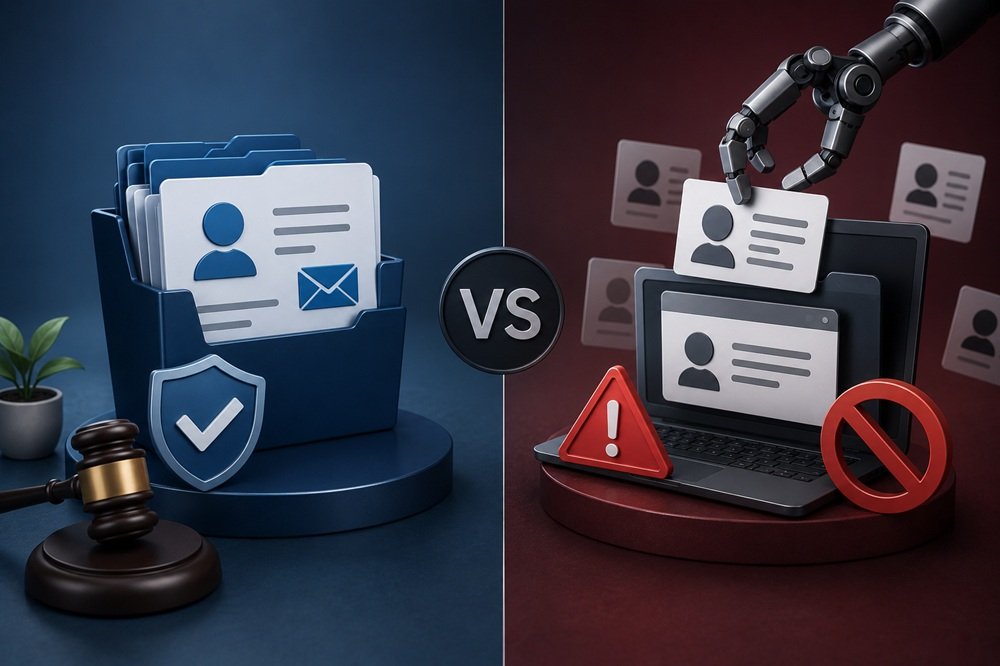
LinkedIn holds the most complete professional contact graph ever assembled, which makes scraping it tempting for B2B prospecting. But scraped LinkedIn data and properly sourced B2B email lists differ enormously in legality, reliability, and results. This article compares them across the dimensions that matter, so you can decide which belongs in your prospecting.
The core difference
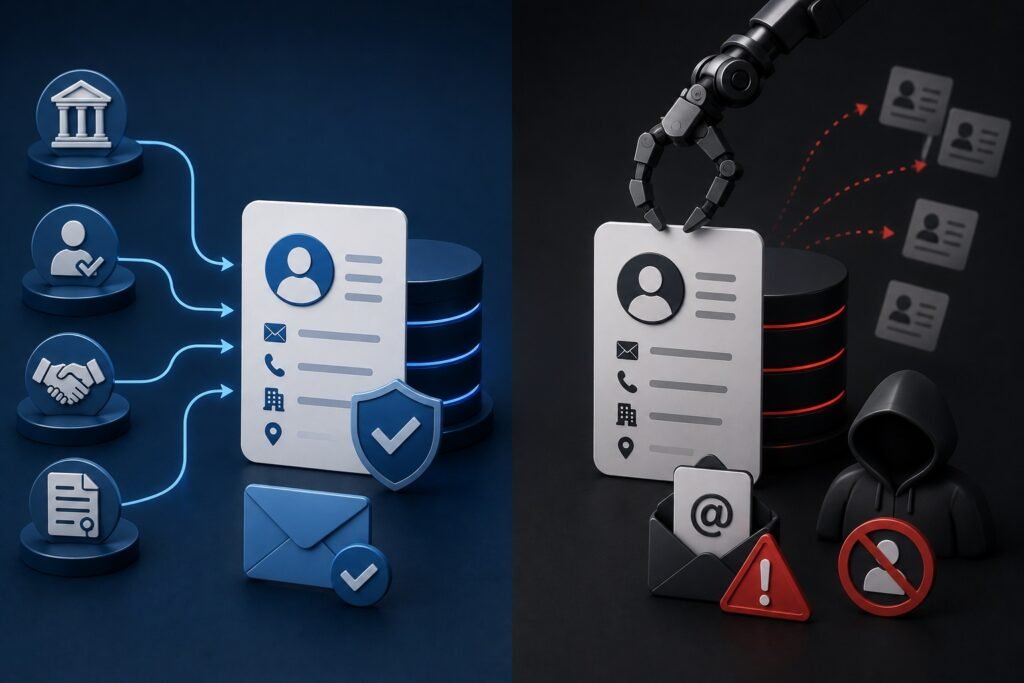
A properly sourced B2B email list is contact data assembled from public filings, primary research, opt-in channels, and licensed partnerships, then verified for accuracy and deliverability before use. Its provenance is documented, its email addresses are validated, and its use for marketing is contemplated by how it was collected.
Scraped LinkedIn data is contact information harvested by automated tools from LinkedIn profiles — usually names, titles, companies, and sometimes inferred or guessed email addresses. It’s collected without consent, typically in violation of LinkedIn’s terms of service, and the email addresses are frequently guessed (firstname.lastname@company.com patterns) rather than verified.
On the surface, both give you a name, title, and company. Underneath, they differ in ways that determine whether your outreach lands in inboxes or in spam folders — and whether you’re exposed to legal risk.
Common questions
Is it better to buy a B2B email list or scrape LinkedIn data?
Neither is automatically the better option. A purchased B2B list can provide structured records, verification information, and clearer vendor accountability, while LinkedIn-based research can provide useful current information about people’s roles and employers. The key issues are
data quality, provenance, permitted use, privacy obligations, platform terms, and how the information will be used.
Is scraping LinkedIn data legal?
There is no simple yes-or-no answer. The legal position can depend on what information is collected, how it is collected, where the individuals are located, and what the data is subsequently used for. Public availability does not automatically eliminate privacy or contractual considerations. The U.S. legal history around public LinkedIn scraping also illustrates that a favorable position under one law does not necessarily resolve other legal or contractual issues. (
legalclarity.org)
Does LinkedIn allow companies to scrape member data?
Businesses should not assume that information visible on LinkedIn can automatically be collected through automated tools. Platform terms and technical restrictions are separate from questions about whether information is publicly accessible under applicable law. Before using a scraping service, review the platform’s current terms, the vendor’s collection methodology, and the legal basis for the intended processing.
Is buying a B2B email list legally safer than scraping LinkedIn?
Not necessarily. Buying a list does not transfer compliance responsibility to the buyer. If personal information is supplied by a third party, the buyer still needs to consider whether the data was obtained fairly, whether the intended use is permitted, what privacy information must be provided, and whether applicable electronic-marketing rules allow the planned outreach. The UK’s ICO, for example, specifically says businesses buying or selling contact lists must consider UK GDPR requirements and the lawful basis for the processing.
Can you email people whose details came from LinkedIn?
That depends on the applicable jurisdiction and marketing rules. Finding someone’s professional email address or job information publicly does not automatically establish consent to receive marketing emails. In the UK, for example, PECR applies to electronic marketing, and the rules differ between corporate subscribers and individual subscribers such as sole traders and some partnerships.
Does publicly available LinkedIn information count as personal data?
It can. A person’s name, job title, employer, professional profile, and contact details can constitute personal data when the individual can be identified. Public availability does not automatically remove data-protection obligations. The ICO specifically addresses the use of publicly available personal information for direct marketing and says businesses must ensure the collection and use are fair, lawful, and transparent.
What are the practical advantages of purchased B2B email lists?
A reputable provider can give you structured company and contact records, filtering, verification indicators, enrichment, and standardized fields. You may also have contractual terms covering permitted use, replacements, and data quality. However, you should verify these claims rather than assuming that a vendor’s database is accurate or compliant simply because it is commercially available.
What are the practical advantages of LinkedIn research?
LinkedIn can be useful for identifying
current job titles, company affiliations, organizational changes, and potential decision-makers. It can therefore be valuable for account research and sales intelligence. The limitation is that finding someone on LinkedIn does not necessarily give you a verified email address, permission to scrape their information, or permission to use that information for unsolicited marketing.
Which source generally produces better B2B contact data?
It depends on the field. LinkedIn can be particularly useful for
role and employment discovery, while specialist B2B databases may provide broader coverage of email addresses, phones, firmographics, and other fields. The strongest workflow is often to use professional-network information for research and cross-check important contact details against reliable, appropriately sourced data rather than treating either source as automatically authoritative.
What should you ask a B2B data vendor about its source?
Ask whether the data is
first-party, licensed, publicly sourced, scraped, contributed, or aggregated from other vendors. Also ask how employment and email information are verified, when records were last refreshed, what geographic coverage exists, how opt-outs are handled, and what rights the vendor grants you to use the data. If the vendor cannot explain its basic provenance and compliance process, treat that as a warning sign.
What is the biggest legal mistake with scraped LinkedIn data?
Assuming that
“publicly visible” means “free to collect and use however you want.” Those are different questions. Data-protection law, electronic-marketing rules, platform terms, contractual restrictions, and other laws can apply independently. In the UK, for example, direct marketing using personal data requires a lawful basis, and businesses must also comply with PECR where applicable.
What is the safest practical approach for B2B prospecting?
Use a documented data-sourcing process. Identify the target accounts and roles, obtain contact information from sources with clear provenance and permitted-use terms, verify important fields, maintain suppression lists, provide required privacy information, and apply the marketing rules for each target jurisdiction. If you use LinkedIn for research, treat it primarily as a
research and validation source, not as a blanket authorization to scrape and email everyone you can identify.
Should businesses use LinkedIn scraping or purchased lists for outbound campaigns?
For most organizations, the better decision is based on
data quality and compliance controls rather than choosing one source universally. A well-maintained, appropriately sourced B2B database can be more scalable for outbound campaigns, while LinkedIn can complement it by helping sales teams validate roles and identify changes. The worst option is an inexpensive scraped dataset with unclear provenance, no suppression process, poor verification, and no clear explanation of how the data may legally be used.
How this applies to your business
For email outreach specifically, properly sourced and verified B2B email lists are the clear choice. The deliverability gap alone justifies it — guessed emails from scraped LinkedIn data bounce at rates that damage your sender reputation and undermine every campaign you run, not just the one using bad data. Add the legal exposure and compliance gaps, and scraped LinkedIn data is a poor foundation for email programs.
Where LinkedIn genuinely shines is as a research and social-selling surface, used through its own tools. Sales Navigator for prospecting research, LinkedIn ads for paid reach, InMail for direct outreach — these are legitimate, effective, and risk-free. The mistake is extracting LinkedIn’s data to use elsewhere, which converts a legitimate platform into a legal and deliverability liability.
The strongest B2B prospecting programs use both appropriately: verified email lists for email campaigns, LinkedIn’s native tools for social touches and research, combined into coordinated multi-channel sequences. Each channel uses data sourced the right way for that channel.
Iscope Digital’s
B2B Email & Postal Data service provides verified, compliantly sourced B2B email data from the
Bizline Direct database — never scraped — built for deliverability and backed by compliance documentation. For more on what separates good sources from bad, see
Where does B2B contact data come from? and on combining channels, our
Online Lead Generation service.