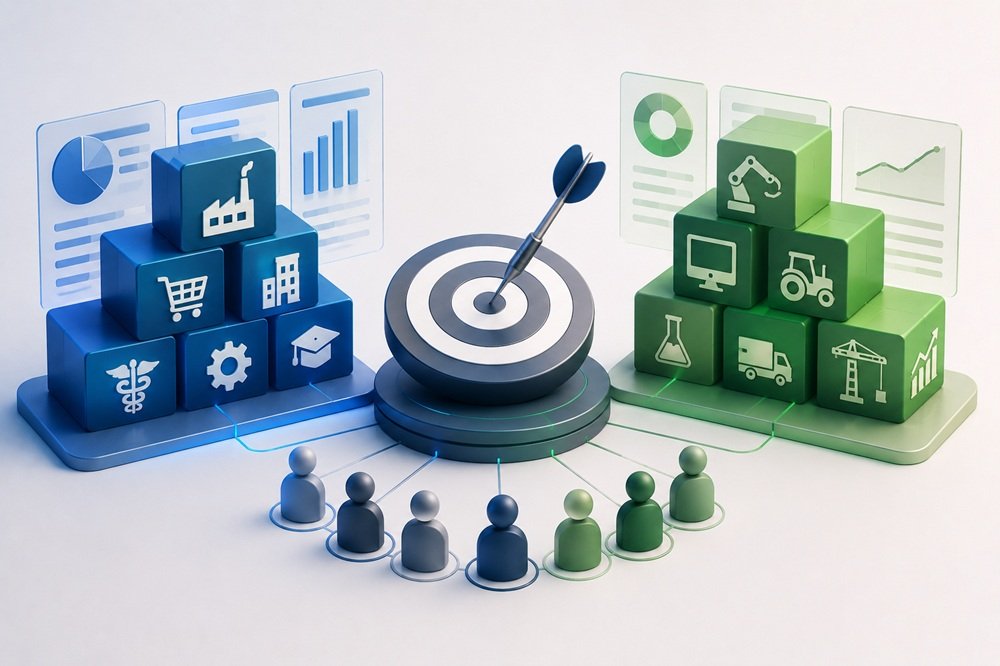
If you’ve ever built a B2B target list, you’ve encountered SIC and NAICS codes — the two classification systems that sort businesses by industry. Choosing between them, or knowing when to use both, directly affects how precisely you can target. This article explains what each system is, how they differ, and which to use for B2B audience targeting.
What SIC and NAICS codes are
Both are standardized systems for classifying businesses by their primary economic activity, used heavily in B2B data targeting to filter companies by industry.
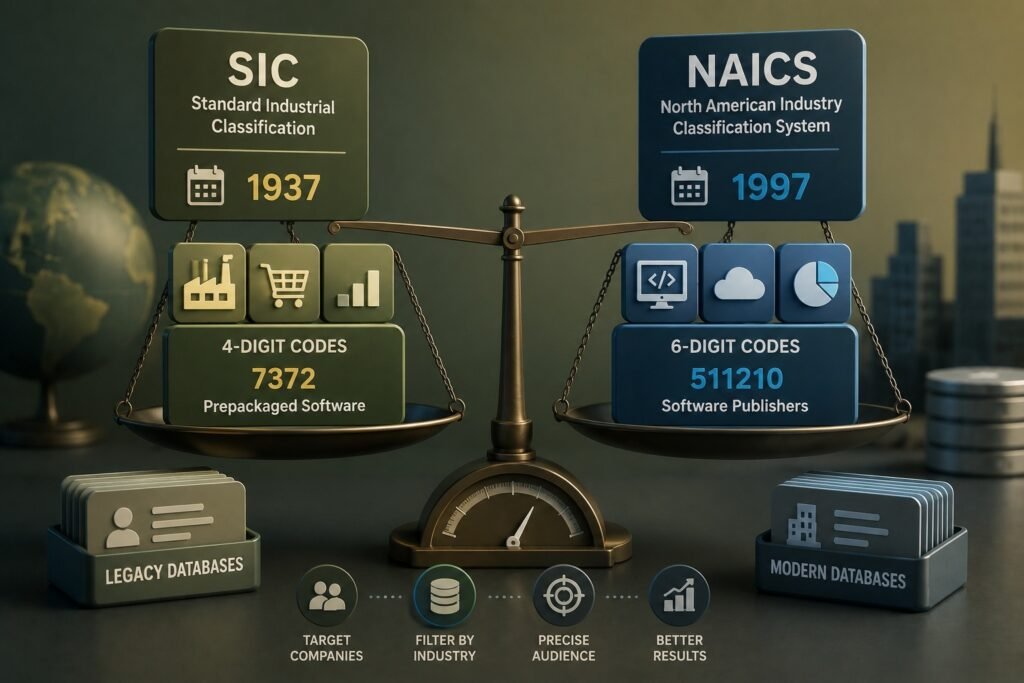
SIC (Standard Industrial Classification) is the older system, established by the US government in 1937. It uses four-digit codes to categorize businesses — for example, 7372 is “Prepackaged Software.” SIC was the dominant classification for decades and remains widely embedded in business databases, credit reporting, and marketing data despite being officially superseded.
NAICS (North American Industry Classification System) replaced SIC for official US government purposes in 1997. Developed jointly by the US, Canada, and Mexico, it uses six-digit codes and reflects a more modern economy — including industries that didn’t exist when SIC was designed, like web search portals and data processing. NAICS code 511210 is “Software Publishers.”
The practical reality in 2026: both systems coexist in B2B data. Government statistics and newer databases favor NAICS; many legacy business databases, credit files, and marketing lists still carry SIC codes. Good B2B data providers maintain both, letting you target by whichever fits your campaign.
Common questions
What is the difference between SIC and NAICS codes?
SIC (Standard Industrial Classification) and NAICS (North American Industry Classification System) are systems used to categorize businesses by industry. SIC is an older classification system that originated in the United States, while NAICS was developed to provide a more modern and detailed classification structure across the United States, Canada, and Mexico. Both can be useful for B2B targeting, but they classify industries differently and should not be treated as interchangeable codes.
Should B2B marketers use SIC or NAICS codes for targeting?
For most modern B2B audience targeting in North America,
NAICS is generally the better starting point because it provides a more detailed and current industry classification framework. SIC can still be useful when working with legacy databases, older customer records, or platforms that specifically organize their data around SIC codes. The best choice ultimately depends on the data sources and targeting platforms being used.
Why are NAICS codes useful for B2B audience targeting?
NAICS codes allow businesses to narrow their target market according to specific industries and sub-industries. This can help marketers identify companies that share similar business characteristics and potentially similar needs. Instead of targeting broad categories such as “manufacturing,” marketers can use more specific NAICS classifications to create narrower account segments. This can improve targeting when industry is an important part of the ideal customer profile.
When are SIC codes still useful?
SIC codes can remain valuable when a company’s existing CRM, prospect database, industry research, or sales platform uses SIC as its primary classification system. They can also be useful when comparing historical datasets because many older business records were categorized using SIC. If a vendor provides both SIC and NAICS information, retaining both can make it easier to match records across different data sources and systems.
Are SIC and NAICS codes interchangeable?
No. A SIC code does not always have a direct one-to-one equivalent in NAICS. The two systems use different structures and classifications, and a single SIC category may correspond to multiple NAICS categories. Businesses should therefore avoid simply copying one code into a field designed for the other. If conversion is necessary, use an appropriate crosswalk or mapping methodology and validate important segments afterward.
How can businesses use NAICS codes to build a B2B audience?
Start by identifying the industries where your existing customers perform well. Find the relevant NAICS classifications and use them alongside other firmographic criteria such as employee count, revenue, geography, and company type. This creates a more precise audience than using industry classification alone. After building the segment, review a sample of companies manually to confirm that the selected codes actually represent the types of businesses you want to target.
Should SIC or NAICS be the only targeting filter?
No. Industry codes are useful for defining the broad business category, but they rarely capture the full ideal customer profile. Combine them with attributes such as company size, revenue, location, technology usage, growth stage, ownership, and relevant decision-maker roles. This prevents the campaign from including companies that technically belong to the right industry but are commercially unsuitable for the product or service.
How accurate are SIC and NAICS codes in B2B databases?
Accuracy can vary depending on the vendor’s data sources, classification methodology, and update process. A company may also operate across multiple business activities, making classification less straightforward. Buyers should test industry-code accuracy against a representative sample of their target market. If industry classification is critical to campaign performance, ask the vendor how codes are assigned, updated, and handled when a company operates in multiple industries.
Which is better for B2B targeting: SIC or NAICS?
For a new North American targeting strategy,
NAICS is generally the stronger choice, particularly when you need detailed industry segmentation. SIC remains useful for legacy data and systems that depend on it. In practice, businesses that work with multiple data sources may benefit from maintaining both codes and using them alongside broader firmographic criteria. The most important factor is not the code system alone but whether the resulting companies actually match your ideal customer profile.
For most B2B campaigns, NAICS at the 4- to 6-digit level gives the best balance of precision and coverage in 2026. Use SIC as a complement when your data provider has stronger SIC coverage for a specific legacy industry, or when targeting databases that predate widespread NAICS adoption.
The biggest practical mistake is targeting too broadly — selecting a 2-digit sector code and reaching tens of thousands of irrelevant companies — or too narrowly, picking one hyper-specific 6-digit code and missing adjacent companies that are equally good prospects. Test your code selection against record counts before committing, and layer codes with firmographic filters (size, revenue, geography) to sharpen the target.
Iscope Digital’s
B2B Email & Postal Data service supports targeting by both SIC and NAICS across the
Bizline Direct database, with a count-and-quote process that shows you exact reach before you buy. For the broader picture of what’s in a B2B record, see
What is a full-record B2B contact vs an enriched record vs a basic record?