A B2B database isn’t a buy-once, use-forever asset — it has to be kept current, or it quietly stops working. How often it’s refreshed is one of the most important quality questions you can ask a vendor. Here’s why refresh frequency matters so much and what “often enough” really looks like.
Why Refresh Frequency Matters
Refresh frequency determines how current your data stays, and currency determines how much of it actually works. Because contacts go stale continuously, a database that isn’t refreshed often enough loses accuracy month by month — raising bounce rates and wasting outreach. Frequency, in short, is a direct lever on results.
How Fast B2B Data Decays
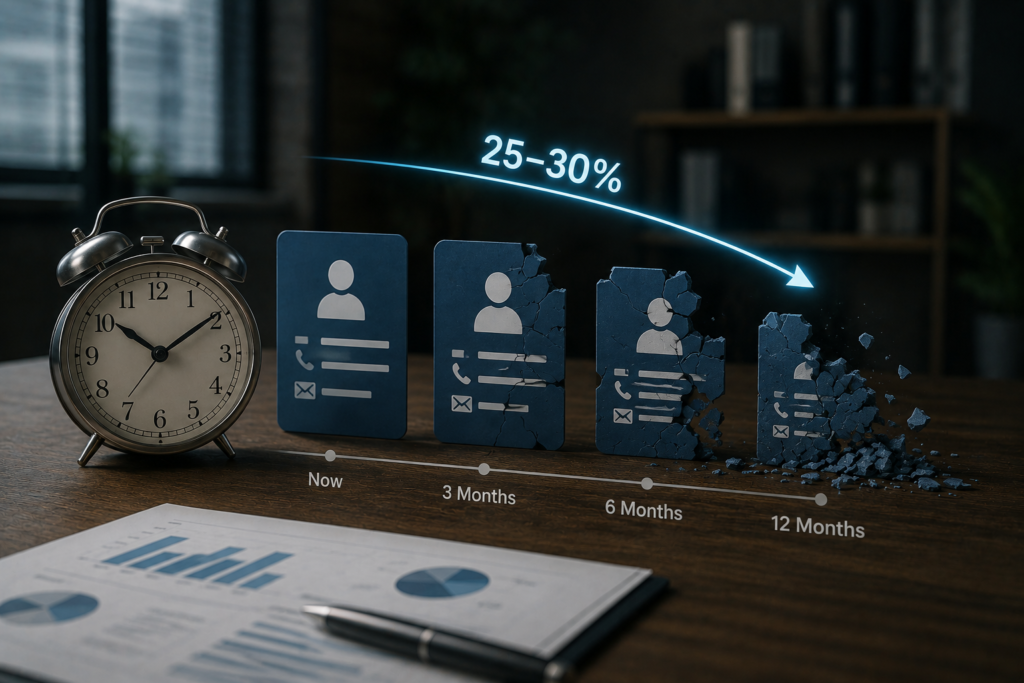
Business contact data decays quickly — industry estimates commonly cite roughly 25–30% per year — because people change jobs, companies restructure, and emails are deactivated. That pace means even a high-quality database degrades noticeably within months if it isn’t continually maintained. The faster your industry moves, the faster the decay.
Continuous vs. Periodic Refresh
Vendors fall on a spectrum. At one end, data is refreshed in occasional batches — perhaps quarterly or yearly — which leaves records aging between updates. At the other, data is verified continuously, with records rechecked on an ongoing cycle and often triggered by events like job changes. Continuous refresh keeps accuracy consistently high; periodic refresh lets it sag and recover.
What to Ask Vendors About Refresh
Ask directly: how often is each record re-verified, and what triggers an update? Strong answers describe frequent or continuous verification and event-driven updates. Vague claims with no cadence usually mean the data is refreshed rarely. The answer to this one question predicts a lot about the data you’ll receive.
Keeping Your Own Data Fresh
Refresh is a shared responsibility. Even with a well-maintained source, the records sitting in your CRM age too. Regular enrichment and re-verification — on a schedule that matches how fast your market moves — keep your own database current. Treating data hygiene as ongoing, not one-time, is what sustains results.

Key Takeaways
Because B2B data decays around 25–30% a year, refresh frequency is a top-tier quality factor. Favor vendors that verify continuously over those that refresh in occasional batches, ask exactly how often records are re-verified, and keep your own CRM data fresh through regular enrichment.
Frequently Asked Questions
How often should a B2B database be refreshed?
Ideally continuously. Because data decays around 25–30% per year, the best providers re-verify records on an ongoing cycle rather than in occasional batches.
How fast does B2B data go stale?
Roughly a quarter to a third of contact data can become outdated each year as people change jobs and companies change, and faster in high-growth industries.
What should I ask a vendor about refresh?
How often each record is re-verified and what triggers an update. Frequent, event-driven verification is far better than rare batch updates.
Do I need to refresh my own CRM data too?
Yes. Records in your CRM age just like any others, so regular enrichment and re-verification are needed to keep your own data current.
How can I tell whether a database provider’s refresh process is effective?
Look beyond marketing claims and ask for evidence. Strong providers can explain their verification methods, share data quality metrics, and demonstrate how recently records were updated or re-verified.
Which fields need to be refreshed most often?
Contact-level fields such as job title, employer, email address, phone number, and department tend to change most frequently. These fields usually benefit the most from continuous verification.
What happens if I rely on outdated database records?
Outdated records lead to higher bounce rates, wasted sales effort, inaccurate reporting, and missed opportunities. Over time, stale data can reduce campaign performance and make prospecting significantly less efficient.
Should I choose a provider based on refresh frequency alone?
No. Refresh frequency is important, but it should be evaluated alongside data accuracy, coverage, verification methods, integrations, and relevance to your target market. Frequent updates have little value if the underlying data quality is poor.
Can automated data enrichment help keep records current?
Yes. Automated enrichment tools can regularly update CRM records with new contact and company information, helping organizations maintain accurate data without relying entirely on manual cleanup processes.
How can regular database refreshes improve sales and marketing ROI?
Regular database refreshes help teams reach the right people with accurate contact information, reducing bounced emails, wasted outreach, and time spent pursuing outdated leads. By maintaining current records, organizations can improve campaign performance, increase sales productivity, and generate more qualified opportunities from the same prospecting effort.