
The six common causes
When PPC conversion rates drop, the cause is usually one (or more) of these six.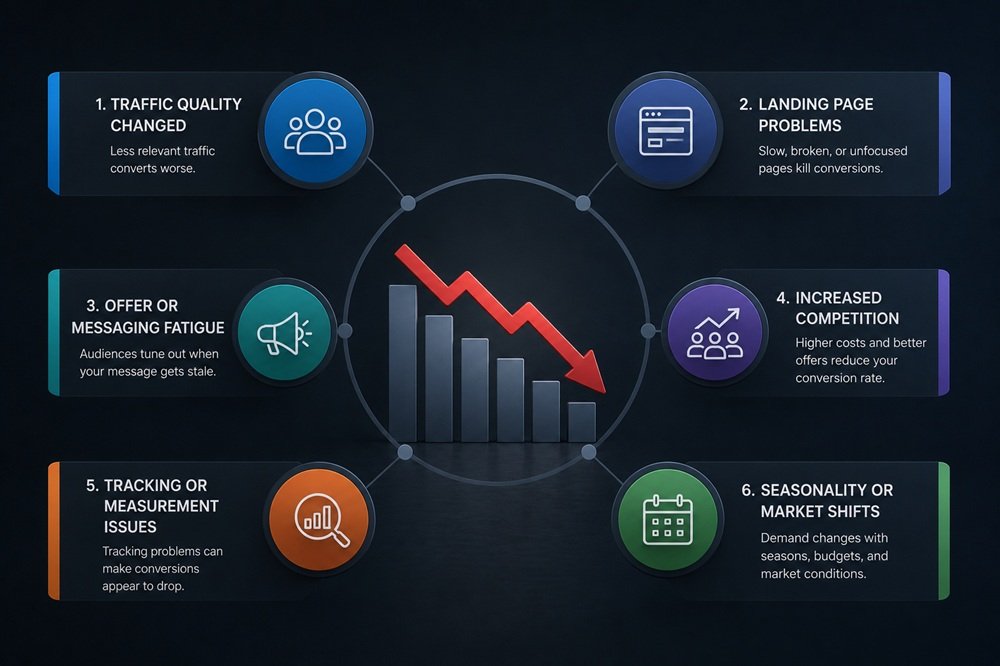 1. Traffic quality changed. Shifts in targeting, keywords, or match types can bring in less-relevant traffic that converts worse — often the culprit when conversion drops without site changes. Auction and competitive dynamics can also shift who sees your ads.
2. Landing page problems. A change to the landing page (or a newly developed technical issue — slow load, broken form, rendering problem) can quietly tank conversions. Always check whether the page still works as intended.
3. Offer or messaging fatigue. An offer or creative that worked can wear out as the audience sees it repeatedly, losing effectiveness over time.
4. Increased competition. New or more aggressive competitors can change the landscape — bidding up costs, offering better deals, or capturing attention — reducing your relative conversion.
5. Tracking or measurement issues. Sometimes the conversion rate didn’t really drop — the tracking broke. A broken conversion tag, analytics misconfiguration, or attribution change can make conversions appear to drop when they didn’t.
6. Seasonality or market shifts. B2B demand fluctuates with seasons, budget cycles, and market conditions; a drop may reflect a genuine temporary demand decline rather than a campaign problem.
Diagnosing which cause applies is essential, because the fixes differ entirely — and the first thing to rule out is whether the drop is real (causes 1–4, 6) or a measurement artifact (cause 5).
1. Traffic quality changed. Shifts in targeting, keywords, or match types can bring in less-relevant traffic that converts worse — often the culprit when conversion drops without site changes. Auction and competitive dynamics can also shift who sees your ads.
2. Landing page problems. A change to the landing page (or a newly developed technical issue — slow load, broken form, rendering problem) can quietly tank conversions. Always check whether the page still works as intended.
3. Offer or messaging fatigue. An offer or creative that worked can wear out as the audience sees it repeatedly, losing effectiveness over time.
4. Increased competition. New or more aggressive competitors can change the landscape — bidding up costs, offering better deals, or capturing attention — reducing your relative conversion.
5. Tracking or measurement issues. Sometimes the conversion rate didn’t really drop — the tracking broke. A broken conversion tag, analytics misconfiguration, or attribution change can make conversions appear to drop when they didn’t.
6. Seasonality or market shifts. B2B demand fluctuates with seasons, budget cycles, and market conditions; a drop may reflect a genuine temporary demand decline rather than a campaign problem.
Diagnosing which cause applies is essential, because the fixes differ entirely — and the first thing to rule out is whether the drop is real (causes 1–4, 6) or a measurement artifact (cause 5).
Common questions
Why did my PPC conversion rate drop?
A drop in PPC conversion rate usually comes from one of six areas: traffic quality, search intent, landing-page performance, conversion tracking, offer/message mismatch, or changes in the competitive environment. Before changing bids or budgets, determine whether the decline is real or simply a measurement problem.
1. Did the quality of your PPC traffic change?
This is one of the first things to investigate. Check whether you recently expanded keywords, changed match types, added search partners, broadened geographic targeting, changed audiences, or increased budgets.
Look at conversion rate by:
- Campaign
- Search term
- Keyword
- Match type
- Device
- Geography
- Audience
- Network
If clicks increased but conversions did not, you may be buying more low-intent traffic.
2. Did your search intent change?
A campaign can maintain strong click-through rates while attracting people who are less likely to buy. Broadening keywords or matching can introduce informational searches, job seekers, students, competitors, or users looking for adjacent products.
Review the actual search terms generating clicks and conversions. For B2B, distinguish between searches indicating commercial intent and searches that merely mention your category.
3. Did the landing page change?
A conversion-rate decline can happen even when PPC performance hasn’t changed. Check whether you recently changed:
- Headlines
- Forms
- CTA placement
- Page speed
- Navigation
- Pricing information
- Social proof
- Mobile layout
- Form fields
- Tracking scripts
Compare the current landing page with the previous version. If conversion rate dropped immediately after a website or landing-page change, the page deserves investigation before you change the advertising strategy.
4. Is your conversion tracking still working?
Always rule this out early.
Check whether Google Ads, analytics, CRM integrations, tag-management systems, forms, thank-you pages, and offline conversion imports are functioning correctly. A broken form or tracking tag can make a healthy campaign appear to have suddenly stopped converting.
Also check whether the definition of a conversion changed. If you changed from counting every form submission to counting qualified leads, the reported conversion rate can fall even though actual business performance improved.
5. Did your offer or messaging become less compelling?
Traffic can remain essentially identical while the offer becomes less attractive.
Examples include:
- Higher pricing
- Weaker promotional offer
- Less compelling CTA
- New competitor positioning
- Outdated messaging
- Longer forms
- Less relevant landing-page copy
- Removal of trust signals
Compare conversion rates against previous periods while controlling for traffic source and landing page. If the same keywords and audiences are converting less effectively, the offer or message may be the problem.
6. Did the market or competition change?
Your PPC account doesn’t operate in isolation. Competitors can change their bids, offers, landing pages, pricing, messaging, or targeting. Search behavior can also change seasonally or because of broader market conditions.
Look at impression share, auction insights, CPC, search volume, and competitor behavior alongside conversion rate. A higher CPC combined with lower conversion rate can indicate that you’re competing for a more expensive or more crowded portion of the market.
How do you diagnose a PPC conversion-rate drop quickly?
Use this sequence:
Tracking → Search terms → Traffic mix → Landing page → Offer → Competition
Don’t immediately change your bidding strategy. First establish where the conversion funnel broke.
For example:
Impressions ↑ → Clicks ↑ → Conversion rate ↓
suggests a different problem from:
Impressions ↓ → CPC ↑ → Conversion rate stable
The first points toward traffic quality or post-click performance; the second may point toward competition or demand changes.
What should B2B advertisers check first?
For B2B, look beyond the reported conversion rate. A campaign can have a lower form-fill rate but generate more qualified opportunities.
Track:
Click → Lead → MQL → SQL → Opportunity → Revenue
If PPC conversion rate falls from 5% to 3% but qualified opportunities per dollar improve, the campaign may actually be performing better.
What is the biggest mistake after a PPC conversion-rate drop?
Changing everything at once.
If you simultaneously change keywords, bidding, landing pages, budgets, targeting, and ad copy, you won’t know what caused the original decline—or which change fixed it.
Instead, isolate the likely cause, make one controlled change, and compare performance against a meaningful baseline.
What should you do if conversion rate suddenly drops overnight?
Treat a sudden drop as a potential technical or tracking issue first. Check forms, conversion tags, analytics, CRM integrations, website availability, redirects, consent systems, and recent site changes.
A gradual decline is more likely to require investigation of traffic quality, search intent, landing-page performance, offer strength, or competitive conditions.
How long should you wait before deciding PPC performance has actually declined?
Don’t overreact to a few days of B2B data unless there is an obvious technical failure. B2B campaigns can have relatively low conversion volumes and long sales cycles, so short-term fluctuations can be misleading.
Compare an appropriate period against a previous comparable period and, where possible, evaluate cost per qualified opportunity and pipeline generated, not conversion rate alone.