
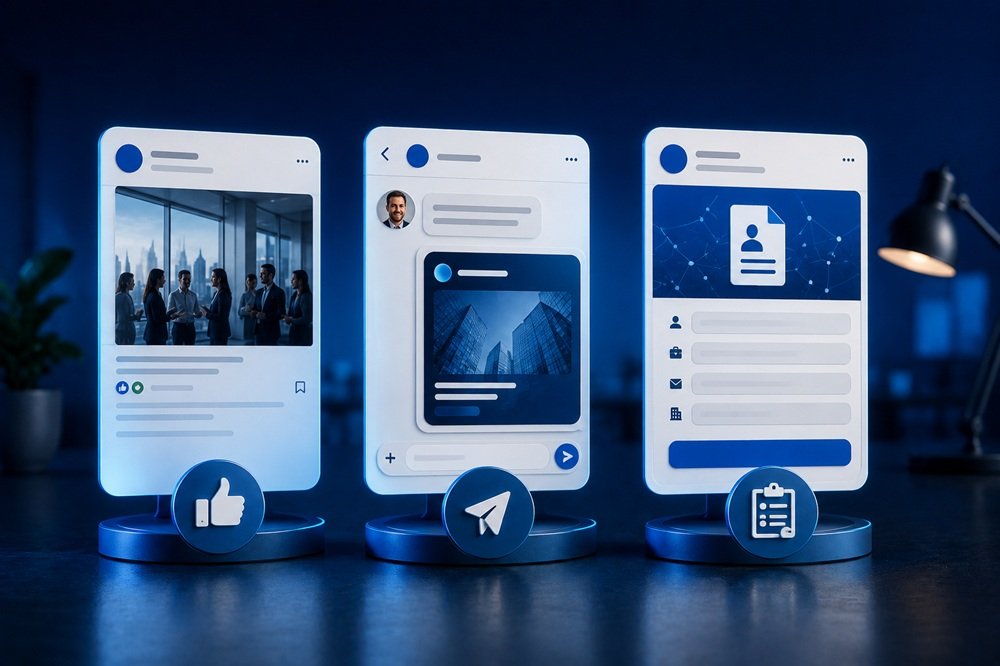
The main LinkedIn ad formats
 LinkedIn’s primary B2B ad formats differ in placement, experience, and ideal use.
Sponsored Content appears in the LinkedIn feed, looking like native posts (with an “promoted” label). It’s the workhorse format for reaching professionals as they scroll their feed — good for awareness, content promotion, and broad engagement. It interrupts gently (it’s in the natural feed flow) and reaches a wide targeted audience.
Message Ads (sponsored messaging) deliver your message directly to recipients’ LinkedIn inboxes. It’s a more direct, personal format — your message arrives as a message rather than a feed post — which commands attention but is more intrusive. It suits direct, personalized outreach and offers where the inbox placement and one-to-one feel add value, but overuse or irrelevance annoys recipients.
Lead Gen Forms aren’t a placement so much as a capture mechanism layered onto ads — a native form pre-filled with LinkedIn profile data that opens within LinkedIn, reducing friction for lead capture. They’re typically combined with Sponsored Content or Message Ads to capture leads with minimal friction (covered in depth in our dedicated article).
The formats serve different jobs: Sponsored Content for feed-based reach and awareness, Message Ads for direct inbox outreach, and Lead Gen Forms for frictionless capture layered onto either. Matching the format to your goal — awareness, direct outreach, or lead capture — is the key decision.
LinkedIn’s primary B2B ad formats differ in placement, experience, and ideal use.
Sponsored Content appears in the LinkedIn feed, looking like native posts (with an “promoted” label). It’s the workhorse format for reaching professionals as they scroll their feed — good for awareness, content promotion, and broad engagement. It interrupts gently (it’s in the natural feed flow) and reaches a wide targeted audience.
Message Ads (sponsored messaging) deliver your message directly to recipients’ LinkedIn inboxes. It’s a more direct, personal format — your message arrives as a message rather than a feed post — which commands attention but is more intrusive. It suits direct, personalized outreach and offers where the inbox placement and one-to-one feel add value, but overuse or irrelevance annoys recipients.
Lead Gen Forms aren’t a placement so much as a capture mechanism layered onto ads — a native form pre-filled with LinkedIn profile data that opens within LinkedIn, reducing friction for lead capture. They’re typically combined with Sponsored Content or Message Ads to capture leads with minimal friction (covered in depth in our dedicated article).
The formats serve different jobs: Sponsored Content for feed-based reach and awareness, Message Ads for direct inbox outreach, and Lead Gen Forms for frictionless capture layered onto either. Matching the format to your goal — awareness, direct outreach, or lead capture — is the key decision.
Common questions
What is the difference between LinkedIn Sponsored Content, Message Ads, and Lead Gen Forms?
They solve different parts of the funnel:
- Sponsored Content: best for reaching and educating your target audience in the LinkedIn feed.
- Message Ads: best for putting a focused offer directly in the LinkedIn inbox.
- Lead Gen Forms: best for reducing friction when you want someone to submit their information.
Importantly, Lead Gen Forms aren’t really a competing ad format. They can be attached to Sponsored Content and Message Ads, allowing you to combine the formats.
When should you use LinkedIn Sponsored Content?
Use Sponsored Content when your primary goal is building demand, reaching a defined professional audience, driving traffic, or promoting content.
Sponsored Content appears directly in the LinkedIn feed and can use formats including single-image, video, carousel, document, and event ads.
For B2B, it is particularly useful for:
- Thought leadership
- Case studies
- Product education
- Webinars
- Research reports
- Gated content
- Retargeting
- Brand awareness
It is generally the best top- and middle-of-funnel starting point.
When should you use LinkedIn Message Ads?
Use Message Ads when you have a specific offer and a clearly defined audience you want to reach through LinkedIn Messaging.
Message Ads contain a focused message and a single CTA. They are delivered when targeted members are active on LinkedIn, and Sponsored Messaging is charged on a cost-per-send basis.
They work well for:
- Webinar invitations
- Demo offers
- Events
- High-value content
- Account-based campaigns
- Specific product offers
They’re less appropriate when you need broad awareness or when the offer requires substantial education before someone is ready to act.
What makes Lead Gen Forms different?
Lead Gen Forms are designed to remove friction from the conversion step. LinkedIn pre-populates the form with professional information from the member’s profile, so prospects don’t have to manually type everything.
They can be used with both Sponsored Content and Message Ads.
They are particularly useful for:
- Demo requests
- Webinar registrations
- Content downloads
- Event registrations
- Consultation requests
Which produces the most leads?
Don’t assume that the format producing the most leads produces the most revenue.
Lead Gen Forms can increase conversion volume because they keep users on LinkedIn and reduce form friction. LinkedIn reports that its Lead Gen Forms have produced 2–3× higher conversion rates than standard Sponsored Content in its internal data, but that is LinkedIn’s own platform data rather than a universal benchmark.
For B2B, measure qualified leads and opportunities, not just form submissions.
Which is best for B2B lead generation?
For most B2B advertisers, I’d structure the funnel like this:
Sponsored Content → Lead Gen Form → CRM → nurture/sales
Then use Message Ads for more focused campaigns where the audience and offer are sufficiently specific.
This lets Sponsored Content create demand while Lead Gen Forms capture existing interest without forcing prospects onto an external landing page.
Should you send LinkedIn traffic to a landing page or use a Lead Gen Form?
Test both.
A Lead Gen Form reduces friction because the prospect stays within LinkedIn and their information is pre-populated. An external landing page gives you substantially more room to explain a complex product, qualify prospects, demonstrate value, and control the conversion experience.
For a simple ebook or webinar, a Lead Gen Form is often a logical choice.
For a complex enterprise product, sending someone to a strong landing page may produce fewer but better-qualified conversions.
Are Message Ads basically LinkedIn cold email?
They’re similar in concept but aren’t the same thing. Message Ads are paid native advertisements delivered through LinkedIn Messaging, rather than emails sent from your company’s email system. LinkedIn controls the audience delivery, and advertisers don’t know exactly which members receive a Sponsored Message unless those members take an identifiable action such as submitting a Lead Gen Form.
That distinction matters when comparing Message Ads with outbound email.
Which format is best for account-based marketing?
Message Ads and highly targeted Sponsored Content can both work well for ABM.
For example:
- Use Sponsored Content to build awareness among employees at target accounts.
- Retarget engaged audiences with a stronger offer.
- Use Message Ads for a focused event, report, or meeting CTA.
- Capture responses through a Lead Gen Form.
- Push leads into the CRM for sales follow-up.
The important factor is the audience and offer, not simply the ad format.
What are the biggest mistakes with LinkedIn Lead Gen Forms?
The biggest is optimizing for cheap leads instead of qualified leads.
A short form with an attractive downloadable asset can generate lots of submissions while producing very little pipeline. Consider adding qualification questions where appropriate, and connect LinkedIn leads to your CRM or marketing automation system so you can measure what happens after the form submission. LinkedIn supports CRM/marketing automation integrations and lead downloads.
How should you compare these formats?
| Format | Best for | Main strength | Main weakness |
|---|---|---|---|
| Sponsored Content | Awareness + demand generation | Broad feed reach | More steps to conversion |
| Message Ads | Focused offers | Direct inbox placement | Can feel intrusive |
| Lead Gen Forms | Lead capture | Very low conversion friction | Can produce low-intent leads |
| Sponsored Content + Form | Scalable lead generation | Reach + low-friction capture | Lead quality needs monitoring |
| Message Ad + Form | Focused B2B campaigns | Direct offer + easy capture | Smaller usable audience |
Which should a B2B company start with?
I’d start with Sponsored Content + Lead Gen Forms for most B2B campaigns.
Then introduce Message Ads when you have a strong, specific offer and a sufficiently narrow audience.
The real KPI should be:
Cost per qualified opportunity → pipeline generated → revenue
—not simply CTR or CPL.
If Sponsored Content generates 500 leads at $40 each while Message Ads generate 100 leads at $100 each, Message Ads could still be the better campaign if those 100 leads produce substantially more qualified opportunities. LinkedIn itself recommends using multiple formats together rather than treating them as mutually exclusive channels.