When buying B2B data, you’ll see records described as “basic,” “full,” or “enriched” — and the labels aren’t standardized across providers, which makes comparing offers confusing. Understanding what these tiers actually contain helps you buy the right depth for your campaign and avoid both overpaying for fields you won’t use and underbuying records too thin to work. This article defines each tier.
The three tiers of B2B records
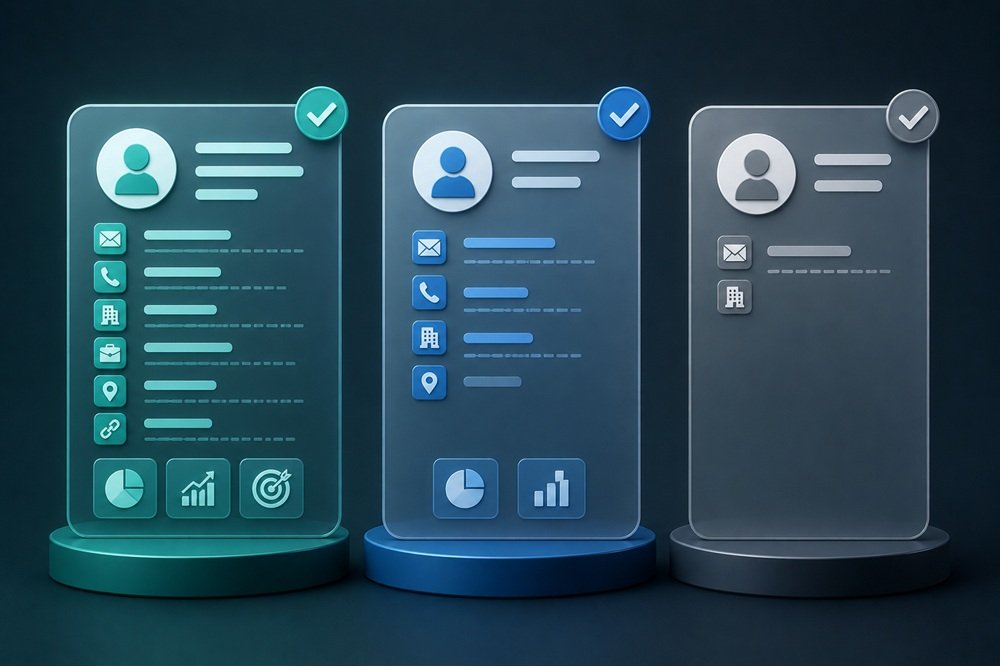
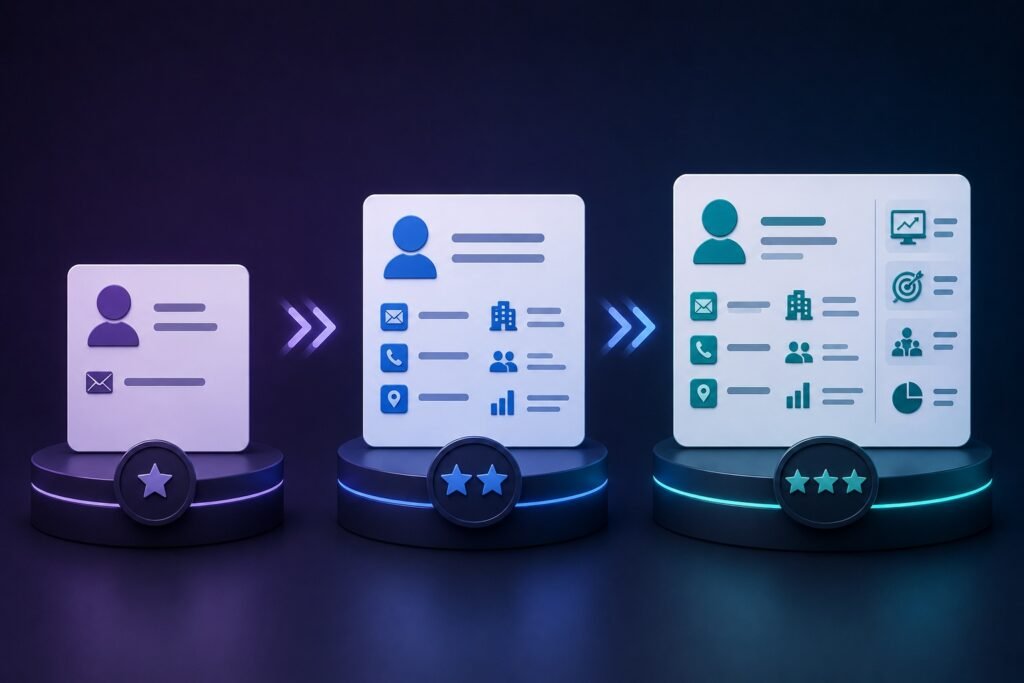
While terminology varies by provider, B2B records generally fall into three depth tiers.
 Basic records
 contain the minimum to identify and reach a contact: name, company, and one contact method (usually email). They’re the cheapest and suit high-volume, low-touch campaigns where you need reach more than depth. The limitation is that they offer little for segmentation, personalization, or scoring — you know who and where, but little else.
Full records contain a complete contact profile: name, job title, verified business email, phone, full postal address, plus company firmographics (company name, website, SIC/NAICS codes, employee size, revenue band, public/private status). This is the standard tier for serious B2B campaigns — enough depth to segment, personalize, score, and route, with verified contact details across multiple channels.
Enriched records are full records augmented with additional intelligence layers: technographic data (what software the company uses), intent signals (is the company in-market), seniority and department mapping, social profiles, and sometimes behavioral or engagement data. Enrichment adds the context that powers advanced targeting, account-based marketing, and predictive scoring.
The progression is additive: full records contain everything basic records have plus more; enriched records contain everything full records have plus intelligence layers. Each tier costs more and enables more sophisticated use.
Common questions
What is a basic B2B contact record?
A basic B2B contact record typically contains a small set of core information, such as a person’s name, company, job title, location, and possibly an email address or phone number. It is useful for simple identification and prospecting but may lack the deeper information needed for precise segmentation, qualification, or personalization.
What is an enriched B2B contact record?
An enriched record starts with an existing contact or company record and adds additional information from one or more data sources. Enrichment might add verified email addresses, phone numbers, company size, industry, revenue, technology usage, headquarters, funding information, seniority, or other attributes. The goal is to make an existing record more complete and actionable.
What is a full-record B2B contact?
A full-record contact generally contains a broader set of
contact-level and company-level information rather than only a name and email address. It may include identity, job role, seniority, department, contact information, firmographics, company relationships, location, technologies, and other relevant intelligence. “Full record” is not a standardized industry term, so buyers should ask vendors exactly which fields are included.
What is the difference between a basic record and a full-record contact?
The main difference is
depth. A basic record may tell you who someone is and where they work. A full record can provide enough information to determine whether the person and company fit your ICP, identify their role in the buying process, and select the appropriate outreach approach. A larger number of fields does not automatically mean higher quality; the fields need to be accurate and relevant.
Is an enriched record the same as a full-record contact?
Not necessarily.
Enriched describes a process—additional information has been added to an existing record.
Full record describes the breadth of information available. An enriched record can still be relatively basic if only one or two fields were added. Conversely, a full record may have been created with many sources from the beginning rather than enriched after the fact.
What fields should a full B2B contact record contain?
Depending on the use case, useful fields can include
name, professional email, phone, job title, seniority, department, company, website, industry, employee count, revenue range, headquarters, location, company hierarchy, technologies, funding, and relevant intent or engagement signals. Not every business needs all of these fields. The most valuable fields are those that improve targeting, qualification, routing, personalization, or account research.
Why does the distinction matter when buying B2B data?
The distinction affects both
price and usefulness. A vendor may advertise millions of contacts, but if most records contain only names and generic emails, the database may be less useful than a smaller dataset with complete company and decision-maker information. Buyers should compare vendors based on the number of
usable fields per target record, not simply the total number of contacts.
Does a full-record contact guarantee better data quality?
No. More fields can actually create more opportunities for inaccuracies. A record with 30 fields is not necessarily better than one with 10 highly accurate fields. Buyers should evaluate
field-level accuracy, completeness, freshness, verification methodology, and source provenance alongside record depth.
How much does an enriched or full-record B2B contact cost?
Pricing varies based on the fields provided, verification level, volume, industry, geography, and vendor pricing model. Basic contact records are generally less expensive, while records containing verified emails, direct dials, firmographics, technographics, and other intelligence command higher prices. Buyers should calculate the
cost per usable record rather than comparing headline per-contact prices.
Which type of B2B record should you buy?
Choose based on the decision you need the data to support.
Basic records can be sufficient for simple prospect identification.
Enriched records work well when you already have a CRM or contact list and need to fill missing information.
Full records are more appropriate when you need comprehensive account and contact intelligence for sophisticated segmentation, sales research, ABM, or outbound campaigns.
What should you ask a vendor before buying full-record B2B data?
Ask for the exact field list, field-level accuracy rates, verification dates, data sources, refresh frequency, geographic and industry coverage, duplicate rate, replacement policy, and pricing for each enrichment layer. Also ask the vendor to provide a sample matching your actual ICP. This makes it easier to determine whether you’re paying for genuinely useful information or simply a larger number of fields.
How this applies to your business
The practical approach is to match record depth to campaign sophistication, then verify the real depth rather than trusting the label. Define what your campaign actually needs — can you run it on full records, or does it require intent signals and technographics? — and buy that tier, no more. Paying for enrichment you won’t use is as wasteful as trying to run ABM on basic records that can’t support it.
When comparing providers, always request the field list and completeness rates rather than comparing on the “full” or “enriched” label. Labels aren’t standardized; field lists are concrete. A provider’s “full” record might be another’s “basic,” and only the actual fields and completeness rates reveal the truth.
Consider the start-lean-and-enrich path for cost efficiency. Buying full records and enriching the subset that proves valuable — the accounts that engage, the segments that convert — often costs less than buying fully enriched records for an entire list, much of which won’t justify the enrichment expense. Enrich what earns it.
Iscope Digital’s
B2B Email & Postal Data service delivers full-record contacts from the
Bizline Direct database, with field-completeness reporting so you know exactly what you’re getting. For adding intelligence layers to records you already own, see our
Database Marketing Solutions, and for how the targeting variables work,
SIC vs NAICS codes for B2B targeting.