If you’ve started shopping for sales or marketing data, you’ve probably hit the term “B2B database” within the first five minutes — and just as quickly wondered what actually separates one from a spreadsheet you could build yourself. This guide breaks down what a B2B database is, what’s inside it, and how to tell whether your business needs one, in plain language for first-time buyers.
Understanding the Basics of a B2B Database
A
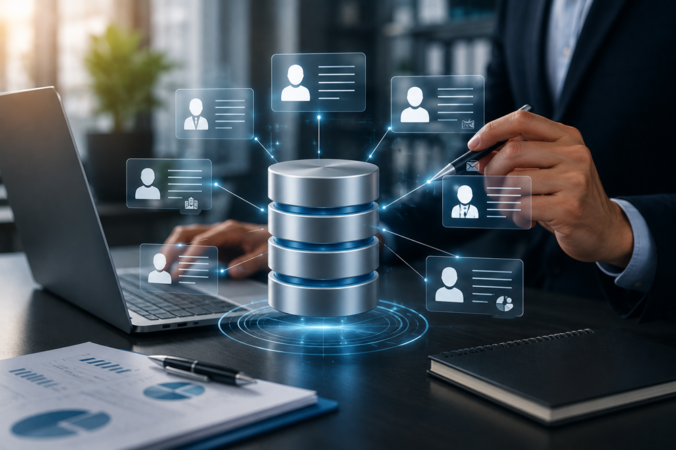
B2B database is a structured, searchable collection of information about businesses and the people who work at them. It pairs details about a company — industry, size, revenue, location — with details about its decision-makers, such as name, job title, email, and phone number.
The word “database” is the key. Unlike a static list, a B2B database is organized so you can search and filter it. That lets you isolate a precise audience in seconds — for example, “marketing directors at software companies in Germany with 200–500 employees” — and pull current contact details for everyone who matches.
What’s Inside a B2B Database
A single entry in a B2B database is called a contact record, and it combines two layers of information.
Person-level fields describe the individual:
- Full name and job title
- Seniority and department
- Business email address
- Direct dial or company phone number
- LinkedIn or professional profile
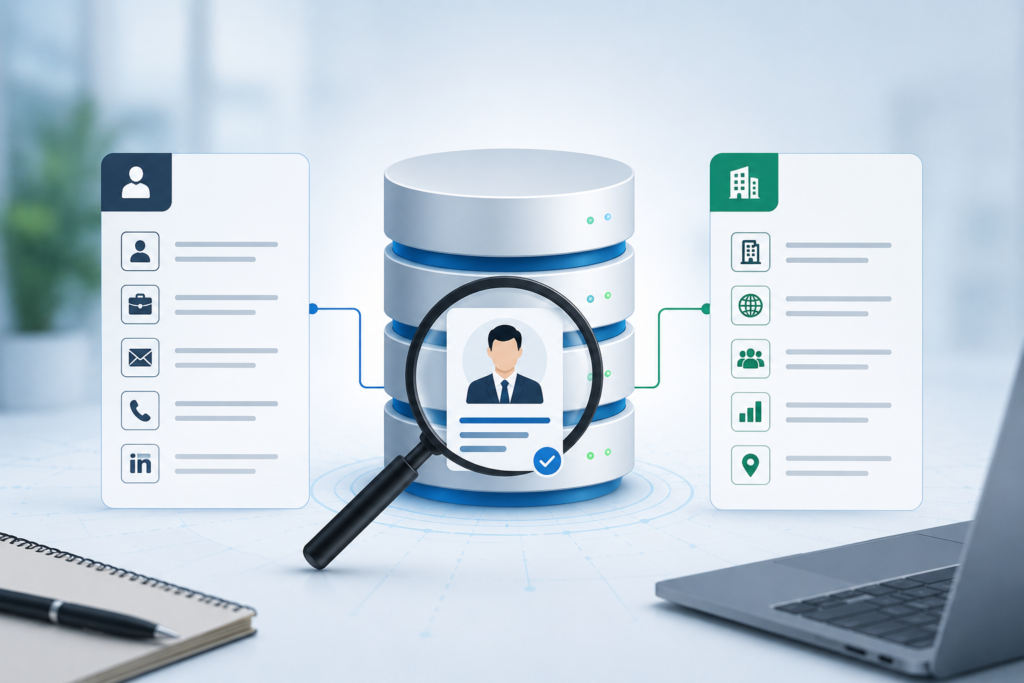 Company-level fields
 describe where they work:
- Company name and website
- Industry and sector
- Employee headcount and revenue band
- Headquarters and office locations
Richer databases add further layers — the technologies a company uses and signals that it may be actively researching a purchase — which we cover in our guide to
firmographic, technographic, and intent data.
How a B2B Database Differs From Free Lists and CRMs
It’s easy to confuse a B2B database with two things it isn’t. A
free or one-off list is a flat, static export with no guarantees about how recent or accurate it is — it starts going out of date the moment you download it. A maintained B2B database, by contrast, is verified and refreshed over time, a difference you’ll feel directly in your email bounce rates.
A
CRM (customer relationship management system, like Salesforce or HubSpot) is where you
manage relationships with contacts you’re already working. A B2B database is where you
find new prospects to feed into that CRM. The two work together rather than replacing one another — a distinction we unpack in
B2B database vs. CRM vs. contact list.
Where B2B Database Providers Get Their Data
Reputable providers build their databases from a blend of sources: publicly available business information, licensed data partnerships, contributions from users of the tool, and proprietary research and verification.
Because no single source is complete or permanently accurate, the providers worth buying from continuously verify their records — checking that emails are deliverable, phone numbers connect, and job titles are current. This matters because business contact data decays quickly; industry estimates commonly put the rate at roughly 25–30% per year as people change jobs and companies change hands.
The Main Types of B2B Data
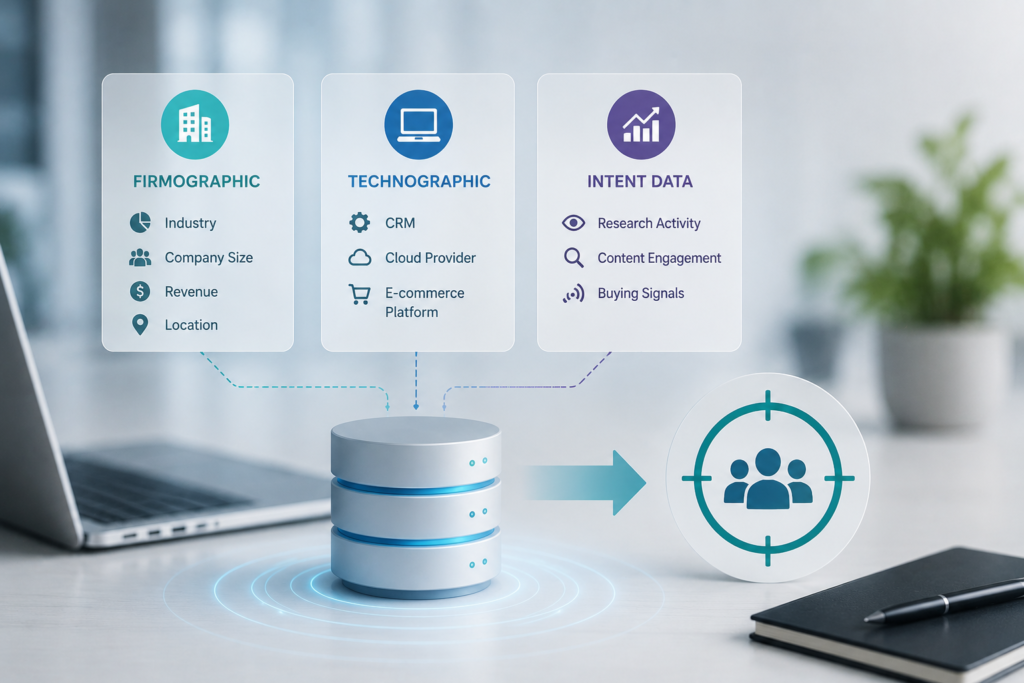
Three categories of data show up in almost every database, and knowing them helps you target more precisely:
- Firmographic data describes what a company is — industry, size, revenue, location.
- Technographic data describes what tools a company uses — its CRM, cloud provider, or e-commerce platform.
- Intent data signals whether a company may be ready to buy, based on aggregated research behavior.
Used together, these let you move beyond “who fits our profile” to “which companies fit
and are likely in-market right now.”
Who Uses B2B Databases and Why
B2B databases serve several teams, each for a different reason. Sales teams use them to build prospect lists and reach decision-makers; marketing teams use them for targeted and account-based campaigns; recruiters use them to source candidates; and founders use them to find their first customers without a research team behind them. The common thread is scale — researching prospects by hand works for a few dozen accounts but breaks down at a few thousand, which is where a database earns its cost.
How Much a B2B Database Costs
Pricing ranges widely, from low-cost per-credit tools aimed at small teams to enterprise subscriptions running into the tens of thousands per year. Providers typically charge in one of three ways: a recurring subscription, credits you spend to unlock contacts, or a per-record fee. The headline principle is that price should track data quality and coverage of
your target audience — not just the total record count a vendor advertises. We break down the models in our
B2B database pricing guide.
How to Know If Your Business Needs One
A B2B database is likely worth it if your team spends significant time hunting for contact details, your outreach bounces often, or you’re trying to reach a specific, well-defined audience at a scale you can’t research manually. It may be premature if you sell to a tiny, well-known set of accounts you can research by hand, or if you haven’t yet defined who your ideal customer is. In that case, sharpen your targeting first — then buy the data to reach it.
Key Takeaways
A B2B database is a searchable, maintained source of company and contact data that helps teams find and reach the right buyers at scale. It’s distinct from a static list (which ages instantly) and a CRM (which manages existing relationships). The most important quality factors are how accurately and how recently the data is verified, and how well its coverage matches your specific target market — not the size of the headline number.
Frequently Asked Questions
What is a B2B database in simple terms?
It’s an organized, searchable collection of information about businesses and their decision-makers — company details paired with contact details — that sales and marketing teams use to find and reach potential customers.
What’s the difference between a B2B database and an email list?
An email list is one narrow, static slice of data. A B2B database is multi-dimensional and maintained: you can target by industry, seniority, company size, technology, and buying signals, then pull whichever current contact details you need.
Is a B2B database the same as a CRM?
No. A B2B database helps you find new prospects; a CRM helps you manage relationships with contacts you already have. Most teams use both, feeding qualified records from the database into the CRM.
How accurate is B2B database data?
Accuracy depends on the vendor’s verification process. Because contact data decays roughly 25–30% per year, the best providers re-verify records continuously rather than selling a one-time snapshot. Always test accuracy on a sample before buying.
How much does a B2B database cost?
Costs range from low-cost per-credit tools to enterprise subscriptions in the tens of thousands per year, charged by subscription, credits, or per record. Price should reflect data quality and relevant coverage, not just record count.
Do small businesses need a B2B database?
Often yes, especially for outbound sales or finding early customers. Smaller teams should prioritize affordable tools with accurate, easy-to-use data over large, expensive platforms with features they won’t use.
How do I know if a B2B database is right for my target market?
Look for coverage that matches your ideal customer profile. Evaluate whether the database includes the industries, company sizes, geographic regions, job titles, and decision-makers you want to reach. Request sample records to verify relevance before purchasing.
What data fields should a good B2B database include?
A quality B2B database should include company information (industry, revenue, employee count, location), contact details (name, title, email, phone), and ideally additional attributes such as technologies used, intent signals, funding data, or organizational hierarchies for more precise targeting.
Can I integrate a B2B database with my CRM or marketing platform?
Most modern B2B database providers offer integrations with popular CRMs and marketing automation platforms. Integrations help streamline lead import, enrichment, segmentation, and campaign execution while reducing manual data entry.
Are B2B databases compliant with privacy regulations?
Reputable providers design their data collection and processing practices to comply with applicable regulations such as GDPR, CCPA, and other privacy laws. However, buyers remain responsible for ensuring their own outreach and data usage practices comply with relevant legal requirements.
What should I look for when comparing B2B database providers?
Focus on data accuracy, coverage within your target market, update frequency, compliance standards, filtering capabilities, integrations, customer support, and pricing. The cheapest database is rarely the best value if the data quality is poor or outdated.