Before committing budget to a B2B database, it’s worth answering a basic question: will it pay for itself? ROI on data isn’t hard to estimate if you know which inputs to track. This article gives you a simple framework to calculate it — and to avoid the common errors that make data spend look better or worse than it really is.
Why ROI Matters for Data Spend
Treating data as a measurable investment, rather than a vague necessity, helps you decide how much to spend and which vendor to choose. An ROI estimate turns the buying decision from a gut call into a comparison of expected return against cost — and gives you a benchmark to judge whether the purchase actually worked.
The Inputs You Need
To estimate ROI, you need a few numbers: the cost of the data, the number of usable leads it produces, your conversion rate from lead to customer, and the value of a customer (ideally lifetime value, not just first sale). With these, you can project the revenue the data is likely to generate and compare it against its cost.
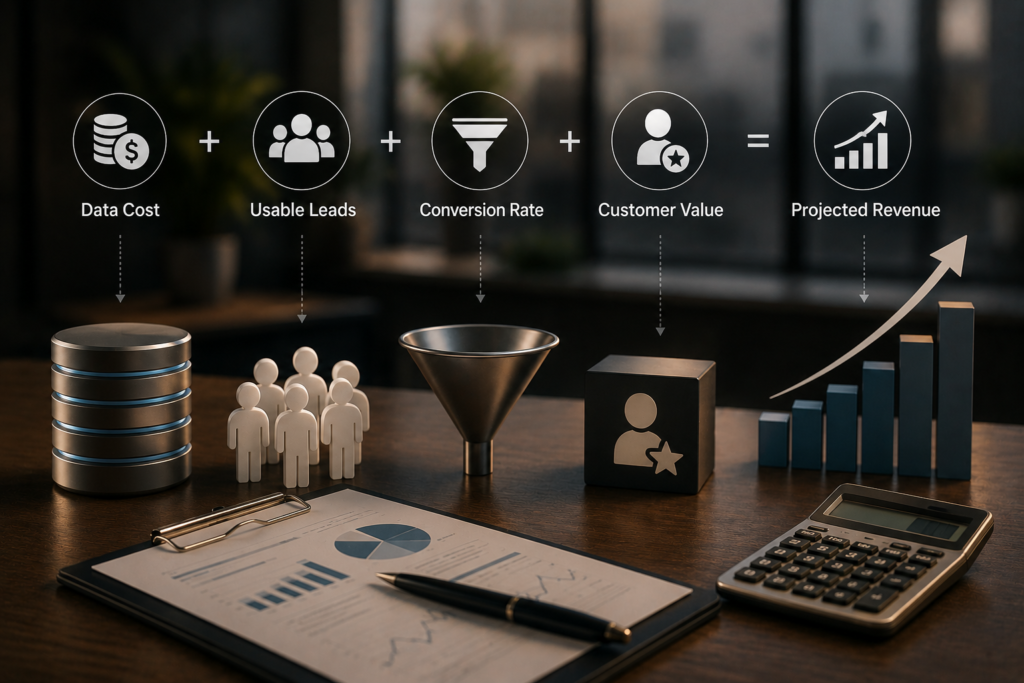
A Simple ROI Calculation
The basic logic: estimate how many customers the data will help you win (usable leads × conversion rate), multiply by customer value to get expected revenue, then compare against the data’s total cost. Expressed as a ratio or percentage, that comparison is your ROI. Even rough inputs give a useful directional answer.
Accounting for the Full Funnel
A common mistake is stopping at leads. The data’s value flows through your whole funnel — deliverability, response, qualification, and close — so your conversion estimate should reflect realistic drop-off at each stage. Using an optimistic, single-step conversion rate inflates ROI; modeling the full funnel keeps the estimate honest.
Don’t Forget the Time Savings
Pure revenue ROI undersells data, because a major benefit is reclaimed time. Hours reps no longer spend hunting for contact details convert into selling time with real value. Including a reasonable estimate of time saved — valued at the cost of that labor — often improves the ROI picture meaningfully.
Common ROI Mistakes
Watch for predictable errors: using first-sale value instead of lifetime value, assuming optimistic conversion rates, ignoring data decay’s effect on usable leads, and omitting time savings. Each skews the result. The goal is an honest estimate you can trust, not a flattering number that sets you up for disappointment.

Key Takeaways
Calculate B2B data ROI by estimating usable leads, conversion rate, and customer value, comparing expected revenue against total data cost — and include reclaimed time and full-funnel drop-off for an honest figure. Avoid optimistic shortcuts like first-sale-only value and single-step conversion. A realistic ROI estimate guides both the buy decision and how much to spend.
Frequently Asked Questions
How do I calculate ROI on a B2B database?
Estimate usable leads × conversion rate to get customers won, multiply by customer value for expected revenue, then compare against the data’s total cost.
What inputs do I need?
Data cost, number of usable leads, conversion rate from lead to customer, and customer value — ideally lifetime value rather than just first sale.
Should I use lifetime value or first-sale value?
Lifetime value gives a truer picture, since customers often generate revenue beyond the first purchase. First-sale value understates the return.
Should I account for the full funnel?
Yes. Model realistic drop-off through deliverability, response, qualification, and close. A single optimistic conversion rate inflates ROI.
Does time saved count toward ROI?
It should. Reclaimed research time converts into selling time with real value, and including it often improves the ROI picture meaningfully.
How does data decay affect ROI?
Decay reduces the number of usable leads over time, so factoring it in keeps your lead estimate — and your ROI — realistic.
What are common ROI mistakes?
Using first-sale instead of lifetime value, optimistic conversion rates, ignoring decay, and omitting time savings. Each skews the result.
How precise does the estimate need to be?
Even rough inputs give a useful directional answer. The aim is an honest, decision-guiding estimate rather than false precision.
Can I use ROI to choose between vendors?
Yes. Comparing expected return against each vendor’s cost — factoring in quality differences — helps you choose on value, not just price.
When should I measure actual ROI?
After the data has run through your funnel for a meaningful period, then compare actual results against your estimate to refine future decisions.