Buying B2B data comes with its own vocabulary, and vendors don’t always slow down to explain it. This glossary defines the 50 terms you’ll encounter most often, grouped by theme so you can scan straight to what you need. Bookmark it as a reference when you’re reading pitches and contracts.
How to Use This Glossary
Terms are organized into themes — core concepts, data types, data quality, contacts and targeting, tools and integration, pricing, and compliance. You don’t need to read it end to end; jump to the section that matches whatever you’re evaluating.
Core Concepts
B2B database — A structured, searchable, maintained collection of business and contact data used for sales and marketing.
Contact record — A single entry pairing a person’s details with their company’s details.
ICP (Ideal Customer Profile) — A description of the company type that best fits your product.
Buyer persona — A profile of the individual decision-maker you target.
Lead — A potential customer who has shown some interest or fit.
Prospect — A potential customer who matches your ICP, with interest not yet confirmed.
TAM — Total Addressable Market: every company that could possibly buy.
SAM — Serviceable Available Market: the slice of TAM you can realistically serve.
SOM — Serviceable Obtainable Market: the share you can realistically win.

Data Types
Firmographics — Company attributes: industry, size, revenue, location.
Technographics — The technology and tools a company uses.
Intent data — Signals suggesting an account may be researching a purchase.
Data sourcing — Where and how a provider obtains its data.
Data Quality and Accuracy
Data coverage — How much of your target universe a database actually contains.
Data accuracy — How often a field’s value is correct and current.
Fill rate — The percentage of records that have a given field populated.
Match rate — The share of your input records a provider can successfully match.
Data decay — The rate at which records become outdated as people and companies change.
Data enrichment — Filling in or updating missing fields on existing records.
Data hygiene — Ongoing cleaning to keep records accurate and deduplicated.
Deduplication — Removing or merging duplicate records.
Verification — Confirming a data point is real and current.
Human-verified data — Data checked by a person rather than only software.
Bounce rate — The percentage of emails that fail to deliver.
Hard bounce — A permanent delivery failure, such as a non-existent address.
Soft bounce — A temporary delivery failure, such as a full mailbox.
Sender reputation — A score affecting whether your emails reach inboxes.
Contacts and Targeting
Direct dial — A phone number that reaches a person directly, not a switchboard.
Business email — An individual work email, as opposed to a generic catch-all.
Catch-all email — A generic address (info@, sales@) not tied to one person.
Seniority — A contact’s level, such as manager, director, VP, or C-level.
Decision-maker — A contact with authority to influence or approve a purchase.
Gatekeeper — Someone who controls access to a decision-maker.
ABM (Account-Based Marketing) — Targeting specific high-value accounts as markets of one.
Suppression list — Contacts you must exclude from outreach.
Tools and Integration
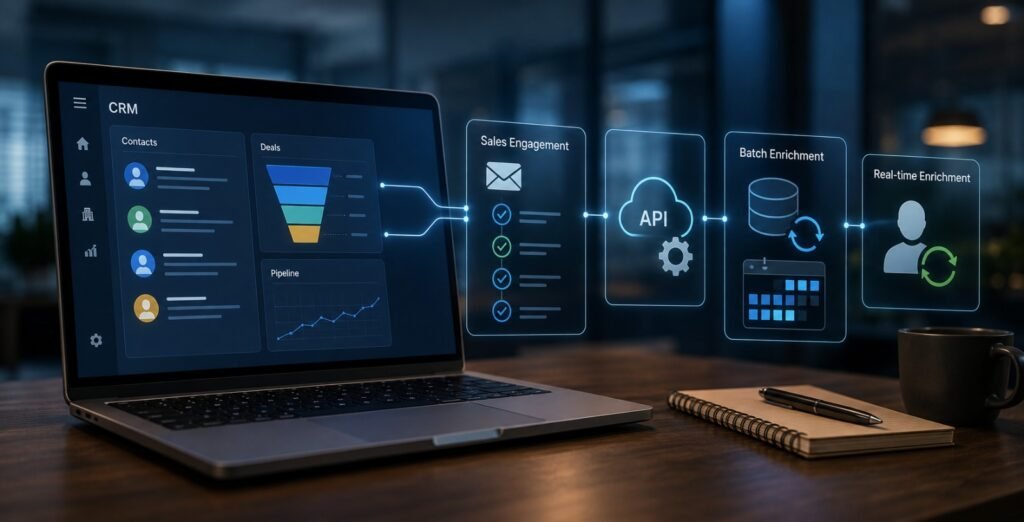
CRM — Software for managing relationships and pipeline with known contacts.
Sales engagement platform — A tool that sequences and tracks outreach.
API — A connection that lets systems exchange data automatically.
Batch enrichment — Updating many records at once on a schedule.
Real-time enrichment — Updating a record at the moment it’s needed.
Pricing Terms
Credits — Units you spend to unlock contacts in credit-based pricing.
Per-record pricing — Paying for each individual record purchased.
Subscription pricing — Paying a recurring fee for access over time.
Cost per lead (CPL) — Total spend divided by qualified leads produced.
Compliance Terms
GDPR — EU regulation governing personal data, including B2B contacts.
CCPA / CPRA — California privacy laws affecting data on residents.
CAN-SPAM — US law governing commercial email.
Legitimate interest — A lawful basis under GDPR sometimes used for B2B outreach.
Opt-in / opt-out — Whether consent is given proactively or assumed until refused.
SLA (Service Level Agreement) — A vendor’s contractual commitments on quality or service.
Definitions of legal terms here are explanatory and not legal advice; consult a qualified professional for your specific situation.
Frequently Asked Questions
What does data decay mean in B2B?
Data decay is the rate at which records go out of date as people change jobs and companies change. B2B contact data is commonly estimated to decay around 25–30% per year.
What’s the difference between fill rate and match rate?
Fill rate is the share of records with a given field populated; match rate is the share of your input records a provider can successfully match to its database.
What is a catch-all email?
A generic address like info@ or sales@ that isn’t tied to a specific person. It usually won’t reach your buyer and often signals weaker data.
What does enrichment mean?
Enrichment fills in or updates missing fields on records you already have, such as adding direct dials or correcting job titles, using a database as the source.
What is email validity rate?
Email validity rate measures the percentage of email addresses in a database that can successfully receive messages. Higher validity rates generally lead to lower bounce rates and better campaign performance.
What is a bounce rate, and why does it matter?
Bounce rate is the percentage of emails that fail to reach the intended recipient. High bounce rates can damage sender reputation, reduce deliverability, and indicate that the underlying data is outdated or poorly maintained.
What does database coverage mean?
Coverage refers to how many companies, industries, regions, or job functions a database includes. A database with strong coverage of your target market is often more valuable than one with a larger overall record count.
What is data verification?
Data verification is the process of checking whether contact and company information is accurate and current. Providers use a combination of automated validation, third-party sources, and human review to maintain data quality.
What is record freshness?
Record freshness refers to how recently a contact or company record has been updated or verified. Fresher records are generally more reliable because they are less likely to contain outdated job titles, email addresses, or company information.
What’s the difference between first-party, second-party, and third-party data?
First-party data is collected directly by a company from its own customers and interactions.
Second-party data is another organization’s first-party data shared through a partnership.
Third-party data is aggregated from multiple external sources and sold or licensed by data providers.
Understanding the source of data helps buyers evaluate accuracy, compliance, and how well the information fits their use case.