A contact record with just a name, email, and company tells you who someone is but not whether they’re worth pursuing. Firmographic enrichment adds the company context that turns a bare contact into a qualified, segmentable, scoreable prospect. This article explains what firmographic enrichment is, which fields matter most, and how to use them.
What firmographic enrichment is
Firmographics are the descriptive attributes of a company — the B2B equivalent of consumer demographics. Firmographic enrichment is the process of appending these company-level attributes to your contact records by matching them against a reference database, so each contact carries the context of the organization they work for.
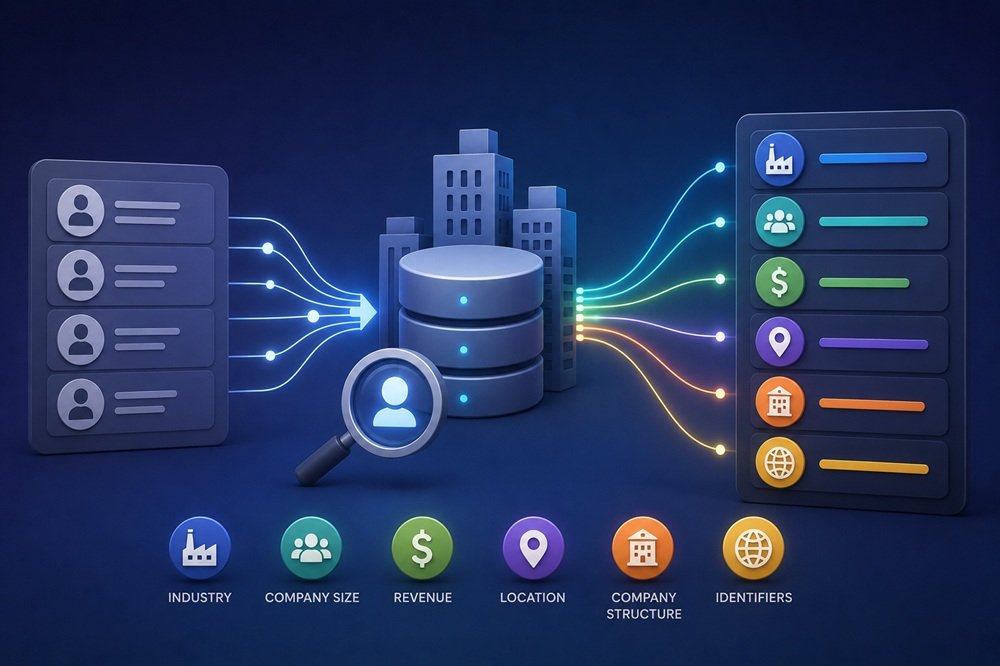
The core firmographic fields include:
industry classification (SIC and NAICS codes),
company size (employee count bands),
revenue (annual revenue bands),
location (headquarters and locations),
company structure (public/private, parent/subsidiary, Fortune ranking), and
company identifiers (legal name, website, founding information).
Enrichment matches your contacts to companies in the reference database and pulls these attributes in. A list of 5,000 contacts with just names and emails becomes a list where every contact carries their company’s industry, size, revenue, and location — transforming an unsegmentable list into one you can slice by any firmographic dimension.
Firmographic enrichment is what makes account-based marketing, lead scoring, territory assignment, and precise segmentation possible. Without it, you can reach contacts but can’t prioritize, route, or tailor based on the kind of company they represent.
Common questions
What’s the difference between firmographics and demographics?
Firmographics describe companies; demographics describe individual people. Firmographics include industry, company size, revenue, and location — attributes of an organization. Demographics include age, income, gender, and household — attributes of a person. In B2B, firmographics are the primary segmentation dimension because you’re targeting people based on the companies they work for. In B2C, demographics dominate because you’re targeting people as individuals. Firmographic enrichment is the B2B analog to demographic enrichment in consumer marketing.
Which firmographic fields matter most?
The four highest-value fields for most B2B targeting are industry (SIC/NAICS — what the company does), company size (employee count — how big they are), revenue (their financial scale), and location (where they are, for territory and regional targeting). These four enable the segmentation most B2B campaigns need. Beyond them, company structure (public/private, Fortune ranking) and growth signals add value for specific use cases. Start with the core four; add others as your targeting sophistication grows.
Why is firmographic enrichment worth doing?
Because it transforms unusable contacts into targetable ones. A list of names and emails without firmographics can be emailed but not segmented, scored, prioritized, or routed — you’re treating every contact the same regardless of whether they’re a 10-person startup or a Fortune 500 division. Enrichment lets you focus on the companies that fit your ideal customer profile, tailor messaging by industry and size, score leads by fit, and assign territories. It’s the difference between spraying and targeting.
How does firmographic enrichment work technically?
The enrichment provider matches your contacts (typically by company name and domain) against their reference database of companies, then appends the firmographic fields from the matched company record. Match quality depends on how cleanly your company identifiers map to the reference database — accurate company names and domains match better than messy or abbreviated ones. The appended firmographics are only as current as the reference database, so freshness matters here too.
How current does firmographic data need to be?
Fresher than you might think. While company-level attributes are more stable than individual contact details, they still change — companies grow and shrink (changing size bands), get acquired (changing structure and parent), rebrand, relocate, and shift revenue tiers. Enrichment against a stale reference database appends outdated firmographics. For accurate segmentation and scoring, the firmographic data should come from a regularly maintained reference source, and high-value records benefit from periodic re-enrichment.
Can I enrich my existing CRM with firmographics?
Yes, and it’s one of the highest-value enrichment uses. Many CRMs are full of contacts with minimal company context — names, emails, maybe a company name, but no industry, size, or revenue. Enriching these existing records with firmographics unlocks segmentation and scoring on data you already own, without rebuying. This is often higher-leverage than acquiring new data, because it makes your existing contacts — with their relationship history — fully usable for targeted campaigns.
What’s the difference between firmographic enrichment and technographic enrichment?
Firmographic enrichment adds company attributes (industry, size, revenue, location). Technographic enrichment adds the technology a company uses (their software stack, platforms, tools). Both are forms of company-level enrichment, but they answer different questions — firmographics tell you what kind of company it is; technographics tell you what they’ve already adopted. Technographics enable targeting like “companies using a competitor’s product” or “companies on a platform your product integrates with.” Firmographics are foundational; technographics are a specialized layer on top.
How this applies to your business
Start enrichment with the core four fields — industry, size, revenue, location — because they enable the segmentation most B2B campaigns actually need. Enriching your contacts with these four transforms an unsegmentable list into one you can target by company fit, and it’s enough to power lead scoring, territory assignment, and industry-tailored messaging. Add structure and technographic layers later as your targeting matures.
Prioritize enriching your existing CRM, not just new acquisitions. Most CRMs are full of contacts with thin company context, sitting unused for targeted campaigns because they can’t be segmented. Firmographic enrichment unlocks this existing data — which already carries relationship history — often delivering more value than buying new contacts. The contacts you already have are usually your highest-potential enrichment target.
Mind the freshness of the reference data behind enrichment. Firmographics change as companies grow, get acquired, and relocate, so enrichment against a stale source appends outdated attributes that corrupt your segmentation. Use a regularly maintained reference database, and periodically re-enrich high-value records so their firmographics reflect current reality rather than a snapshot from years ago.
Iscope Digital’s
Database Marketing Solutions include firmographic enrichment matched against the weekly-refreshed
Bizline Direct database, appending current industry, size, revenue, and location to your contacts. For the targeting codes at the heart of firmographics, see
SIC vs NAICS codes for B2B targeting and on record depth generally,
full-record vs enriched vs basic B2B contacts.