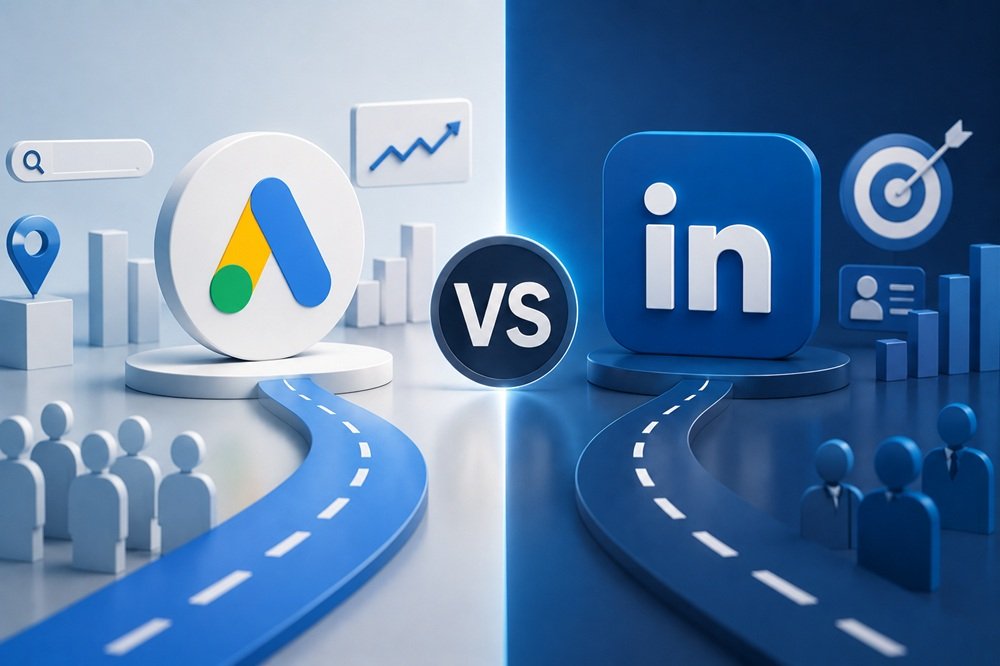
Google Ads and LinkedIn Ads are the two dominant paid channels for B2B, and they work in fundamentally different ways — one captures existing demand, the other targets specific professionals. Choosing between them (or balancing both) is one of the most consequential B2B PPC decisions. This article compares them and explains when each one wins.
Two fundamentally different approaches
Google Ads and LinkedIn Ads differ in the most basic way: how they reach prospects.
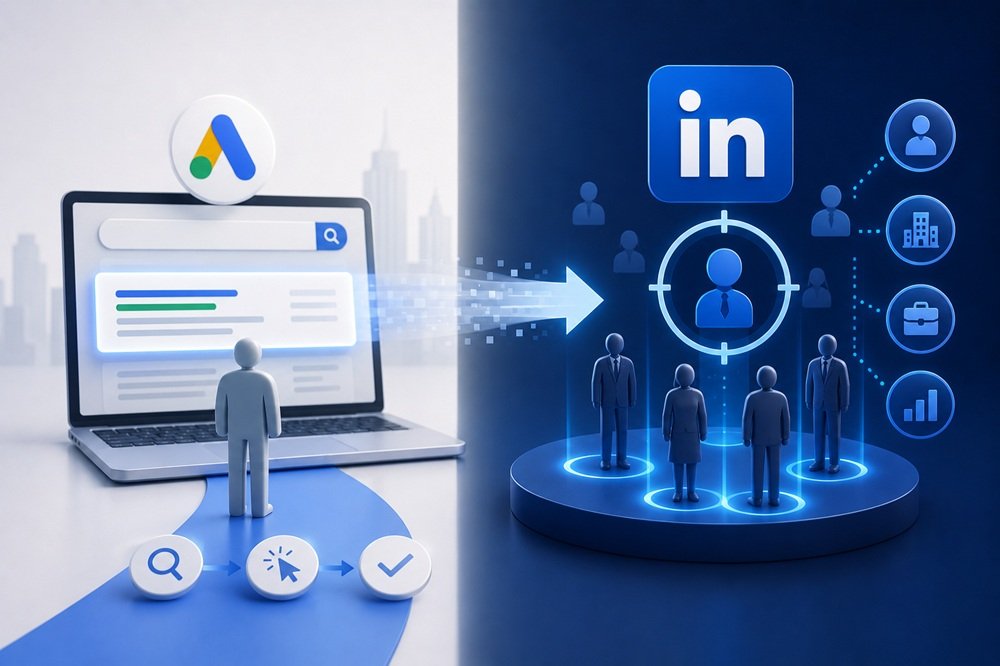 Google Ads (Search) captures existing demand.
 When someone searches for a solution like yours, your ad appears — you’re reaching people actively looking, at the moment of intent. This is demand
capture: the prospect already wants something and you intercept their search. Its strength is high intent (searchers are actively seeking); its limit is that it only reaches people already searching, not those who don’t yet know they need you.
LinkedIn Ads targets specific professionals. Using LinkedIn’s professional data, you target by job title, company, industry, seniority, and other professional attributes — reaching specific people regardless of whether they’re searching. This is demand
generation: you put your message in front of the right professionals to create awareness and interest. Its strength is precise professional targeting (reach exactly the decision-makers you want); its limit is lower intent (you’re reaching people who weren’t looking) and typically higher cost per click.
The core distinction: Google captures people actively searching (high intent, limited to existing demand); LinkedIn targets specific professionals proactively (precise targeting, creates demand, lower intent). They’re not really competitors so much as complementary tools for different jobs — capturing existing demand versus generating new demand among specific targets. The “which wins” question is really “which job do you need done?”
Common questions
What’s the core difference between Google Ads and LinkedIn Ads for B2B?
How they reach prospects. Google Ads (Search) captures existing demand — your ad appears when someone searches for a solution like yours, reaching active seekers at the moment of intent. LinkedIn Ads targets specific professionals by job title, company, and industry regardless of whether they’re searching — reaching the right people proactively to create awareness. Google intercepts existing intent; LinkedIn generates interest among precisely targeted professionals. One captures demand that exists; the other creates demand among specific targets. This difference drives when each wins.
When does Google Ads win for B2B?
When there’s existing search demand for your solution and you want to capture high-intent prospects actively looking. If people search for what you offer — a recognized category, a problem with a known solution type — Google Ads intercepts them at the moment of intent, producing high-intent leads. Google wins when demand exists and you want to capture it efficiently. It’s less effective when no one is searching for your solution yet (a new category, an unrecognized problem) — you can’t capture search demand that doesn’t exist.
When does LinkedIn Ads win for B2B?
When you need precise professional targeting and demand generation — reaching specific decision-makers who may not be searching. LinkedIn wins when your ideal customers are definable by professional attributes (specific titles, companies, industries) and you want to create awareness and interest proactively, especially for solutions people don’t search for yet or for account-based approaches targeting specific companies. Its precise targeting reaches exactly the right professionals regardless of search behavior. LinkedIn’s strength is putting your message in front of defined targets; it wins when targeting precision and demand creation matter more than capturing existing search intent.
Which produces higher-intent leads?
Google Ads, generally — because searchers are actively looking for a solution, while LinkedIn targets professionals who weren’t necessarily seeking anything. A Google searcher demonstrates intent through their search; a LinkedIn ad reaches someone in their feed who may have no current intent. So Google leads tend to be higher-intent and closer to ready, while LinkedIn leads are often earlier-stage, requiring more nurturing. This intent difference is a key tradeoff: Google for high-intent demand capture, LinkedIn for precise targeting of professionals who need awareness and nurturing.
Which is more expensive?
LinkedIn typically has higher cost per click than Google for B2B, reflecting its precise professional targeting and the value of reaching specific decision-makers. However, cost per click isn’t the full picture — the right comparison is cost per qualified lead or per customer (CAC), where the answer depends on intent and conversion. Google’s higher-intent traffic may convert better per click; LinkedIn’s precisely-targeted but lower-intent traffic may need more nurturing. Compare on cost per qualified outcome for your situation, not just CPC — the cheaper-per-click channel isn’t necessarily cheaper per customer.
Should I use both?
Often, yes — they’re complementary, doing different jobs. A common B2B approach uses Google Ads to capture existing search demand (high-intent prospects actively looking) and LinkedIn Ads to generate demand and target specific accounts/professionals proactively (awareness among defined targets). Together they cover both capturing demand that exists and creating demand among the right professionals. Many strong B2B programs run both, balanced by goals and budget. They’re not an either/or so much as two tools for different parts of demand generation — using both covers more of the funnel than either alone.
How do I decide where to start if I can only do one?
Start with Google Ads if there’s existing search demand for your solution — capturing high-intent active seekers is usually the more efficient starting point when demand exists. Start with LinkedIn if your solution is in a new or unsearched category, or if precise account/professional targeting is central to your strategy and there’s little search demand to capture. The deciding question is whether people are already searching for what you offer (start with Google) or whether you need to create awareness among specific targets who aren’t searching (start with LinkedIn).
How this applies to your business
Choose based on whether you’re capturing existing demand or generating new demand among specific targets. If people search for your solution, Google Ads captures that high-intent demand efficiently. If you need to reach specific professionals who may not be searching — for awareness, for new categories, for account-based targeting — LinkedIn’s precise professional targeting wins. The channels do different jobs, so the choice follows from which job you need done: intercepting active searchers (Google) or proactively reaching defined targets (LinkedIn).
Compare on cost per qualified outcome, not cost per click. LinkedIn’s higher CPC doesn’t necessarily mean higher cost per customer — Google’s higher-intent traffic may convert better while LinkedIn’s precisely-targeted traffic needs more nurturing. The meaningful comparison is cost per qualified lead or CAC for your situation, accounting for the intent and conversion differences. Judging the channels by CPC alone misleads; judging by the cost of the qualified outcomes they produce reveals which is actually more efficient for your goals.
Consider using both, since they’re complementary rather than competing. Google captures existing search demand; LinkedIn generates demand among precisely-targeted professionals. Together they cover both intercepting active intent and creating awareness among the right targets — more of the demand-generation picture than either alone. If budget allows, balancing both (weighted by your goals) typically outperforms relying on one. If you must choose one, start with whichever matches your situation: Google where demand exists to capture, LinkedIn where you need to create it among specific targets.
Iscope Digital’s
PPC Management service runs and balances both Google Ads and LinkedIn Ads based on your demand landscape and goals. For comparing LinkedIn’s specific ad formats, see
LinkedIn Sponsored Content vs Message Ads vs Lead Gen Forms compared, and for the metrics to judge each channel by,
CAC vs CPC vs CPL.