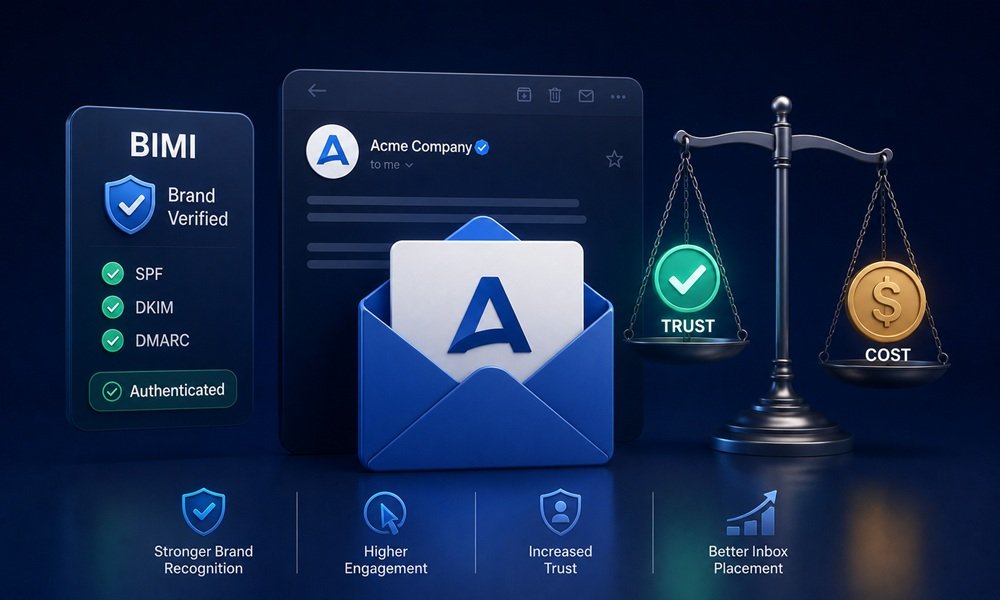
BIMI promises something marketers have long wanted: your brand logo displayed next to your emails in the inbox. But achieving it requires authentication work and, often, a paid certificate that costs real money annually. Is it worth it? This article explains what BIMI is, what it requires, and how to decide whether the investment makes sense for your business.
What BIMI is and what it requires
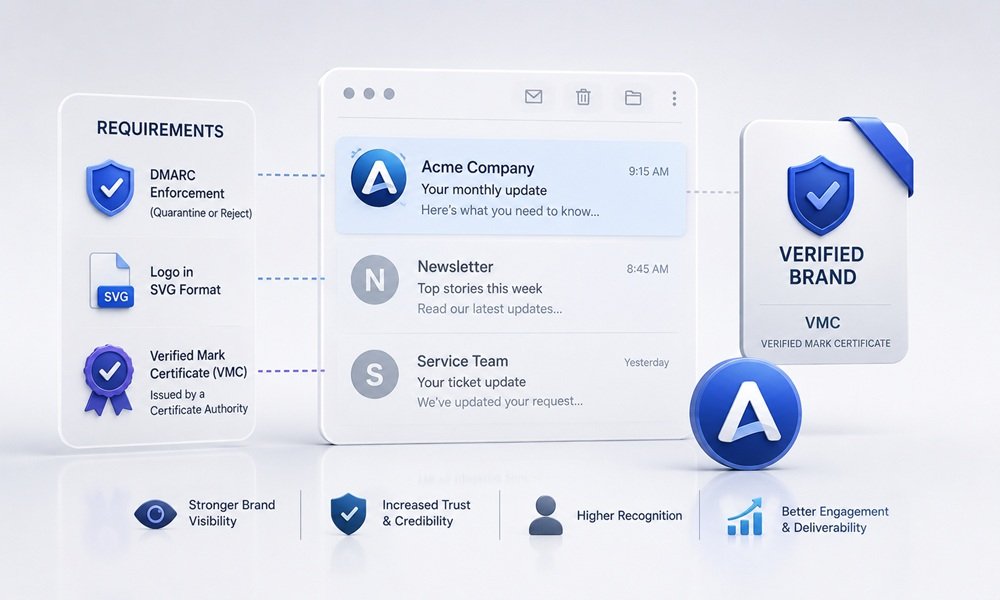
BIMI (Brand Indicators for Message Identification) is a standard that allows your verified brand logo to display alongside your emails in supporting inboxes — a visible brand mark in the inbox list, next to the sender name. It’s both a branding benefit (visibility and recognition) and a trust signal (a verified logo indicates an authenticated, legitimate sender).
BIMI has prerequisites that make it more than just uploading a logo. First, you need strong email authentication in place — specifically DMARC at an enforcement policy (quarantine or reject), not just monitoring. BIMI builds on authentication; you can’t have it without the authentication foundation. Second, your logo must be in a specific format (SVG, with particular specifications). Third — and this is the cost question — many implementations require a
Verified Mark Certificate (VMC), a paid certificate that verifies you own the trademark to your logo, issued by certificate authorities for an annual fee.
So the BIMI investment has two parts: the authentication work (achieving DMARC enforcement, which you should arguably do anyway for deliverability) and the VMC cost (an annual fee for the certificate that many inbox providers require to display your logo). The authentication work has standalone value; the VMC is the specific cost that prompts the “is it worth it” question.
The benefit is brand visibility and trust in the inbox. The question is whether that benefit justifies the VMC’s annual cost plus the authentication effort, for your specific business.
Common questions
What does BIMI actually do?
BIMI displays your verified brand logo next to your emails in supporting inboxes — a visible brand mark in the inbox list alongside your sender name. This provides brand visibility (recipients see your logo, aiding recognition) and a trust signal (a verified logo indicates an authenticated, legitimate sender, helping distinguish your genuine mail from spoofs). It’s a relatively small visual element, but in a crowded inbox, brand recognition and a trust indicator can support open rates and brand perception. The effect is incremental brand presence and trust, not a transformation.
What do I need to implement BIMI?
Three things: strong email authentication with DMARC at an enforcement policy (quarantine or reject, not just monitoring), your logo in the required SVG format, and — for many implementations — a Verified Mark Certificate (VMC) proving you own the trademark to your logo. The DMARC enforcement requirement means BIMI builds on a solid authentication foundation; you can’t shortcut it. The VMC is the paid component, an annual certificate from a certificate authority. Together these prerequisites make BIMI a real implementation effort, not just a logo upload.
How much does a VMC cost?
A Verified Mark Certificate is an annual cost in the range of roughly a thousand-plus dollars per year, varying by provider — a recurring fee, not one-time. The certificate verifies you own the trademark to your logo, which also means you typically need a registered trademark for your logo to obtain one, adding potential cost and time if you don’t already have trademark registration. The VMC fee plus any trademark prerequisite is the core financial investment in BIMI, and it’s what the “is it worth it” question centers on.
Is BIMI worth the cost?
It depends on your brand’s email volume, recognition value, and goals. For high-volume senders with strong brand recognition where inbox presence and trust meaningfully affect engagement and brand perception, the VMC’s annual cost can be justified by the branding and trust benefits at scale. For low-volume senders or those where inbox logo display offers little marginal value, the cost may not justify the modest benefit. The authentication work is worth doing regardless (for deliverability); the VMC specifically is worth it when brand visibility at your email scale justifies the annual fee.
Do I need a VMC, or can I do BIMI without one?
It depends on the inbox providers you care about. Some BIMI implementations and providers require a VMC to display your logo; the requirements have evolved and vary by mailbox provider. Where a VMC is required, you need it to get the logo displayed in those inboxes. Check which providers your audience uses and what each requires — if the providers your recipients use require a VMC, you’ll need one for the benefit; if not, you may achieve some BIMI benefit with authentication alone. Requirements differ, so verify for your audience’s providers.
Does BIMI improve deliverability?
Not directly, but its prerequisites do. BIMI itself is a display feature, not a deliverability mechanism. However, achieving BIMI requires DMARC at enforcement, which
does improve deliverability and protect against spoofing — so pursuing BIMI drives you to implement authentication that benefits deliverability. In that sense, the path to BIMI has deliverability value even though BIMI’s logo display doesn’t directly affect inbox placement. The authentication you do for BIMI helps deliverability; the logo itself is a branding and trust feature, not a deliverability tool.
Should I implement the authentication even if I skip the VMC?
Yes, almost certainly. The DMARC enforcement that BIMI requires is valuable for deliverability and domain protection regardless of whether you pursue the logo display — it improves inbox placement and prevents spoofing of your domain. So even if you decide the VMC cost isn’t worth it for your business, achieving DMARC enforcement is worthwhile on its own merits. Decouple the decisions: do the authentication work for its deliverability and security benefits; decide separately whether the VMC’s branding benefit justifies its annual cost.
How this applies to your business
Decide on BIMI based on your email scale and brand-recognition value, separating the authentication work from the VMC cost. The DMARC enforcement BIMI requires is worth doing regardless for its deliverability and anti-spoofing benefits. The VMC specifically — the annual certificate cost — is worth it when your email volume and brand recognition make inbox logo display valuable enough to justify the recurring fee. High-volume, recognized brands often find it worthwhile; low-volume senders often don’t.
Do the authentication work regardless of your VMC decision. Achieving DMARC at an enforcement policy improves deliverability and protects your domain from spoofing — benefits worth having on their own, independent of the BIMI logo. Even if you conclude the VMC cost isn’t justified, pursuing the authentication foundation pays off in better inbox placement and domain security. Treat the authentication as a deliverability investment and the VMC as a separate branding decision.
Check your audience’s mailbox providers and their specific requirements before committing. BIMI support and VMC requirements vary by provider, so the benefit you’ll actually get depends on which inboxes your recipients use. Verify whether the providers your audience uses display BIMI logos and whether they require a VMC — this tells you what the investment will actually buy for your specific audience, preventing paying for a benefit your recipients’ inboxes won’t show.
Iscope Digital’s
Email Marketing service implements the full authentication stack including BIMI where it’s worth it for the client’s brand and scale. For the authentication foundation BIMI requires, see
SPF, DKIM, DMARC explained for marketers, and for the deliverability those protocols support,
What is email deliverability?