For two decades, the open rate was email marketing’s headline metric — the number reported to executives, used to judge campaigns, and optimized above all else. In 2026, it’s effectively dead as a reliable measure. This article explains why the open rate lost its meaning, and lays out the metrics that actually matter for judging email performance now.
Why the open rate died
The open rate’s decline has two main causes that together rendered it unreliable.
Privacy changes broke the measurement. Apple Mail Privacy Protection and similar features pre-load tracking pixels regardless of whether recipients actually open emails, registering “opens” that never happened. With a large share of recipients affected, the open rate became inflated and disconnected from genuine behavior — the number no longer reflects real opening.
The metric was always shallow. Even before privacy changes, an open was a weak signal — it indicated an email was opened, not that it was read, valued, or acted upon. Opens never directly connected to business outcomes; they were a proxy for engagement that was easy to measure but never meant much on their own. Privacy changes simply exposed and worsened a metric that was always more convenient than meaningful.
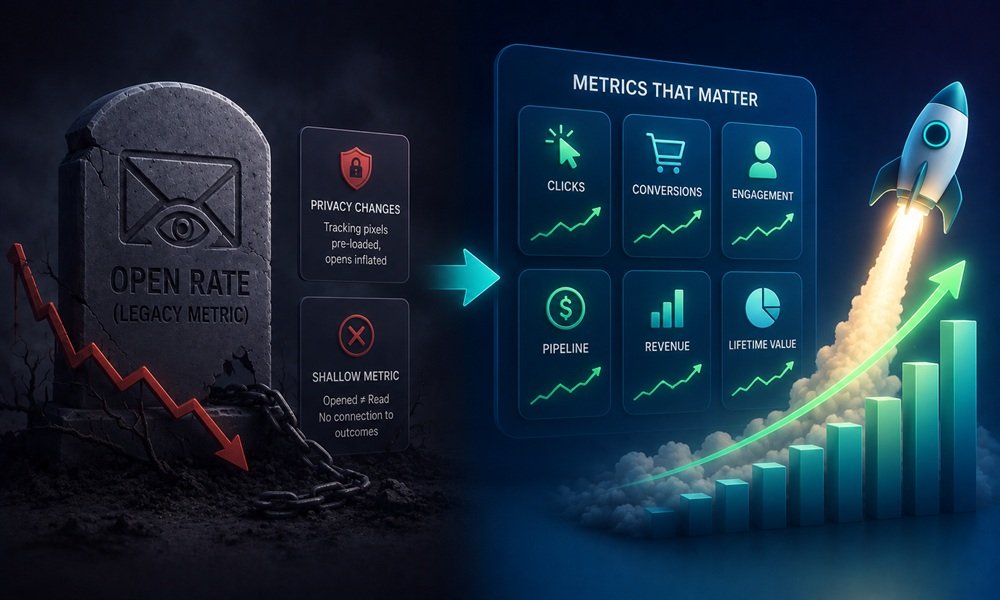
The result is that judging email performance by open rate in 2026 is judging by a number that’s both unreliable (inflated by privacy features) and shallow (never connected to outcomes). The metrics that matter now are the ones that reflect genuine recipient action and connect to business results — clicks, conversions, and the downstream pipeline and revenue email actually produces.
This isn’t a loss so much as a forced upgrade: the death of the open rate pushes email measurement toward metrics that were always more meaningful but easier to ignore when the open rate offered a convenient headline.
Common questions
Is the open rate completely useless now?
Not completely, but unreliable enough that it shouldn’t be a primary metric. Privacy changes inflate it and disconnect it from genuine opening behavior for a large share of recipients, so you can’t trust it to reflect real engagement. Some directional value may remain in aggregate trends over time, but for judging campaign performance or making decisions, relying on open rate leads to wrong conclusions. Treat it as a deprecated, low-trust metric — note it if you must, but don’t base decisions on it.
What metrics should replace the open rate?
Metrics reflecting genuine action and connecting to outcomes: click-through rate and clicks (deliberate actions privacy features don’t fake), conversion rate (the actions that matter — sign-ups, purchases, replies, demos booked), and downstream metrics (website engagement, pipeline contribution, revenue attributed to email). These require real recipient behavior and connect to business results, unlike opens. Reorienting around clicks and conversions gives you reliable, meaningful measurement. The further down the funnel toward actual outcomes you measure, the more meaningful the metric.
Why are clicks more reliable than opens?
Because a click requires deliberate recipient action that privacy features don’t fabricate. Where MPP pre-loads tracking pixels and registers fake opens, it doesn’t fake clicks — a click means someone actually clicked a link, a genuine action. Clicks therefore remain a trustworthy engagement signal in the post-privacy environment. They’re also closer to business outcomes than opens (a click indicates real interest and moves toward conversion), making them both more reliable and more meaningful than the open rate they’re replacing as a primary metric.
How do I measure conversions from email?
Track the actions that matter for your business that email drives — sign-ups, purchases, demo bookings, replies, content downloads, pipeline created — by connecting email engagement to downstream outcomes through your analytics and CRM. This means setting up proper attribution (UTM tracking, CRM integration) so you can see which email activity led to which conversions. Conversion measurement is more work than reading an open rate, but it measures what actually matters — the business results email produces — rather than a shallow, unreliable proxy. The effort buys meaningful measurement.
What about deliverability metrics?
They remain essential, perhaps more so. Inbox placement (whether email reaches inboxes), bounce rate, and complaint rate are reliable, foundational metrics that aren’t affected by the privacy changes that broke open rate. In fact, as open rate becomes unreliable for gauging engagement, deliverability metrics become relatively more important for understanding whether your email is reaching people at all. Monitor inbox placement, bounces, and complaints closely — they tell you about the foundation (is email arriving?) that engagement metrics build on.
How do I report email performance to executives now?
Lead with outcomes, not opens. Report clicks and especially conversions and pipeline contribution — the metrics connecting email to business results executives care about — rather than open rates that are both unreliable and disconnected from outcomes. This actually improves executive reporting: instead of explaining a shallow proxy metric, you report email’s actual contribution to leads, pipeline, and revenue. The death of the open rate is an opportunity to elevate email reporting from vanity metrics to business impact, which serves both email’s credibility and better decision-making.
Does this change how I optimize email?
Yes — optimize toward clicks and conversions rather than opens. Instead of optimizing subject lines purely for open rate (an unreliable target), optimize the whole email for driving clicks and conversions: relevant content, clear calls to action, strong offers, good segmentation. This shifts focus from getting the email opened (which you can’t reliably measure anyway) to getting recipients to act (which you can measure and which matters). Optimizing for genuine action produces better business results than optimizing for a shallow, unreliable open metric.
How this applies to your business
Retire the open rate as a primary metric and rebuild your email measurement around clicks, conversions, and pipeline. The open rate is now both unreliable (inflated by privacy features) and shallow (never connected to outcomes), so judging email by it leads to wrong conclusions. Reorienting around metrics that reflect genuine action and business results gives you trustworthy, meaningful measurement — and the transition is a forced upgrade to metrics that were always more meaningful than the convenient open rate.
Treat the shift as an opportunity to elevate email reporting. Reporting clicks, conversions, and pipeline contribution rather than open rates connects email to the business outcomes executives care about, improving email’s credibility and enabling better decisions. Instead of defending a vanity metric, you demonstrate email’s actual contribution to leads and revenue. The death of the open rate, handled well, makes email’s value clearer to the organization rather than obscuring it behind a shallow proxy.
Optimize toward genuine action, not opens. Shift your optimization from subject-lines-for-opens toward whole-email optimization for clicks and conversions — relevance, clear calls to action, strong offers, good segmentation. This focuses effort on getting recipients to act (measurable and meaningful) rather than getting emails opened (unmeasurable and shallow post-privacy). Optimizing for the actions that connect to business results produces better outcomes than chasing an unreliable open metric.
Iscope Digital’s
Email Marketing service measures and optimizes email programs on clicks, conversions, and pipeline contribution rather than open rates. For the privacy change that broke open tracking, see
Apple Mail Privacy Protection, and for the deliverability metrics that remain essential,
What is email deliverability?