HIPAA looms over anything involving healthcare data, and marketers often assume it blocks healthcare marketing entirely. It doesn’t — but it draws important lines around what data can be used and how. Understanding where those lines fall is essential for anyone marketing to or within healthcare. This article explains, in general educational terms, how HIPAA relates to B2B healthcare marketing. It is not legal advice.
What HIPAA does and doesn’t cover
HIPAA — the Health Insurance Portability and Accountability Act — protects the privacy and security of
protected health information (PHI): individually identifiable health information held or transmitted by covered entities (healthcare providers, health plans, healthcare clearinghouses) and their business associates.
The crucial distinction for marketers is what HIPAA covers versus what it doesn’t. HIPAA governs
PHI — patient health information. It does
not govern ordinary business contact information about healthcare professionals in their professional capacity. Marketing to a physician as a business contact — reaching Dr. Smith, a cardiologist, at her practice about a medical device or service — generally involves professional business data, not patient PHI, and is therefore generally outside HIPAA’s core scope.
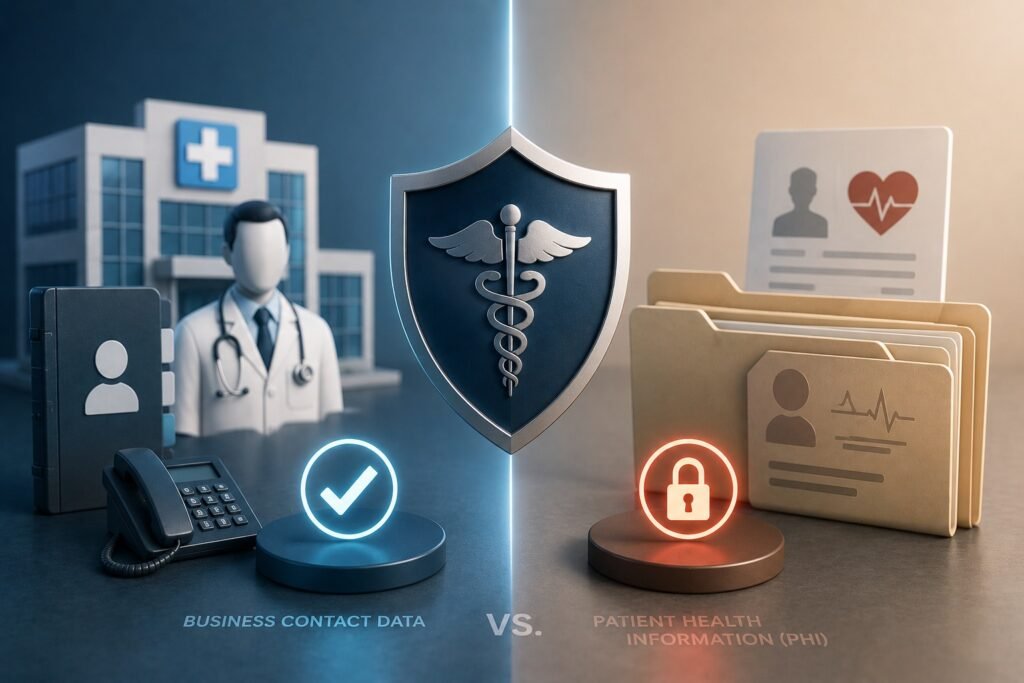
Where HIPAA becomes central is when marketing involves
patient information. Using PHI for marketing — targeting patients based on their health conditions, treatments, or other protected information — is tightly restricted and generally requires patient authorization, with limited exceptions. This is the line: marketing to healthcare
professionals as business contacts is different from marketing that uses
patient health information.
So B2B healthcare marketing — reaching providers, practices, and healthcare organizations as business entities — generally operates outside HIPAA’s patient-data restrictions, while any marketing touching actual patient PHI enters HIPAA’s tightly regulated zone. This distinction is fundamental, though the specifics require legal guidance.
Common questions
Does HIPAA apply to B2B healthcare marketing?
HIPAA does not automatically apply to every company that markets to the healthcare industry. The HIPAA Privacy Rule applies to covered entities and business associates, and its restrictions primarily concern protected health information (PHI). A B2B vendor marketing software or services to hospitals, clinics, or health systems may therefore have HIPAA obligations in some circumstances but not simply because its audience is healthcare organizations.
What is PHI under HIPAA?
Protected health information is individually identifiable health information held or transmitted by a covered entity or business associate, subject to HIPAA’s definitions and exclusions. Examples can include information about a person’s health condition, treatment, or healthcare services when associated with identifying information. B2B marketers should distinguish ordinary professional information—such as a work email and job title—from patient information. The latter can create significantly different compliance obligations when it constitutes PHI.
Can healthcare companies use patient information for marketing?
HIPAA generally requires an individual’s authorization before a covered entity uses or discloses PHI for marketing, subject to limited exceptions. HHS defines marketing broadly as communications about a product or service that encourage recipients to purchase or use it. Importantly, covered entities generally cannot sell patient or enrollee lists to third parties for the third party’s own marketing purposes without the required authorization.
Can a B2B healthcare vendor buy a hospital’s patient list for marketing?
Generally, this is a major compliance red flag. HHS states that covered entities may not sell patient or enrollee lists to third parties for the third party’s own marketing purposes without authorization from the individuals involved. A healthcare vendor should not assume that a commercial relationship with a hospital gives it permission to use the hospital’s patient information for its own advertising or lead generation.
Can healthcare organizations market their own products and services to patients?
Certain communications about a covered entity’s own health-related products or services are excluded from HIPAA’s definition of marketing. HHS gives examples such as a provider describing its own health-related services to patients or a health plan describing products included in its own benefits. These exceptions are specific, however, and do not mean that a healthcare organization can freely use PHI to promote unrelated third-party products.
Can a B2B marketer use a healthcare professional’s business email?
A professional email address belonging to a healthcare worker is not automatically PHI simply because the person works in healthcare. However, the marketer still needs to consider other applicable privacy and marketing laws, the source and permitted use of the contact information, and whether any health information is being processed. HIPAA and general email-marketing compliance are separate questions. A B2B marketer should not assume that HIPAA compliance alone makes an email campaign lawful.
When does a B2B healthcare vendor become a HIPAA business associate?
A company can become a business associate when it performs certain functions or provides services for a covered entity that involve creating, receiving, maintaining, or transmitting PHI on the covered entity’s behalf. In those circumstances, HIPAA generally requires a written business associate agreement containing appropriate assurances about PHI protection. HHS also notes that business associates have direct obligations under portions of the HIPAA Rules.
What should B2B healthcare marketers avoid when using healthcare data?
Avoid treating patient information as an ordinary marketing database. In particular, marketers should be cautious about purchasing patient lists, using PHI for independent marketing, combining patient information with advertising audiences, or assuming that a healthcare organization’s customer data can be reused for a vendor’s own campaigns. HHS specifically states that covered entities cannot provide PHI to third parties for the third party’s independent business purposes without the required authorization.
What should healthcare B2B marketers do before launching a campaign?
First determine whether the campaign involves PHI, whether the organization is a covered entity or business associate, and whether the intended use is marketing under HIPAA. Then review the data source, contractual permissions, applicable privacy and marketing laws, suppression requirements, and any business associate agreement that may be required. For campaigns involving patient information or other sensitive healthcare data, legal and privacy review should occur before launch. HIPAA compliance is highly fact-specific, so these FAQs should be treated as general guidance rather than legal advice.
How this applies to your business
Understand the core distinction: B2B healthcare marketing to providers as business contacts generally operates outside HIPAA’s patient-data restrictions, while any marketing using patient PHI enters HIPAA’s tightly regulated zone. This line determines your compliance posture. If you’re reaching physicians and healthcare organizations as business entities about relevant products and services, you’re generally working with professional data; if your targeting relies on patient health information, you’re in restricted territory.
Don’t mistake “outside HIPAA” for “no compliance needed.” Healthcare marketing intersects with many rules beyond HIPAA — pharmaceutical and device marketing regulations, the privacy laws governing the contact data itself, and state requirements. Provider marketing that’s outside HIPAA’s patient-data scope still needs review for these other applicable rules. Treat HIPAA as one part of a broader healthcare-marketing compliance picture, not the only consideration.
Work with legal counsel to confirm where your activities fall, especially if anything touches patient information. The determinations of what constitutes PHI and whether HIPAA applies are technical legal questions with serious consequences. This article is general educational information, not legal advice; consult an attorney familiar with HIPAA and healthcare-marketing regulation for your specific situation, particularly before any activity that might involve patient data.
Iscope Digital’s
Specialty Lists & Data Cards service provides professional healthcare-provider data — including NPI-verified physician data — for B2B healthcare marketing within applicable rules. For the NPI verification that anchors provider data, see
NPI-verified physician lists: what NPI verification really means, and on healthcare data sourcing quality generally,
Where does B2B contact data come from?