B2B data pricing is notoriously opaque. Providers rarely publish rates, pricing varies by an order of magnitude depending on the model, and the same list can cost wildly different amounts depending on how you buy it. This article explains the pricing models, realistic 2026 ranges, and what actually drives the cost — so you can budget accurately and avoid overpaying.
How B2B data is priced
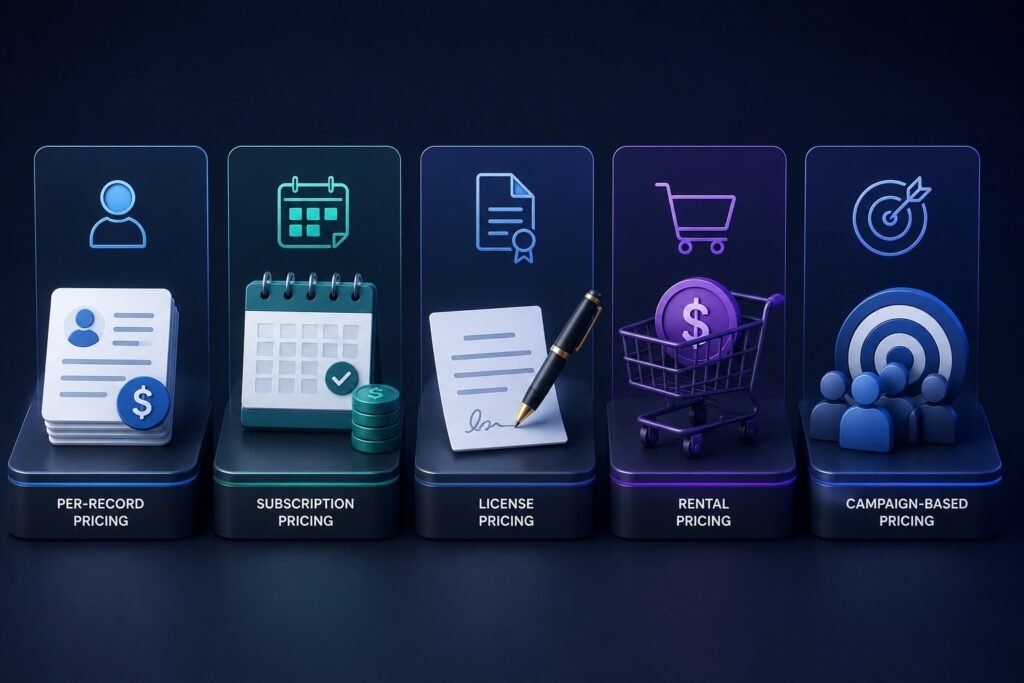
B2B contact data is sold under several distinct pricing models, and understanding which you’re being quoted is essential to comparing offers.
Per-record pricing charges a fixed amount per contact record, typically with volume tiers (the price per record drops as volume rises). This is the most common model for one-time list purchases. Ranges vary widely based on data quality and specificity.
Subscription pricing charges a recurring fee for ongoing access to a database, often with credits or record limits per period. This suits teams that need continuous access and benefit from refresh. Annual subscriptions to B2B data platforms range from a few thousand to tens of thousands of dollars depending on volume and features.
License pricing charges for the right to use a dataset for a defined period and purpose, often for larger volumes. The buyer licenses the data rather than buying records outright.
Rental pricing charges for one-time campaign use without transferring ownership of the records — common for specialty and consumer lists, less so for standard B2B.
The model matters as much as the number. A “cheap” per-record price can cost more than a subscription if you buy repeatedly; a subscription is wasteful if you only need data once.
Common questions
How much does B2B contact data cost in 2026?
B2B contact data can range from
a few cents per record for basic bulk data to several dollars per contact for premium, verified, or enriched records. Current 2026 pricing research puts bulk B2B contact records broadly around
$0.10–$2.00 each, while platform-based pricing can be considerably higher once subscriptions, seats, credits, and additional features are included.
What does a typical B2B contact database subscription cost?
Entry-level platforms can cost roughly
$50–$200 per user per month, while enterprise platforms can run into the
tens of thousands of dollars per year. For example, Apollo publicly lists plans beginning around $49 per user/month on annual billing, while UpLead lists its Essentials plan at $74/month annually or $99/month monthly.
How much does one B2B contact record cost?
There is no universal per-contact price because vendors use different credit systems. Current 2026 market comparisons put bulk contact data at roughly
$0.10–$2 per record, while premium providers and fully enriched records can cost more. A contact containing only an email is usually cheaper than one containing a verified email, direct phone, firmographics, technographics, and additional intelligence.
Why do B2B data vendors use credits instead of a simple price per contact?
Credits allow vendors to charge differently for different types of information. For example, one credit might unlock an email while additional credits are required for a verified phone number or enrichment. Apollo’s current model illustrates this: email access can consume a credit, while certain people-enrichment requests involving mobile numbers can consume substantially more.
Is a cheap B2B contact list always better value?
No. The effective cost depends on how many records are actually usable. A $0.20 contact that has an outdated email, incorrect employer, or irrelevant job title may be more expensive in practice than a $1 verified contact. Buyers should calculate
cost per usable record, taking into account duplicates, invalid contacts, missing fields, and verification requirements.
How much more does premium B2B data cost?
Premium data can command a substantial premium when it includes verified direct dials, mobile numbers, intent signals, technographics, enrichment, international coverage, or specialized industry information. Enterprise platforms can also charge substantial annual subscription fees. For example, current market estimates place ZoomInfo’s larger plans around
$15,000–$40,000+ annually, although actual pricing is quote-based and can vary by users, credits, and add-ons.
What is the difference between buying a contact list and subscribing to a B2B data platform?
A purchased list is usually a defined dataset delivered for a particular purpose, while a platform subscription gives users ongoing access to search, filtering, enrichment, exports, and sometimes sales-engagement functionality. A list can be more economical for a one-time campaign, while a platform may provide better value for teams that prospect continuously. The right choice depends on usage volume and how frequently the data needs to be refreshed.
What hidden costs should you consider when buying B2B contact data?
Look beyond the advertised subscription or record price. Potential additional costs include
extra credits, additional seats, API access, enrichment, phone data, intent data, international coverage, integrations, verification, data cleaning, implementation, and contract commitments. Some platforms also charge differently depending on whether data is viewed, exported, enriched, or synchronized with a CRM.
How should you compare B2B contact data prices in 2026?
Calculate the
effective cost per usable, qualified contact rather than comparing headline subscription prices. For example:
Effective Cost per Usable Contact = Total Data Cost ÷ Valid, Relevant, Usable Contacts
Then compare vendors based on the fields that actually matter to your campaign—such as email accuracy, direct-dial coverage, job-title accuracy, company matching, geographic coverage, and freshness. A larger database is not necessarily cheaper or better if a significant portion of its records cannot be used.
How this applies to your business
Start by defining your actual need precisely — how many records, what specification, one-time or ongoing — because the right pricing model depends entirely on usage. A team running one campaign and a team prospecting continuously should buy data completely differently, and a provider quoting without understanding your usage pattern can’t give you the right structure.
Always verify quality before optimizing for price. The cheapest quote is meaningless if the data is scraped or stale. Establish quality first (sample, sourcing questions, accuracy verification), then compare prices among providers that clear the quality bar. Price-shopping among bad providers just finds the cheapest bad data.
Finally, budget for the full lifecycle. Data acquisition is the first cost, not the only one — refresh, hygiene, and integration follow. A provider whose price includes ongoing refresh may cost more upfront but less over a year than a cheaper one-time list that’s 30% wrong within months.
Iscope Digital’s
B2B Email & Postal Data service offers both one-time per-record purchases (from 1,000 records) and weekly-refreshed subscriptions (from 5,000 records) drawn from the
Bizline Direct database, with transparent count-and-quote pricing and samples before purchase. For evaluating whether cheap data is worth it, see
Where does B2B contact data come from? and on buying models,
full-record vs enriched vs basic B2B contacts.