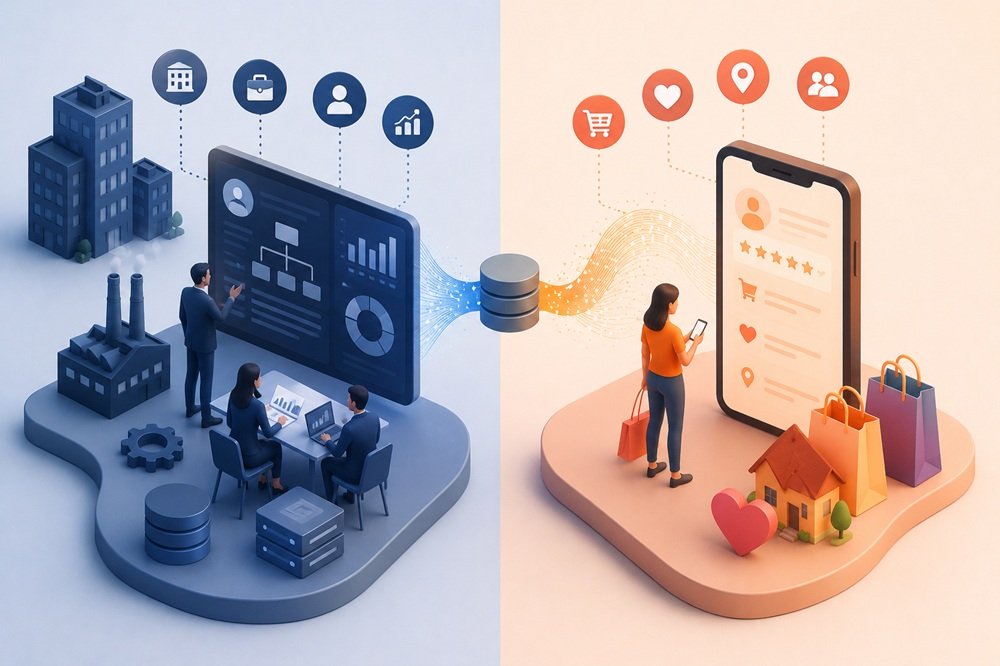
Marketing data falls into two broad camps — business-to-business (B2B) and business-to-consumer (B2C) — and the distinction shapes everything from how the data is sourced to which laws govern its use. Treating them interchangeably is a common and expensive mistake. This article defines B2B data, contrasts it with B2C data, and explains why the difference matters for targeting, compliance, and campaign design.
What B2B data actually is
B2B data is structured contact information about individuals in their professional capacity — the people who make or influence purchasing decisions at businesses. A B2B contact record identifies a person by their role within an organization and includes the firmographic context of that organization.
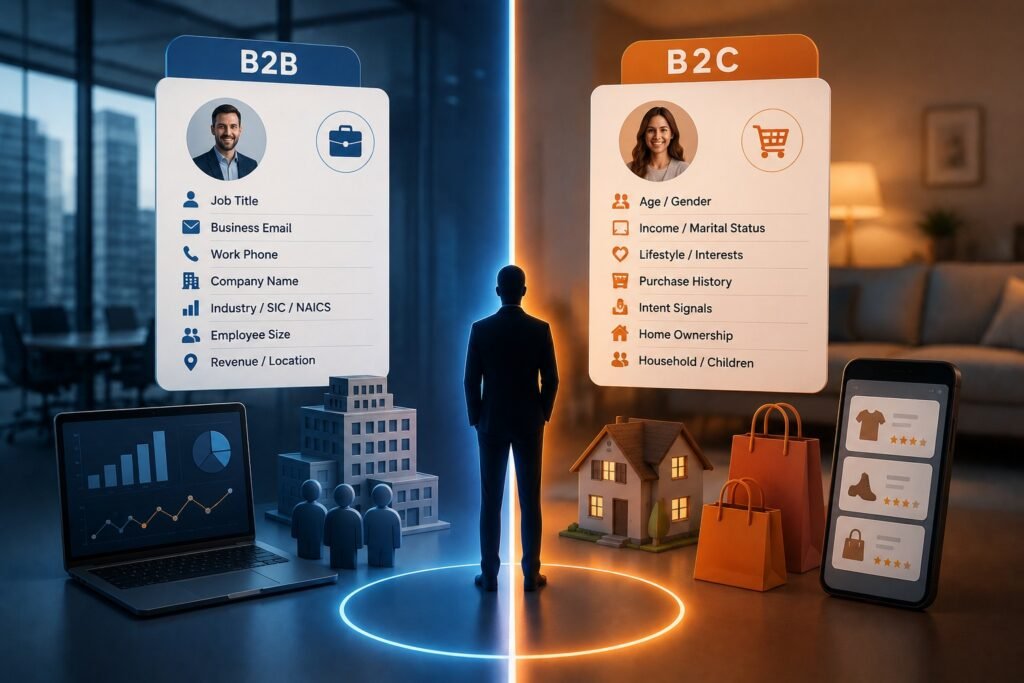
A typical full B2B record contains personal fields (name, job title, business email, work phone), and company fields (company name, industry codes like SIC and NAICS, employee size, revenue band, location). The defining characteristic is that the person matters
because of their role — you’re reaching a “VP of Operations at a 500-person manufacturer,” not “a 45-year-old homeowner in Tampa.”
B2C data, by contrast, is information about individuals as private consumers. A B2C record centers on demographics (age, gender, household income, marital status), lifestyle and behavior (purchase history, interests, intent signals), and household context (home ownership, presence of children). The person matters because of who they are personally and what they buy.
The two data types are sourced differently, priced differently, governed by different laws, and used for fundamentally different campaigns. A B2B list targets a buying committee inside a company; a B2C list targets households or individuals making personal purchases.
Common questions
What is B2B data?
B2B data is information about businesses and the professionals who work for them. It can include company details such as industry, employee count, revenue, location, website, and technology usage, as well as professional contact information such as names, job titles, departments, seniority, business email addresses, and phone numbers. Businesses use B2B data for sales prospecting, marketing, account-based marketing, recruiting, market research, and CRM enrichment.
What is B2C data?
B2C data is information about individual consumers rather than businesses. It can include characteristics such as age, location, purchasing behavior, interests, household information, and consumer preferences. B2C data is generally used to understand and target individual customers, while B2B data is used to understand organizations and the professionals involved in business decisions.
What is the main difference between B2B and B2C data?
The biggest difference is the entity being targeted.
B2B data focuses on businesses and professional relationships, while B2C data focuses primarily on individual consumers. B2B datasets often need to connect people to their employers and provide organizational information. B2C datasets tend to focus more heavily on individual characteristics, behaviors, households, and consumer preferences.
Why is B2B data more focused on companies and organizations?
B2B purchases are usually made within an organizational context. A company’s industry, size, revenue, location, technology, and business model can determine whether it is a suitable prospect. The individual contact is important, but their relevance is often connected to the organization they work for and their role within its purchasing process. This makes account-level information particularly important in B2B sales and marketing.
What types of information are common in B2B databases?
Common B2B fields include company name, website, industry, NAICS or SIC classification, employee count, revenue range, headquarters, locations, technology usage, contact name, job title, department, seniority, professional email, and business telephone number. Some providers also offer intent signals, organizational structures, funding information, or other specialized attributes.
What types of information are common in B2C databases?
B2C datasets can include consumer demographics, geographic information, purchasing behavior, interests, preferences, household characteristics, and other consumer-related attributes. The specific information depends on the data source and intended use. Because consumer information can be highly personal, businesses need to pay particular attention to applicable privacy and data-protection requirements.
Why does B2B data often include multiple contacts at one company?
A B2B purchase can involve several people, including users, managers, technical evaluators, executives, finance teams, procurement, and other stakeholders. B2B databases therefore often connect multiple contacts to the same company. This allows sales and marketing teams to map buying groups and identify several relevant stakeholders instead of treating one individual as the entire opportunity.
How does B2B data support sales and marketing differently from B2C data?
B2B data helps teams identify target accounts, find relevant decision-makers, segment companies, map buying groups, and prioritize organizations. B2C data is more commonly used to segment and target individual consumers based on characteristics or behaviors. B2B campaigns therefore tend to emphasize account fit and professional roles, while B2C campaigns often emphasize individual consumer attributes and behavior.
Does B2B data include personal information?
It can. A business email address, named professional contact, telephone number, job title, or other information associated with an identifiable individual can constitute personal information or personal data under applicable laws. The fact that someone uses the information in a professional capacity does not automatically remove privacy obligations. Businesses should evaluate the relevant jurisdiction, data source, intended use, and applicable legal requirements before processing B2B contact data.
Which is more valuable: B2B data or B2C data?
Neither is inherently more valuable. Their value depends on the business model and target audience. A company selling enterprise software may need detailed B2B company and contact information, while a consumer brand may benefit more from B2C audience and behavioral data. The right dataset is the one that provides accurate, relevant information for the customers a business is actually trying to reach.
The most common mistake is using consumer data sources for B2B campaigns or vice versa — buying a cheap consumer list to reach business decision-makers, then wondering why deliverability and response rates collapse. The data types aren’t interchangeable; using the wrong one wastes budget and risks compliance exposure.
If your business serves both markets, treat them as two separate data programs with their own sourcing, refresh schedules, and compliance documentation. The discipline of keeping them distinct pays off in cleaner targeting and lower legal risk.
Iscope Digital’s
B2B Email & Postal Data service provides verified B2B contacts from the proprietary
Bizline Direct database, while our
B2C Email & Postal Data service handles consumer audiences with full state-privacy compliance. For more on how fast B2B data degrades, see
How often should B2B databases be refreshed?