Sales development reps spend a surprising share of their day not selling, but researching — hunting for emails, verifying titles, and assembling lists. A B2B database promises to give that time back. But how much can it really replace, and what still needs a human? Here’s an honest look.
What SDRs Actually Spend Time On
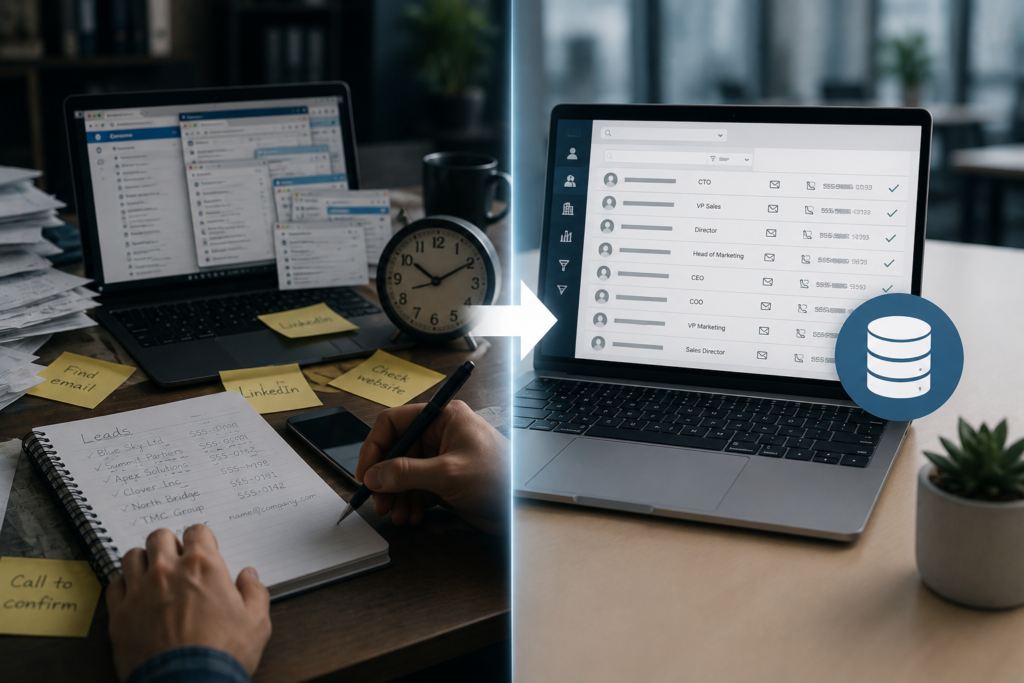
An SDR’s day is a mix of activities: building target lists, finding and verifying contact details, researching accounts for personalization, writing and sending outreach, and following up. A meaningful portion of that — especially list-building and contact-finding — is manual data work rather than actual selling.
Where a Database Saves the Most Time
A database eliminates the slowest, most repetitive research: finding contact details and building lists. What might take hours of manual searching becomes a few minutes of filtering and exporting. This is where the clearest time savings come from, because it removes work that adds no unique value when done by hand.
What a Database Can’t Replace
A database supplies data, not judgment. It can’t decide your strategy, craft a compelling message, build genuine rapport, handle objections, or do the deeper account research that makes outreach feel personal and relevant. The human work of connecting and persuading remains firmly with the rep.
The Realistic Time Savings
The honest framing is that a database removes the mechanical research, not the craft of selling. For teams where reps spend heavily on contact-finding and list-building, the reclaimed time can be substantial. But it shifts time toward selling rather than eliminating the SDR role — the rep does more of what only a person can do.
How to Redeploy Reclaimed Time
The point of saving research time is to reinvest it. Reps can use the recovered hours for more outreach, better personalization, more thoughtful follow-up, and more live conversations. Teams that treat the savings as a chance to raise quality — not just quantity — tend to see the biggest gains.

Key Takeaways
A B2B database can replace much of an SDR’s mechanical research time — the list-building and contact-finding — but not the human work of strategy, messaging, and relationship-building. The real value is shifting reps’ hours from data entry toward the selling activities that actually move pipeline.
Frequently Asked Questions
Can a B2B database replace SDRs entirely?
No. It replaces mechanical research like contact-finding and list-building, but not the human work of strategy, messaging, rapport, and handling objections.
How much time does a database save SDRs?
It varies by team, but the clearest savings come from eliminating manual contact-finding and list-building — often hours that can be redirected toward selling.
What should reps do with the time they save?
Reinvest it in more outreach, stronger personalization, better follow-up, and more live conversations — the activities a database can’t do for them.
Does a database make personalization easier?
It provides useful firmographic and technographic hooks, but the rep still has to turn that data into a relevant, human message. The data assists personalization rather than automating it.
How quickly can SDRs start using a new B2B database?
Most modern databases can be integrated into existing prospecting workflows within days. The speed depends on your CRM setup, sales processes, and how much customization your team requires.
Will a B2B database improve outreach response rates?
A database can improve targeting accuracy and provide richer prospect insights, which may lead to better response rates. However, results still depend heavily on message quality, timing, and sales execution.
How accurate are the contacts in a B2B database?
Accuracy varies by provider. The best databases continuously verify and refresh contact information, but users should still expect some level of data decay as people change jobs, roles, and companies.
What features should I look for when choosing a B2B database?
Key features include data accuracy, coverage of your target market, firmographic and technographic filters, CRM integrations, compliance practices, and regular data updates.
How do I calculate the ROI of a B2B database?
Most teams measure ROI by comparing the cost of the database against time saved on prospect research, increased sales activity, improved pipeline generation, and the revenue attributed to new opportunities sourced through the platform.
Do SDRs become more productive when they stop doing manual research?
In most cases, yes. SDR performance is typically limited by the amount of time available for prospecting and outreach. When a B2B database removes the need to manually search for contacts and company information, reps can focus on activities that directly influence pipeline creation, such as personalized outreach, follow-ups, and discovery conversations. The result is often higher activity levels without increasing headcount.