Landing page optimization can feel like guesswork — there are endless things to change, and most tweaks produce little. But certain categories of change reliably move B2B conversion rates more than others. Knowing which changes have the highest expected impact lets you focus optimization effort where it pays off. This article covers the landing page changes that most often lift B2B conversion.
The highest-impact change categories
While every page and audience differs, certain categories of landing page change tend to produce the largest conversion lifts for B2B.
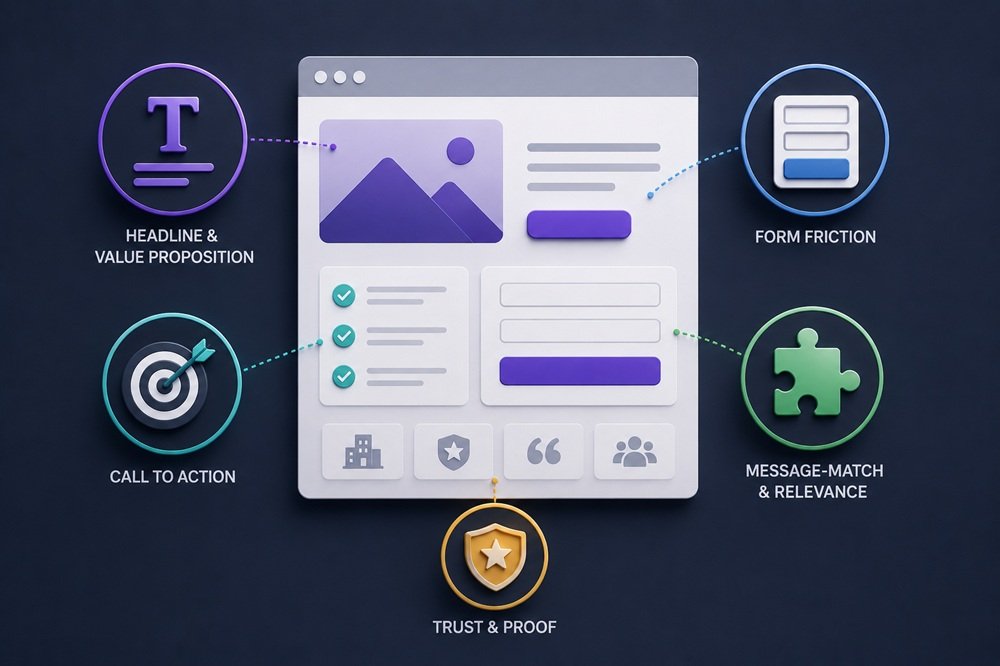 The headline and value proposition.
 The headline is the first thing visitors read and often determines whether they stay. Clarifying what you offer, who it’s for, and why it matters — making the value proposition immediately clear and compelling — is frequently the single highest-impact change. A confusing or generic headline loses visitors before anything else can work.
The call to action (CTA). What you ask visitors to do, how clearly, and how the ask is framed strongly affects conversion. Clear, prominent, well-worded CTAs that match the visitor’s readiness (a low-commitment ask converts better than a high-commitment one for cold traffic) often lift conversion meaningfully.
Form friction. For B2B lead-capture pages, the form is a major conversion lever. Reducing form friction — asking for fewer fields, requesting only what’s necessary — frequently increases conversions, since every additional field costs some completions.
Message-match and relevance. Ensuring the landing page matches what brought the visitor there (the ad, the search, the offer) sustains the intent that got them to the page. Mismatch — a page that doesn’t deliver on the ad’s promise — kills conversion.
Trust and proof. Social proof, credibility signals, and reassurance (testimonials, logos, security indicators) address the hesitation that stops B2B buyers from converting.
Focusing optimization on these categories — clarity, CTA, form friction, message-match, and trust — tends to produce more lift than tweaking minor visual details.
Common questions
What single change most often lifts conversion?
Clarifying the headline and value proposition is frequently the highest-impact single change. The headline is the first thing visitors read and often determines whether they stay or leave, so making it immediately clear what you offer, who it’s for, and why it matters can lift conversion substantially. A confusing or generic headline loses visitors before the rest of the page matters. While impact varies by page, the headline and value proposition are so foundational — they decide whether visitors engage at all — that clarifying them is often where the biggest gains come from.
How much does form length affect B2B conversion?
Significantly — for lead-capture pages, the form is a major conversion lever, and every additional field tends to cost some completions. Reducing form friction by asking for fewer fields, requesting only what’s genuinely necessary, frequently increases conversions. There’s a tension here: more fields capture more information per lead but reduce completion volume; fewer fields capture more leads with less information each. The right balance depends on your needs, but many B2B forms ask for more than necessary, so reducing form friction is often a reliable conversion improvement. Ask only for what you truly need at this stage.
Why does message-match matter so much?
Because it sustains the intent that brought the visitor to the page. When a landing page matches what brought the visitor there — the ad they clicked, the search they made, the offer that drew them — it delivers on the implied promise and maintains their interest. Mismatch (a page that doesn’t deliver on the ad’s promise, or feels disconnected from the search intent) breaks that continuity and kills conversion, as visitors feel they’ve landed in the wrong place. Ensuring tight message-match between the source (ad, search, offer) and the landing page is a frequently-overlooked but high-impact factor, especially for paid traffic.
What kinds of trust signals help B2B conversion?
Signals that address B2B buyers’ hesitation — social proof (testimonials, case studies, client logos), credibility indicators (certifications, recognitions), and reassurance (clear information, security indicators, professional presentation). B2B buyers are cautious and risk-aware, so reassurance that you’re credible and that others trust you addresses the hesitation that stops conversion. Trust elements that are relevant and genuine help; generic or unconvincing ones don’t. The principle is reducing the perceived risk of taking the requested action by demonstrating credibility and others’ positive experience, which is often what’s holding hesitant B2B visitors back from converting.
Should I focus on the CTA?
Yes — the call to action is a high-impact lever. What you ask visitors to do, how clearly and prominently, and how the ask is framed all affect conversion. Clear, prominent, well-worded CTAs that match the visitor’s readiness convert better — and matching the ask to readiness matters: a low-commitment ask (download a guide) converts cold traffic better than a high-commitment one (request a demo). Optimizing CTA clarity, prominence, wording, and commitment-level to match your visitors’ stage is often a reliable conversion improvement. The CTA is where intent converts to action, so getting it right has outsized impact.
What changes are usually NOT worth the effort?
Minor visual tweaks that don’t address the high-impact categories — small color changes, subtle layout adjustments, and cosmetic details — usually produce little conversion lift compared to clarifying the value proposition, improving the CTA, reducing form friction, ensuring message-match, and adding trust. Optimization effort spent on minor visual details often yields disappointing results because it doesn’t address what actually drives conversion decisions. Focus on the substantive categories that affect whether visitors understand the offer, trust you, and take the action — not on cosmetic tweaks that rarely move the needle meaningfully.
How do I know which changes actually worked?
Through testing and measurement — ideally A/B testing changes to measure their actual impact rather than assuming. Testing a change against the original reveals whether it genuinely lifts conversion, since intuitions about what will work are often wrong. For pages with enough traffic, A/B testing the high-impact changes (headline, CTA, form, trust elements) measures real impact and builds evidence about what works for your specific audience. Where traffic is too low for rigorous testing, apply the high-impact-category principles and monitor results. Measurement turns optimization from guesswork into evidence-based improvement, confirming which changes actually moved conversion.
How this applies to your business
Focus optimization on the high-impact categories — value proposition clarity, the CTA, form friction, message-match, and trust signals — rather than minor visual tweaks. These categories address what actually drives conversion decisions: whether visitors understand the offer, find the page relevant to what brought them, trust you, and are asked to take an appropriate action. Concentrating effort here tends to produce far more lift than cosmetic adjustments, which rarely move the needle. Knowing which changes matter most lets you direct limited optimization effort where it pays off.
Match your CTA and form to your visitors’ readiness, since this is a common, fixable conversion drag. A high-commitment ask or a long form suits warm, ready visitors but loses cold ones, so matching the ask and form to your traffic’s stage — lower commitment and shorter forms for cold traffic — frequently improves conversion. Many B2B pages ask for too much (long forms, high-commitment CTAs) relative to their visitors’ readiness, leaving easy conversions on the table. Aligning the ask to where visitors actually are is a reliable improvement.
Test changes to confirm real impact rather than assuming. Intuitions about what will lift conversion are often wrong, so A/B testing high-impact changes (where traffic allows) measures genuine impact and builds evidence about what works for your specific audience. Testing turns optimization into evidence-based improvement and prevents wasted effort on changes that feel right but don’t help. Where traffic is too low for rigorous testing, apply the high-impact-category principles and monitor results, building toward testing as traffic grows.
Iscope Digital’s
Creative & Web Development service builds and optimizes high-converting B2B landing pages focused on the changes that actually lift conversion. For diagnosing when conversion drops on existing pages, see
Why your PPC conversion rate dropped, and for the page performance that underpins conversion,
Core Web Vitals in 2026.