Most businesses sit on a pile of incomplete contact records — names and companies without email addresses, postal lists with no digital reach, CRM entries missing the one field needed to start a conversation. Email append is the service that fills those gaps. This article explains what email append is, how the matching process actually works, and what to expect from it.
What email append is
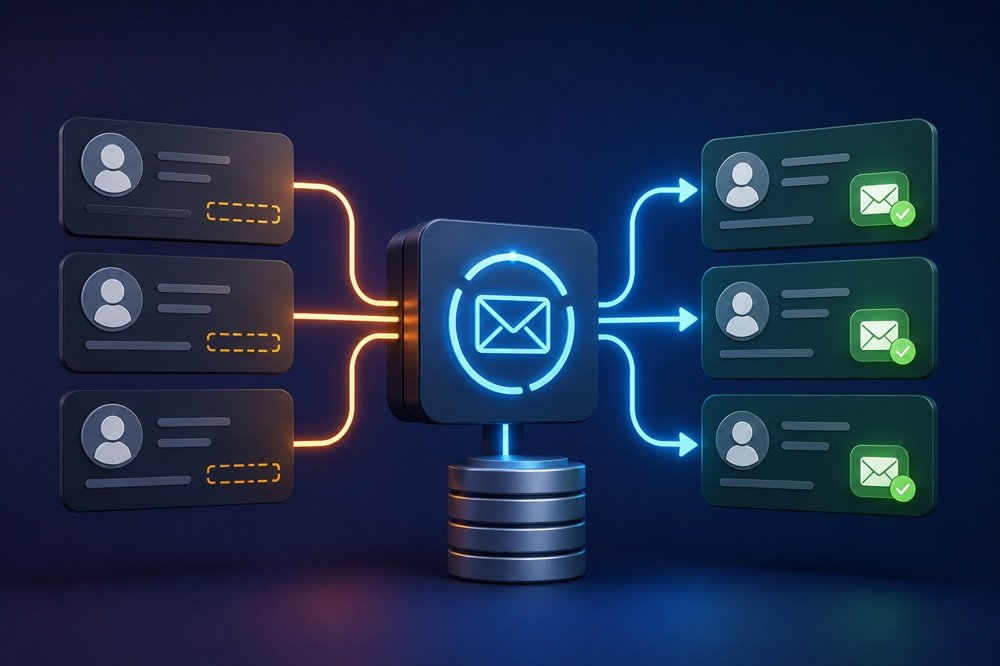
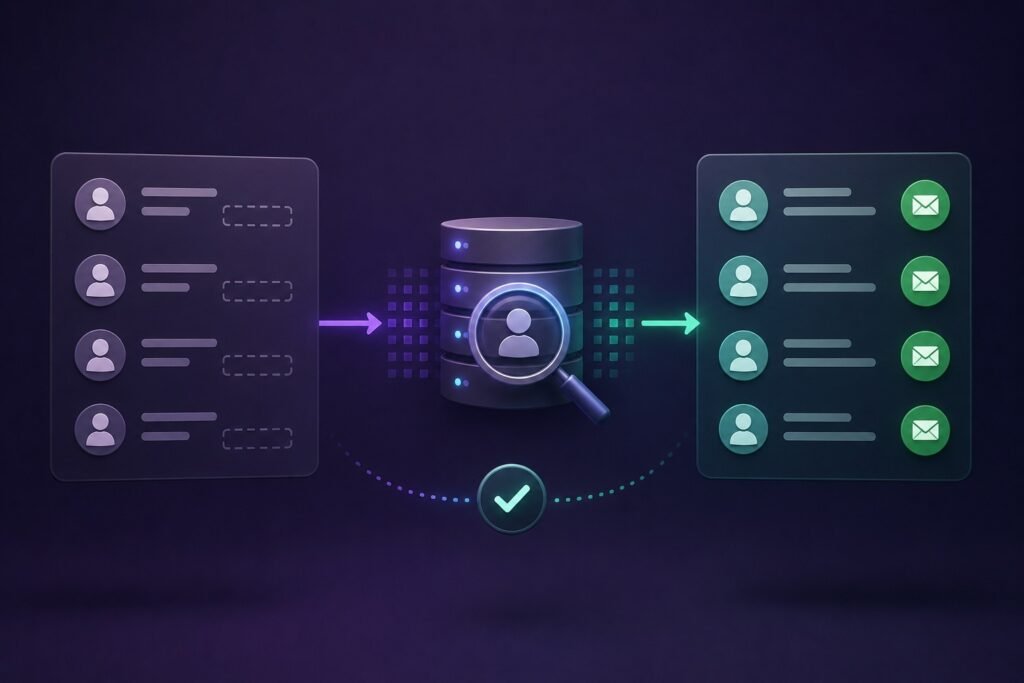
Email append is the process of adding missing email addresses to existing contact records by matching them against a reference database. You provide records that have some identifying information — a name and company, or a postal address — and the append service matches those records against its database to find and add the corresponding email address.
The process works through matching logic. The append provider takes your input records and compares them against their reference database using the identifying fields you provide. When a record matches with sufficient confidence, the provider returns the appended email address. Records that don’t match confidently are returned unappended rather than guessed.
There are two main types.
B2B email append matches business contacts (name + company) to business email addresses.
B2C email append matches consumers (name + postal address) to personal email addresses. The two use different reference databases and different matching logic because business and consumer data are structured differently.
Good email append is matching, not guessing. A quality provider matches your records against verified data and returns confirmed addresses; a poor one guesses email patterns (firstname.lastname@company.com) and returns unverified addresses that bounce. The difference determines whether append helps or hurts your program.
Common questions
What is email append?
Email append is the process of adding a professional email address to an existing business contact record when the email address is missing. A business might provide information such as a person’s name, company, job title, and location, and an email-append provider attempts to identify the corresponding business email address.
How does email append work?
The process typically looks like this:
- You provide existing contact records — such as name, company, domain, job title, or location.
- The vendor matches the records against its available data sources.
- Potential email addresses are identified for matching contacts.
- The vendor applies verification or confidence checks to determine whether the address appears valid and belongs to the right person.
- Matched records are returned with the email address and, depending on the service, a verification or confidence status.
- You import the results into your CRM, database, or marketing system.
The exact matching and verification methodology varies significantly between providers.
What information does a vendor need for email append?
The more reliable identifiers you provide, the easier it is to match the correct person. Useful fields include
first name, last name, company name, company domain, job title, location, LinkedIn or professional profile information, and existing contact identifiers. A record containing only a person’s name is much harder to match accurately than one containing their name, current company, domain, and job title.
How do vendors find the email address?
Vendors can use combinations of proprietary databases, licensed data sources, public business information, professional information, email-pattern analysis, matching algorithms, and other permitted sources. Some may infer an address from a company’s known email pattern and then attempt to validate it. Because methodologies differ, buyers should ask where appended addresses originate and how the vendor determines that an address belongs to the specific individual.
What is the difference between email append and email verification?
Email append finds or adds an email address; email verification evaluates whether an email address appears valid and deliverable. They are separate processes. An appended address can still be outdated, incorrectly matched, or undeliverable. For that reason, businesses should evaluate both the vendor’s
match rate and the
accuracy or deliverability of the returned addresses.
What is a good email append match rate?
There is no universal benchmark because match rates depend heavily on the quality of the input records, geography, industry, data age, and vendor coverage. A clean database containing names, current companies, domains, and other identifiers can produce substantially better results than an incomplete or outdated list. Instead of accepting a vendor’s headline percentage, test the service against a representative sample of your own records.
Can email append identify the correct person every time?
No. Matching systems can produce incorrect associations, particularly when people share names, have changed employers, or have incomplete records. An email address can also be valid but belong to a different person at the same company. This is why buyers should distinguish between
“email found,” “email verified,” and “correct person matched.”
Is email append legal?
The legality and permitted use of appended email addresses depend on the jurisdiction, the type of information involved, how it was collected, the vendor’s sourcing and licensing practices, and how you intend to use it. A business email address can still constitute personal data when it identifies an individual. Before using appended addresses for marketing, businesses should evaluate applicable privacy and electronic-communications requirements and understand the vendor’s compliance and sourcing documentation.
How should you evaluate an email append vendor?
Request a sample test using your own data and measure
match rate, correct-person match rate, verified-email rate, invalid rate, duplicate rate, and overall usable-email rate. Also ask how addresses are sourced, whether inferred emails are included, how catch-all domains are handled, when records were last updated, and what happens when an appended address is incorrect. A controlled sample test is usually more informative than a vendor’s advertised match percentage.
Clean your input data before appending. Match rates depend heavily on input quality — accurate, complete names and companies (or addresses) match far better than messy, sparse records. A round of standardization and deduplication before append meaningfully improves results and reduces wasted spend on records that won’t match.
Treat appended contacts with care after the match. Because appended contacts didn’t give you their address directly, deliverability and engagement need monitoring — start with a permission-style or re-engagement message, watch bounce and complaint rates, and warm into the list gradually. Handled well, append extends your reach; handled carelessly (especially with guessed addresses), it can damage deliverability. And consult an attorney about compliance, particularly for B2C append.
Iscope Digital’s
Database Marketing Solutions includes email append matched against the verified
Bizline Direct database — matched, not guessed — with a free match analysis on your file. For realistic expectations on results, see
Email append match rates: what’s realistic and what’s vendor fluff? and on broader record-building,
What is firmographic enrichment and which fields matter most?