Structured data — markup that tells search engines and AI systems exactly what your content means — has become essential for visibility, and JSON-LD is the preferred format for implementing it. But which schema types matter for a B2B site, and where should they go? This article explains JSON-LD schema, the types that matter for B2B, and how to deploy them effectively.
What JSON-LD schema does
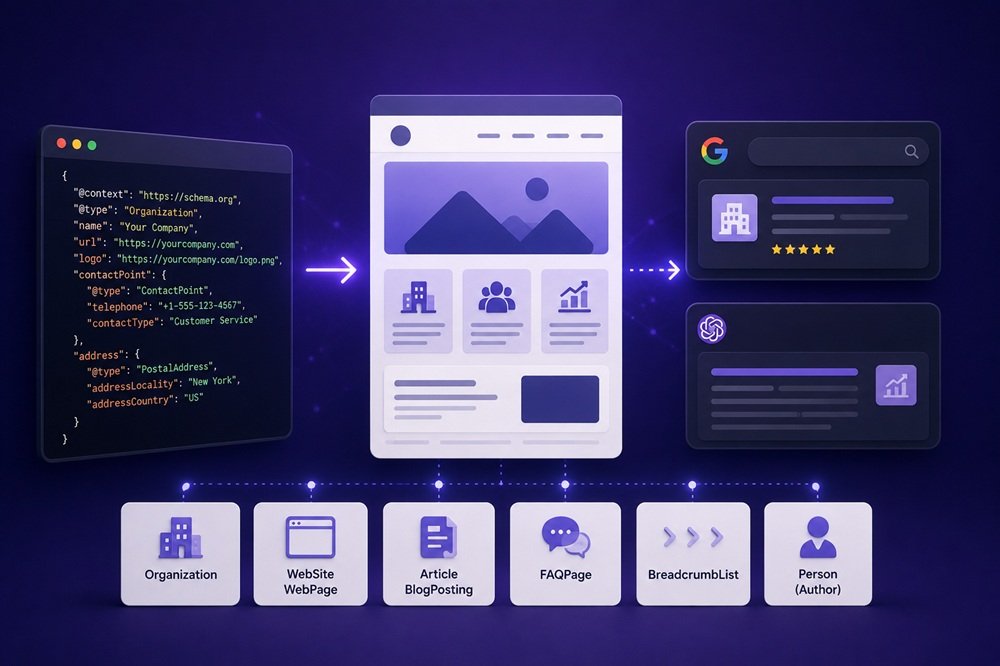
JSON-LD (JavaScript Object Notation for Linked Data) is a format for adding structured data to web pages — machine-readable markup that explicitly describes what your content is and means. Where ordinary HTML tells browsers how to display content, structured data tells search engines and AI systems what the content actually represents: this is an organization, this is an article, this is its author, this is a FAQ.
It matters because search engines and increasingly AI engines rely on structured data to understand and represent content. Schema markup can enable rich results in search (enhanced listings), helps search engines understand your content accurately, and — increasingly important — helps AI engines parse and cite your content correctly. As AI-driven search and answer engines grow, structured data’s role in helping machines understand content has only increased.
For B2B websites, the schema types that matter most include:
Organization (describing your company — name, logo, contact, location),
WebSite and
WebPage (describing the site and pages),
Article or
BlogPosting (for blog and content pages, including author and date),
FAQPage (for FAQ-structured content, which can enable rich results),
BreadcrumbList (for navigation structure), and
Person (for author information supporting expertise signals).
The principle is matching the schema type to the content: each page gets the schema types that accurately describe what it contains, helping both search engines and AI systems understand and represent it correctly.
Common questions
What is JSON-LD and why is it preferred?
JSON-LD is a format for adding structured data to web pages — machine-readable markup describing what content means. It’s preferred over older structured-data formats (like inline microdata) because it’s cleaner to implement and maintain: JSON-LD sits in a script block separate from the visible HTML, rather than being woven into the markup, making it easier to add, update, and manage without touching the page’s display code. Search engines support and recommend it. Its separation from display markup and ease of maintenance make JSON-LD the standard choice for implementing structured data on modern sites.
Which schema types matter most for B2B websites?
The core types: Organization (your company details — name, logo, contact, location), WebSite and WebPage (site and page descriptions), Article or BlogPosting (content pages with author and date), FAQPage (FAQ-structured content, which can enable rich results), BreadcrumbList (navigation structure), and Person (author information). These cover the main content types a B2B site contains — company information, pages, articles, FAQs, and authorship. Matching each page to the schema types that accurately describe its content is the approach; not every page needs every type, but the right types for each page’s content help machines understand it correctly.
Where should each schema type be deployed?
Match schema to content by page type. Organization schema typically goes site-wide (often on the homepage and/or globally), describing your company. Article/BlogPosting schema goes on blog and content pages, with author and date. FAQPage schema goes on pages with FAQ-structured content. BreadcrumbList goes on pages with breadcrumb navigation. WebPage schema describes individual pages. The principle is that each page carries the schema types accurately describing what it contains — content pages get Article schema, FAQ content gets FAQPage schema, and so on. Deploy each type where the content it describes actually lives.
How does schema help with AI engines?
By helping AI systems parse and understand your content accurately, which supports correct representation and citation. As AI engines increasingly answer questions by drawing on web content, structured data helps them understand what your content is, who wrote it, and what it covers — aiding accurate parsing and citation. Schema like Article (with author and date), FAQPage, and Organization provides explicit signals AI systems can use. While AI engines also process unstructured content, structured data reduces ambiguity and helps machines represent your content correctly — increasingly valuable as AI-driven search grows. It’s part of making content machine-understandable for both search and AI.
Does FAQPage schema really enable rich results?
FAQPage schema can enable enhanced search presentation for FAQ content, helping your FAQ-structured content appear more prominently in some cases — though the specifics of what rich results appear depend on the search engine and evolve over time. Beyond rich results, FAQPage schema helps machines understand question-and-answer content, which supports both search and AI representation of that content. So FAQPage schema serves both potential rich-result presentation and general machine-understanding of your Q&A content. Implement it on genuinely FAQ-structured content, where it accurately describes the question-answer format, rather than forcing it onto content that isn’t really FAQ-structured.
Can incorrect schema hurt my site?
Yes — inaccurate or misleading schema can cause problems. Schema that doesn’t accurately describe the content (marking up content as something it isn’t, or including false information) can lead search engines to distrust your markup or, in cases of clearly manipulative markup, can carry penalties. The principle is that schema must accurately represent the actual content. Used honestly to describe what’s genuinely on the page, schema helps; used to misrepresent content or game results, it can hurt. Implement schema accurately and validate it, rather than stuffing pages with markup that doesn’t match the real content.
How do I validate my schema?
Through structured-data testing and validation tools that check whether your JSON-LD is correctly formatted and recognized. These tools parse your markup and report errors, warnings, and what schema types are detected, letting you confirm your implementation is valid and accurate before and after deployment. Validation catches formatting errors and confirms the schema is being read correctly. Regularly validating your structured data — especially after changes — ensures it’s working as intended and accurately representing your content. Don’t assume schema is correct without validating; errors can silently prevent it from working.
How this applies to your business
Implement the core B2B schema types, matched accurately to your content. Organization schema for your company details, Article/BlogPosting for content pages with authorship, FAQPage for FAQ content, BreadcrumbList for navigation, and WebPage/WebSite for site structure cover the main content types a B2B site contains. Deploying the right schema types on the pages whose content they describe helps both search engines and AI systems understand and represent your content correctly — increasingly important as AI-driven search grows. Match schema to content rather than applying types indiscriminately.
Use JSON-LD for its maintainability and accuracy. Its separation from display markup makes it easier to add, update, and manage than older formats woven into the HTML — and that maintainability matters for keeping schema accurate as content changes. Implement schema that honestly describes your actual content, since accurate schema helps while misleading schema can hurt. The combination of JSON-LD’s clean implementation and accurate, content-matched markup gives you reliable structured data that aids machine understanding without the risks of inaccurate or manipulative markup.
Validate your structured data and treat it as part of AI-era visibility. Validation tools confirm your JSON-LD is correctly formatted and read as intended, catching errors that could silently prevent it from working — validate especially after changes. And recognize that structured data increasingly serves not just traditional search (rich results, accurate understanding) but AI engines parsing and citing your content. As AI-driven search grows, well-implemented schema helps machines represent your content correctly across both search and AI surfaces, making it a worthwhile investment in your site’s machine-understandability.
Iscope Digital’s
Creative & Web Development service implements and validates accurate JSON-LD schema as part of building machine-understandable B2B sites. For how schema supports AI-engine visibility specifically, see
JSON-LD schema for AI engines, and for the accessibility standards that complement structured markup,
WCAG 2.1 AA accessibility requirements.