JSON-LD schema is the most concrete, immediately deployable AEO tactic available to B2B websites. By marking up your content with schema.org vocabulary, you give AI engines explicit, machine-readable facts they can cite with confidence. Not all schema types matter equally for AEO. This article explains which types to prioritize and how to deploy them.
What JSON-LD schema does for AEO
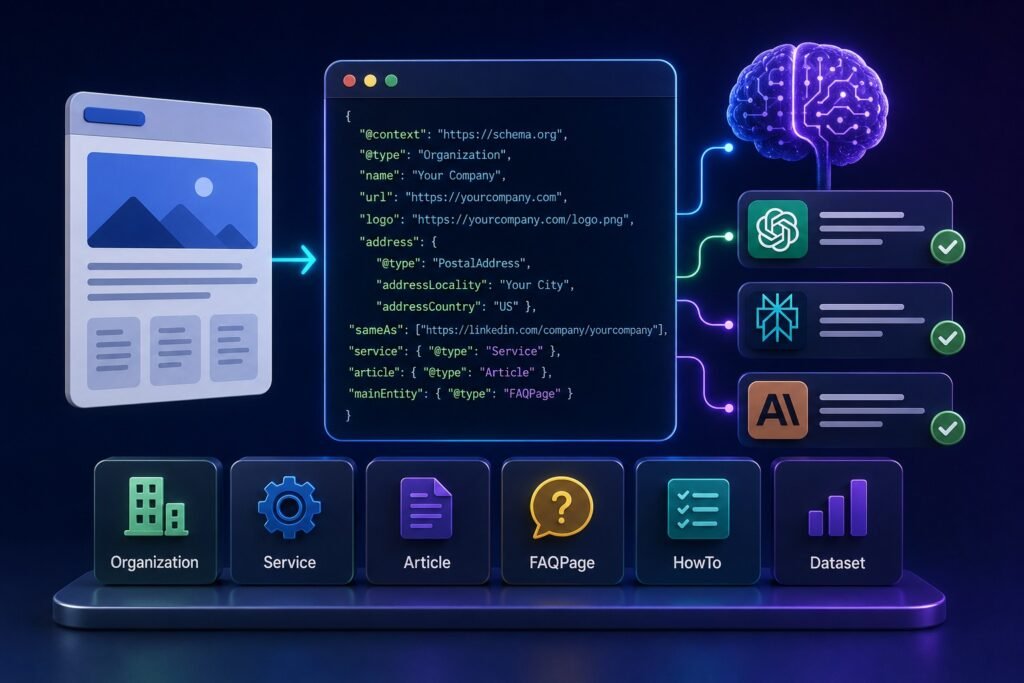
JSON-LD (JavaScript Object Notation for Linked Data) is a format for embedding structured data in HTML pages. It uses the schema.org vocabulary — a shared standard maintained by Google, Microsoft, Yahoo, and Yandex — to describe what a page is about in terms an AI engine can parse without ambiguity.
When ChatGPT, Perplexity, Claude, or Google AI Overviews encounter a page with rich JSON-LD, they extract the structured facts directly rather than inferring them from the surrounding text. A page that declares “this organization is named Iscope Digital, founded in 2001, located in Fort Lauderdale, offering these specific services” via Organization schema is far easier to cite accurately than a page where the same facts are buried in prose.
For B2B sites, six schema types do most of the AEO heavy lifting: Organization, Service, Article, FAQPage, HowTo, and Dataset (where applicable). Each serves a different citation purpose, and they compose — a single page can carry multiple schema types simultaneously.
Common questions
Does JSON-LD schema help B2B websites appear in AI answers?
JSON-LD can help search and retrieval systems understand the entities and relationships represented on a page, but it does not guarantee AI citations or higher rankings. For B2B websites, structured data is most useful when it accurately describes the business, its content, services, products, authors, and site structure. It should support clear, useful page content rather than be treated as a shortcut to AI visibility.
Which JSON-LD schema types matter most for B2B websites?
The most useful types depend on the site’s content, but common priorities include
Organization, WebSite, WebPage, Article, BlogPosting, Service, Product, BreadcrumbList, Person, and ProfilePage. A B2B company should implement only the types that accurately represent its pages. For many B2B sites, establishing a clear Organization entity and then adding appropriate page-specific markup is more useful than deploying dozens of unrelated schema types.
Why is Organization schema important for B2B companies?
Organization schema helps describe the business entity behind the website. It can identify information such as the organization’s name, logo, website, contact information, and other relevant properties. Consistent organization information can help systems distinguish the company from similarly named entities and connect its website, content, products, and other digital properties.
Should B2B websites use Person and ProfilePage schema?
Yes, when the website has genuine authors, executives, consultants, subject-matter experts, or other identifiable professionals with meaningful profile pages. Article markup can identify the author as a Person, while ProfilePage markup can describe the individual’s profile page. This creates clearer relationships between
content → author → organization, which can be useful for entity understanding and establishing authorship context.
When should B2B websites use Article or BlogPosting schema?
Use Article or BlogPosting markup on individual editorial pages that contain genuine articles or blog posts. Useful properties can include the headline, author, publisher, publication date, modification date, and image. The markup should accurately represent the visible article and should not be used to label generic landing pages or promotional content as articles.
Is Service schema important for B2B websites?
Service schema can be valuable for businesses that sell clearly defined services. It should generally be used on pages dedicated to a particular service rather than placing every service in the markup of every page. The structured data should correspond to what the visitor can actually see on the page and should accurately describe the service being offered.
Should B2B companies use Product schema?
Product schema is appropriate when the company genuinely offers products that fit the Schema.org and applicable search-feature definitions. It can be particularly relevant for B2B software, physical products, or clearly defined product offerings. Businesses should not use Product schema simply because they sell something commercially; the markup needs to accurately represent the underlying offering and its visible page content.
Does FAQPage schema improve AI citations?
FAQPage schema does not guarantee AI citations. FAQs can still be valuable because clearly structured questions and answers make information easier for users and automated systems to understand. However, businesses should use FAQPage markup only where the content meets the applicable requirements and is visible on the page. The quality and usefulness of the actual answers matter more than simply adding the markup.
Should B2B websites use BreadcrumbList schema?
BreadcrumbList can help describe the relationship between pages within a site’s information architecture. For example, a page could be represented as
Home → Services → Data Enrichment. Breadcrumb markup is most useful when the same hierarchy is also visible to users. It can help systems understand where an individual page sits within the broader website structure.
Can multiple JSON-LD types be used on the same B2B page?
Yes. A page can contain multiple related entities. For example, an article could use Article, WebPage, BreadcrumbList, Person, and Organization information. The entities should have logical relationships rather than being a collection of unrelated schema blocks. Using stable
@id values can help connect the same organization or author across different pages.
What JSON-LD schema should a typical B2B website prioritize first?
A practical implementation order is:
- Organization — establish the business entity.
- WebSite — describe the overall website.
- WebPage — identify individual pages appropriately.
- BreadcrumbList — clarify site hierarchy where breadcrumbs exist.
- Article/BlogPosting — mark up editorial content.
- Person/ProfilePage — establish genuine authors and experts.
- Service — describe dedicated service pages.
- Product — use where genuine products qualify.
The goal should be
accurate entity understanding, not maximizing the number of schema types deployed.
Can JSON-LD alone make a B2B site more visible in AI search?
No. Structured data is only one part of an AI-search and SEO strategy. Crawlability, content quality, topical relevance, authority, original information, internal linking, technical accessibility, and user experience remain important. For AI visibility specifically, businesses should focus on producing information that is genuinely useful and worth referencing, then use JSON-LD to accurately clarify the entities and relationships already represented on the site.
The biggest mistake B2B teams make is deploying schema once and treating it as done. Schema needs ongoing maintenance — when services change, when authors update, when facts shift. Outdated schema is worse than no schema, because it creates factual inconsistency that AI engines detect and penalize.
The second-biggest mistake is deploying schema that contradicts the visible page content. AI engines cross-reference; if your schema says you’re located in New York and your contact page says Fort Lauderdale, the engine downweights your citation reliability. Schema must match the page.
Iscope Digital deploys comprehensive JSON-LD schema as part of every
AI Engine Optimization engagement and every new build from our
Creative Web Development team. For the foundational definition of AEO and how it relates to SEO, see
What is AI Engine Optimization (AEO) and how does it differ from SEO?