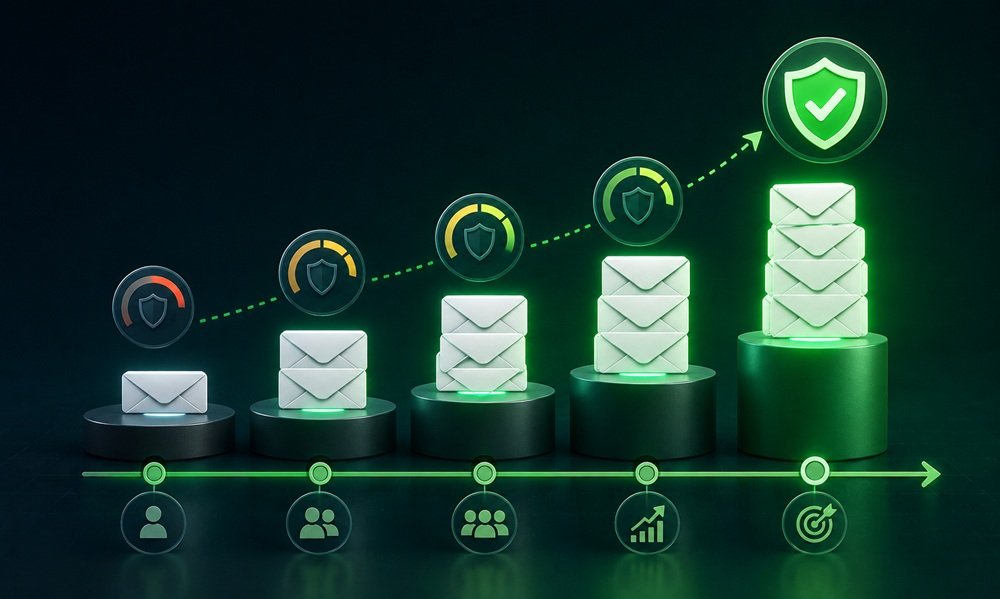
When you start sending email from a new IP address or domain, mailbox providers don’t trust you yet — and sending too much too soon gets you flagged as a spammer. IP warming is the gradual process of building that trust. Done right, it establishes a strong sender reputation; done wrong, it burns the reputation before you’ve built it. This article explains how to warm an IP without torching your deliverability.
What IP warming is and why it matters
IP warming is the practice of gradually increasing email sending volume from a new IP address (or domain) over time, so mailbox providers can build a positive reputation for it based on observed good behavior. New IPs have no sending history, so providers treat them with suspicion — a brand-new IP suddenly blasting large volume looks exactly like a spammer, and gets filtered or blocked accordingly.
The logic is reputation-building through demonstrated good behavior. By starting with low volume to your most engaged recipients and increasing gradually, you give mailbox providers a track record of wanted, well-received mail. They observe low complaints, good engagement, and consistent patterns, and progressively extend trust — improving your inbox placement as the reputation builds.

Warming applies to new sending infrastructure: a new dedicated IP, a new sending domain, or a significant change in sending patterns. It typically takes weeks, with volume increasing on a schedule that lets reputation build at each level before stepping up.
The danger is impatience. Sending too much too fast — exceeding what your nascent reputation can support — triggers spam filtering and can burn the IP’s reputation before it’s established, which is far harder to recover from than to avoid. The discipline of warming is patience: building trust gradually rather than demanding it immediately.
Common questions
Why do new IPs need warming?
Because they have no sending history, and mailbox providers treat unknown senders with suspicion. A brand-new IP suddenly sending large volume looks like a spammer (spammers frequently use fresh IPs), so providers filter or block it. Warming builds a positive track record — starting small with engaged recipients and increasing gradually gives providers evidence of good behavior (low complaints, good engagement), so they progressively extend trust. Without warming, a new IP’s large send gets treated as suspicious bulk mail and lands in spam or gets blocked.
How long does IP warming take?
Typically several weeks, depending on your target sending volume and how aggressively (but safely) you ramp. Warming to support modest volume takes less time than warming for very high volume. The process increases volume on a schedule — starting low and stepping up as reputation builds at each level. There’s no fixed universal duration; it depends on your volume goals and how the reputation develops. The key is letting reputation build at each level before increasing, rather than rushing to full volume on a fixed deadline regardless of how the warming is going.
How should I structure the warming schedule?
Start with low volume sent to your most engaged recipients (who are most likely to open and least likely to complain), then increase volume gradually on a schedule, expanding to broader segments as reputation builds. Begin with the recipients who’ll generate the best engagement signals, since strong early engagement builds reputation fastest. Increase incrementally — letting each volume level establish before stepping up — and monitor deliverability and engagement at each stage, slowing down if metrics deteriorate. The schedule should be guided by how the reputation is actually developing, not forced to a fixed timeline.
What’s the biggest mistake in IP warming?
Impatience — sending too much too fast, exceeding what the nascent reputation can support. Rushing volume triggers spam filtering and can burn the IP’s reputation before it’s established, which is far harder to recover from than to avoid in the first place. The temptation to reach full volume quickly is exactly what causes warming to fail. Discipline and patience are the core of successful warming: build trust gradually, monitor the signals, and resist the urge to accelerate beyond what the reputation can bear. A burned new IP is a costly setback.
Should I warm to my most engaged recipients first?
Yes. Starting with your most engaged recipients — those most likely to open, click, and least likely to complain or mark as spam — generates the strongest positive engagement signals early, which builds reputation fastest. Sending early warming volume to unengaged or risky recipients produces weak engagement and possible complaints, slowing or damaging reputation-building. Front-loading engaged recipients in the warming process gives mailbox providers the best possible early impression of your sending, accelerating the trust-building that warming is designed to achieve.
Do I need to warm a new domain too, not just a new IP?
Yes — domain reputation matters alongside IP reputation, and a new sending domain also needs to build trust. Mailbox providers increasingly weight domain reputation, so a new domain, like a new IP, benefits from gradual volume ramp-up to establish a positive track record. If you’re launching both a new domain and new IP, both need warming. The principle is the same: build reputation gradually through demonstrated good sending behavior rather than demanding immediate trust from a sender with no history.
How do I monitor warming progress?
Watch deliverability and engagement metrics at each volume level — inbox placement, open rates, bounce rates, complaint rates, and any spam-folder signals. Strong engagement and low complaints/bounces indicate the reputation is building well and you can proceed to the next volume level. Deteriorating metrics signal you’re moving too fast and should slow down. Inbox-placement testing can directly show where your mail is landing across providers during warming. Let these signals guide the pace — proceed when they’re healthy, slow down when they’re not, rather than following a fixed schedule blindly.
How this applies to your business
Warm any new sending infrastructure patiently, because impatience is what burns new IP and domain reputations. Whether launching a new dedicated IP, a new sending domain, or significantly changing sending patterns, build reputation gradually — starting low, increasing incrementally, and letting trust build at each level. The weeks of patience that proper warming requires are far cheaper than recovering from a burned reputation caused by rushing. Treat warming as a non-negotiable phase, not an obstacle to push through quickly.
Start with your most engaged recipients to build reputation fastest. Front-loading the recipients most likely to open and least likely to complain generates the strong early engagement signals that build sender reputation quickly. Sending early warming volume to unengaged or risky segments produces weak signals that slow reputation-building. Lead with engagement to give mailbox providers the best early impression, then expand to broader segments as trust establishes.
Let the metrics guide the pace rather than following a fixed schedule blindly. Monitor inbox placement, engagement, bounces, and complaints at each volume level — proceed when they’re healthy, slow down when they deteriorate. Warming should be responsive to how the reputation is actually developing, not forced to a predetermined timeline regardless of signals. This adaptive, metrics-driven approach builds reputation reliably while avoiding the over-aggressive ramp that burns it.
Iscope Digital’s
Email Marketing service handles IP and domain warming as part of deliverability engineering, with metrics-driven ramp schedules. For the reputation that warming builds, see
What is email deliverability?, and for the authentication that should be in place before warming begins,
SPF, DKIM, DMARC explained for marketers.