“When will we see results?” is the question every B2B lead-generation program faces, and impatience kills more campaigns than poor execution does. Lead generation produces results on a timeline shaped by your sales cycle, channel, and goals — and understanding that timeline prevents the premature cancellations that waste the investment. This article lays out realistic lead-generation timelines.
What “results” means and when they arrive
Lead-generation results arrive in stages, each on its own timeline.
Initial lead flow — the first leads — can arrive quickly, often within days to weeks of a campaign launching, depending on channel. Paid channels (search, social, content syndication) produce leads almost immediately once live; organic and content-driven channels take longer to ramp.
Qualified leads — leads that pass MQL and SQL criteria — take longer, because qualification and nurturing happen after initial capture. Expect weeks to a couple of months before a steady flow of genuinely qualified leads emerges, as raw leads are nurtured and filtered.
Pipeline and revenue — the results that actually matter — arrive on the timeline of your sales cycle. If your B2B sales cycle is six months, leads generated today won’t become closed revenue for roughly six months, regardless of how fast they were captured. This is the crucial point: lead-generation ROI lags by the length of your sales cycle.
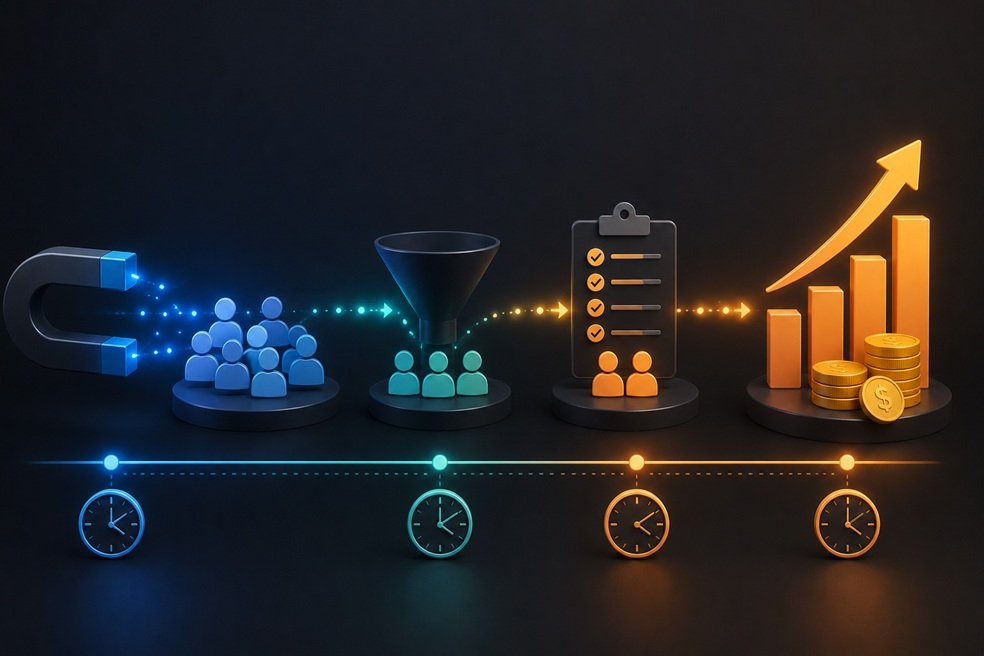
The mistake that kills campaigns is judging lead generation by revenue too early — cancelling at month two because no deals have closed, when the sales cycle means deals couldn’t possibly have closed yet. Realistic timelines account for capture (fast), qualification (weeks to months), and revenue (sales-cycle-dependent, often months).
Common questions
How quickly will I see the first leads?
From paid channels, often within days to weeks of launch — paid search, paid social, and content syndication produce leads almost immediately once campaigns are live. Organic and content-driven approaches take longer to ramp as content gains traction. So initial lead
flow can be fast, especially through paid channels. But initial leads aren’t the same as qualified leads or revenue — early lead flow is encouraging but not yet “results” in the sense that matters.
How long until I see qualified leads?
Typically weeks to a couple of months, because qualification and nurturing happen after initial capture. Raw leads need to be nurtured and filtered through MQL and SQL criteria before a steady flow of genuinely qualified leads emerges. The timeline depends on your nurturing process and how much development leads need. Expect a ramp: early on, you’re capturing and beginning to nurture; the steady flow of qualified leads builds over the first one to two months as the funnel fills and matures.
When will lead generation produce revenue?
On the timeline of your sales cycle. If your typical B2B sales cycle from qualified lead to closed deal is six months, then leads generated today produce revenue roughly six months out — no faster, regardless of how quickly the leads were captured. This is the most important and most overlooked point: lead-generation ROI lags by your sales-cycle length. Long-cycle B2B (enterprise, high-value) sees revenue much later than short-cycle, transactional B2B. Map your expectations to your actual sales cycle.
Why do so many lead-gen campaigns get cancelled too early?
Because they’re judged by revenue before the sales cycle allows revenue to appear. A campaign cancelled at month two for “not producing deals” may have been working perfectly — the leads were captured and qualifying, but the six-month sales cycle meant no deals could have closed yet. Impatience, driven by measuring the wrong thing at the wrong time, kills campaigns just as the pipeline they built is about to convert. Judging too early by revenue is the classic, costly mistake.
What should I measure at each stage?
Match the metric to the timeline. Early (weeks): lead volume and cost per lead, confirming the campaign is capturing leads efficiently. Mid (1–2 months): qualified lead flow and MQL-to-SQL conversion, confirming the leads are developing into qualified prospects. Later (sales-cycle-dependent): pipeline contribution and revenue, the ultimate measure. Measuring revenue early (when the sales cycle hasn’t allowed it) or only measuring volume (ignoring quality and revenue) both mislead. Stage-appropriate metrics give an honest read of progress.
Can I accelerate lead-generation results?
Initial lead flow and qualified-lead timelines can be accelerated somewhat — through paid channels for fast capture, strong nurturing for faster qualification, and tight targeting for better-fit leads. But the revenue timeline is largely fixed by your sales cycle, which lead generation can’t compress — a six-month sales cycle means six months to revenue regardless of lead-gen speed. You can accelerate the front of the funnel; the back is governed by how long your buyers take to decide. Set expectations accordingly.
How long should I commit before judging a campaign?
At least long enough for one full sales cycle to play out, plus the ramp time — so leads generated early can actually progress to revenue. For a six-month sales cycle, judging a lead-gen program fairly means giving it well beyond six months, so the pipeline it builds has time to convert. Cancelling before a full cycle judges the program before its results could possibly appear. Commit to a timeline that matches your sales cycle, and measure stage-appropriate metrics along the way.
How this applies to your business
Map your lead-generation expectations to your actual sales cycle, because that’s what governs when revenue appears. Leads captured today produce revenue roughly one sales cycle later — six months out for a six-month cycle, regardless of how fast the leads were captured. Setting this expectation upfront prevents the premature cancellations that kill campaigns just as their pipeline is about to convert. Know your sales cycle, and plan the program’s timeline around it.
Measure stage-appropriate metrics rather than judging revenue too early. Track lead volume and cost early, qualified-lead flow in the first months, and pipeline and revenue on the sales-cycle timeline. Measuring revenue at month two (before the cycle allows it) produces a false negative that triggers premature cancellation; measuring only volume ignores whether leads convert. Stage-appropriate metrics give an honest, timely read of whether the program is working.
Commit to a timeline that lets at least one full sales cycle play out before judging the program. Lead generation builds pipeline that converts on your sales cycle’s schedule, so a fair evaluation requires giving it beyond one full cycle plus ramp time. The programs that succeed are the ones given time to let their pipeline mature; the ones that fail are often cancelled while working, before their results could appear.
Iscope Digital’s
Online Lead Generation service reports stage-appropriate metrics throughout the campaign timeline, from early lead flow to pipeline contribution. For what counts as a qualified lead along the way, see
MQL vs SQL, and for the cost expectations during the ramp,
Cost per lead (CPL) for B2B in 2026.