“Lead generation” means different things to different people — and the gap between how marketers and sales leaders define it causes more friction than almost any other term in B2B. This article defines online lead generation clearly, reconciles the marketing and sales perspectives, and explains what a lead actually is in operational terms.
What online lead generation actually is
Online lead generation is the process of attracting and capturing the interest of potential customers through digital channels, producing contacts (leads) that can be developed toward a sale. It spans the channels and tactics that turn anonymous online audiences into identified, contactable prospects — content offers, forms, paid campaigns, email outreach, and more.
The friction starts with what counts as a “lead.” To a marketer, a lead is often anyone who showed interest — downloaded a guide, filled a form, attended a webinar. To a sales leader, a lead is someone worth a salesperson’s time — a qualified prospect with budget, authority, need, and timing. These are very different bars, and the gap between them is where marketing and sales conflict: marketing reports “500 leads,” sales says “none of these are real.”
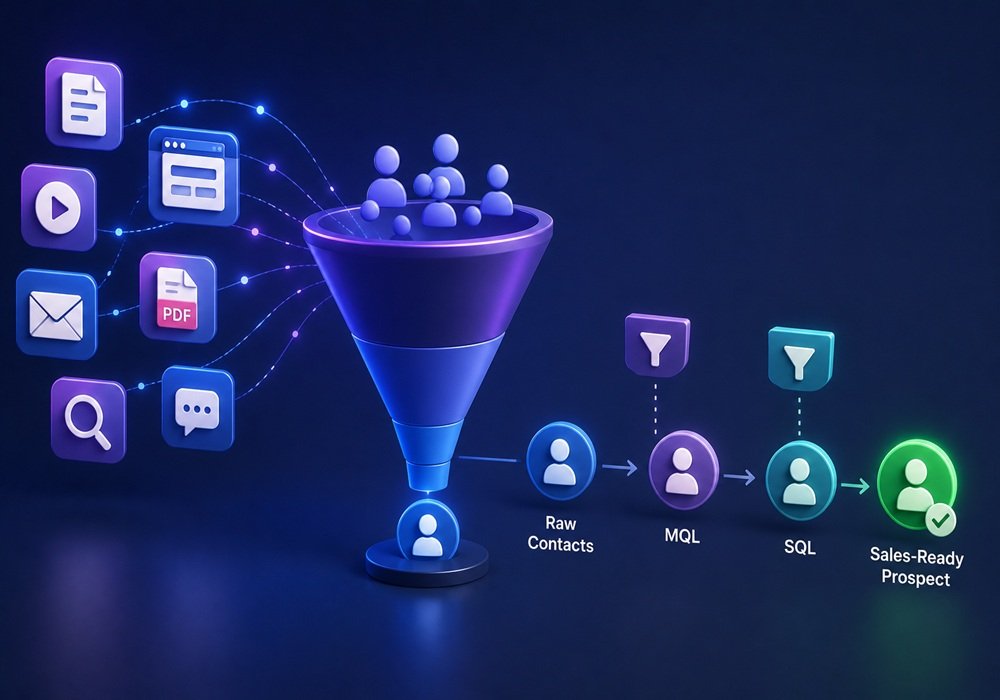
The reconciliation is qualification stages. A raw contact becomes a marketing-qualified lead (MQL) when it meets marketing’s interest criteria, then a sales-qualified lead (SQL) when it meets sales’ readiness criteria. Online lead generation produces the top of this funnel; qualification determines what’s worth sales’ attention. Understanding lead generation means understanding that “lead” is a spectrum from raw contact to sales-ready prospect, not a single thing.
Common questions
What is online lead generation?
Online lead generation is the process of attracting potential business customers through digital channels and capturing enough information to identify, qualify, or follow up with them. It can include search, paid advertising, social media, content marketing, webinars, landing pages, email campaigns, referrals, and other digital activities. The goal is not simply to generate website traffic, but to create identifiable prospects who may eventually become qualified opportunities or customers.
How do marketers define online lead generation?
Marketers typically view online lead generation as the process of turning digital audience attention into identifiable contacts or accounts. They may focus on activities such as content downloads, form submissions, webinar registrations, demo requests, newsletter signups, and other conversion events. Marketing teams often measure lead volume, conversion rates, cost per lead, lead quality, and marketing-sourced pipeline.
How do sales leaders define online lead generation?
Sales leaders generally care less about the number of contacts generated and more about whether those contacts can become revenue. From a sales perspective, online lead generation should produce prospects that fit the ideal customer profile and have a realistic path toward a sales conversation. Sales leaders are therefore more likely to evaluate qualified leads, meetings, opportunities, pipeline, conversion rates, and revenue rather than raw form submissions.
What is the difference between a lead, MQL, and SQL?
A
lead is generally an identifiable prospect who has shown some level of potential interest or relevance. An
MQL, or Marketing Qualified Lead, meets predefined marketing qualification criteria. An
SQL, or Sales Qualified Lead, has been reviewed or qualified according to sales criteria and is considered appropriate for direct sales follow-up. Companies should define these stages operationally so that marketing and sales use the terms consistently.
What online channels generate B2B leads?
Common channels include organic search, paid search, LinkedIn and other social platforms, display advertising, content marketing, webinars, email marketing, referral traffic, industry publications, landing pages, and partner programs. Different channels can produce very different types of leads. A channel that generates inexpensive leads may not necessarily produce the highest-quality opportunities, so businesses should evaluate channel performance beyond lead volume.
What makes an online B2B lead high quality?
A high-quality lead generally combines
good company fit, relevant contact information, meaningful business need, and some indication of potential buying interest or suitability. The exact definition depends on the company’s ICP and sales process. A senior executive at a target account may be valuable even with limited online activity, while a highly engaged visitor from an irrelevant company may have little commercial value.
How should marketers measure online lead generation?
Marketers should track the complete progression from traffic and conversions through qualified leads, opportunities, and revenue. Useful metrics include conversion rate, cost per lead, cost per qualified lead, MQL-to-SQL conversion, pipeline generated, customer acquisition cost, and revenue attributed to campaigns. Looking only at the number of leads can encourage teams to optimize for volume rather than commercial quality.
How should sales leaders evaluate online lead generation?
Sales leaders should determine whether digital leads create usable pipeline. Important metrics include lead acceptance rate, speed to follow-up, meetings booked, SQL-to-opportunity conversion, opportunity value, win rate, sales-cycle length, and revenue. Sales should also provide feedback about lead quality so marketing can improve targeting and qualification. This creates a feedback loop rather than treating lead generation as a marketing-only responsibility.
Does website traffic count as lead generation?
No. Website traffic is an audience or visibility metric, while lead generation involves identifying or capturing potential prospects. A visitor who reads an article and leaves without providing any information may contribute to awareness and future demand, but they are not necessarily a lead. Businesses should distinguish between
traffic, engagement, identifiable leads, qualified leads, and opportunities when measuring the funnel.
Is online lead generation the same as demand generation?
No. Lead generation focuses on identifying potential prospects, often through a conversion or capture mechanism. Demand generation is broader and includes activities designed to create awareness, interest, preference, and demand for a company’s offering. Some demand-generation activities may generate leads directly, while others influence future buyers without producing an immediate identifiable contact. Both can contribute to pipeline but should not be measured in exactly the same way.
Measure lead generation through to pipeline and revenue, not just volume and cost. Measuring only count and CPL incentivizes generating many cheap, low-converting leads that waste sales’ time. Tracking through to qualified opportunities and closed revenue judges lead generation on what actually matters — the business it produces — and aligns marketing’s incentives with sales’ outcomes.
Treat lead generation as a marketing-sales partnership with defined handoffs. Marketing generates and initially qualifies; sales converts. The agreed handoff criteria and a service-level agreement on lead handling are what make the partnership work. Lead generation that lives entirely in marketing, disconnected from sales’ definition of a real lead, produces the volume-without-value problem that frustrates everyone.
Iscope Digital’s
Online Lead Generation service produces qualified B2B leads with defined quality criteria and CRM-native delivery, measured against pipeline contribution. For the qualification distinction at the heart of lead definitions, see
MQL vs SQL: definitions that actually mean something operationally and on holding lead quality accountable,
Lead-quality SLAs: how to write one that holds the agency accountable.