As businesses confront messy, fragmented customer data, two solutions get proposed — implement a Customer Data Platform (CDP) or enrich the CRM you already have. They’re often discussed interchangeably, but they solve different problems and suit different situations. This article explains what each does, how they differ, and how to decide which (or both) your business needs.
What each one actually does
CDPs and CRM enrichment address related but distinct data challenges.
A Customer Data Platform (CDP) is a system that unifies customer data from many sources — website, app, email, CRM, support, transactions — into a single, persistent customer profile, then makes that unified data available to other tools. Its core job is
unification: solving the problem of customer data scattered across disconnected systems by creating one coherent view of each customer that updates in real time.
CRM enrichment is the process of improving the data in your existing CRM by appending missing fields, updating decayed information, and adding context (firmographics, contact details, intent signals) from external reference sources. Its core job is
improvement: solving the problem of incomplete or outdated records by filling gaps and correcting decay.
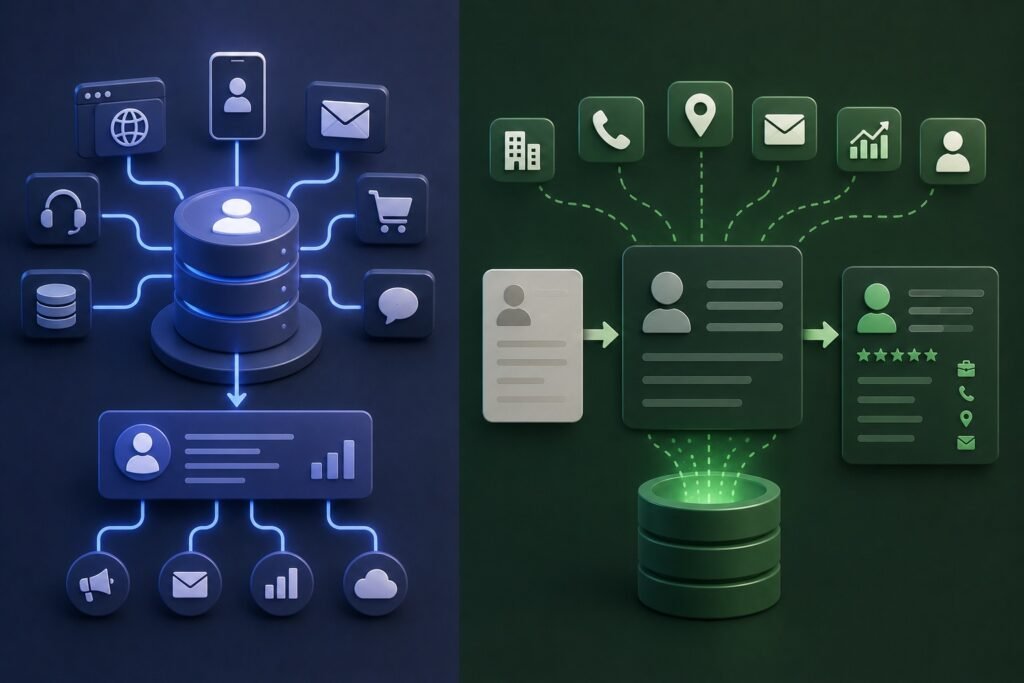
The distinction: a CDP
connects and unifies data you already have across systems; enrichment
improves and completes the data within a system using external sources. A CDP doesn’t make your data more accurate or complete — it organizes and unifies it. Enrichment doesn’t unify across systems — it improves data quality within one. They solve different problems, which is why the right choice depends on which problem you actually have.
Common questions
What is a customer data platform (CDP)?
A customer data platform is a system designed to collect and unify customer or prospect data from multiple sources into persistent profiles. A CDP can bring together information from websites, applications, marketing systems, customer service platforms, transactions, and other sources to create a more connected view of an individual or account. Its primary purpose is data unification and activation rather than simply adding missing fields to CRM records.
What is CRM enrichment?
CRM enrichment is the process of adding or updating information in an existing CRM record using internal or external data sources. For example, enrichment might add company size, industry, job title, professional email, phone number, technology usage, or other attributes to an existing account or contact. The goal is usually to make CRM records more complete and useful for sales, marketing, and operations.
What is the difference between a CDP and CRM enrichment?
A CDP primarily
unifies data from multiple systems, while CRM enrichment primarily
improves the information already stored in the CRM. A CDP might combine website behavior, product usage, purchases, support activity, and marketing engagement into a unified profile. Enrichment might take an existing company record and add employee count, industry, revenue range, or updated contact information. They can complement each other rather than being direct substitutes.
When does a business need CRM enrichment?
CRM enrichment is often enough when the main problem is incomplete, outdated, or inaccurate customer and prospect records. If salespeople are missing job titles, company information, contact details, or firmographic attributes, enrichment can address the problem without introducing a larger customer-data platform. It is particularly useful for organizations that already have a functioning CRM and simply need better information within it.
When does a business need a CDP?
A CDP becomes more useful when customer information is fragmented across multiple systems and the business needs a unified profile for analytics, segmentation, personalization, or activation. Companies with substantial website activity, product usage data, multiple marketing platforms, customer-service interactions, and complex customer journeys may benefit more from a CDP than from basic CRM enrichment.
Can CRM enrichment replace a CDP?
Usually not. Enrichment can improve CRM records, but it does not necessarily unify behavioral and transactional information across an organization’s entire technology stack. If the core problem is fragmented customer data rather than missing firmographic or contact fields, enrichment alone may not solve it. However, businesses with relatively simple data environments may not need the complexity of a full CDP.
Can a CDP replace CRM enrichment?
Not necessarily. A CDP can unify information, but the quality of the underlying contact and company data still matters. If CRM records are missing basic firmographic or contact attributes, external enrichment can remain useful. A CDP and enrichment process can therefore work together: enrichment improves record quality, while the CDP connects those records with behavioral and transactional data.
Which is more important for B2B sales teams: a CDP or CRM enrichment?
For many B2B sales teams,
CRM enrichment is the more immediate need. Salespeople generally benefit from accurate company information, current job titles, verified contact details, firmographics, and account relationships. A CDP becomes more valuable when the organization wants to combine those records with website behavior, product engagement, marketing interactions, and other signals to identify and prioritize accounts.
How should businesses decide between a CDP and CRM enrichment?
Identify the underlying data problem first. If the problem is
“Our CRM records are incomplete or outdated,” start with enrichment. If the problem is
“Customer information exists across many systems and we cannot create a unified customer view,” a CDP may be more appropriate. If both problems exist, the strongest architecture may involve enrichment feeding cleaner data into a broader customer-data environment.
What should you consider before buying either solution?
Evaluate data sources, integration requirements, identity resolution, company and contact matching, data freshness, enrichment coverage, activation capabilities, implementation complexity, governance, security, and total cost. Avoid purchasing a CDP simply because it offers more features than an enrichment tool. Likewise, avoid relying on enrichment when the real problem is fragmented behavioral data. Choose the solution that addresses the specific data-management problem your teams are actually experiencing.
How this applies to your business
Diagnose your actual problem before choosing a solution. If your pain is fragmentation — customer data scattered across systems with no unified view — a CDP addresses that. If your pain is data quality — incomplete, outdated, thin records — enrichment addresses that. The expensive mistake is implementing a CDP to solve a data-quality problem (it won’t; it’ll just unify the bad data) or trying to enrich your way out of a genuine fragmentation problem (enrichment doesn’t connect systems). Match the solution to the real problem.
For most businesses, enrichment delivers faster, cheaper value than a CDP, because it improves data you’re actively using without a major platform implementation. Unless you have genuine, costly fragmentation across many disconnected systems, improving the quality of your existing CRM data is usually the higher-return first move. Start there, and consider a CDP only if a real unification problem remains.
If you do pursue a CDP, treat data quality as a prerequisite, not a competing priority. A CDP unifies whatever you feed it, so feeding it dirty data produces unified dirty data. Enriching and cleaning before or alongside CDP implementation ensures the unified profiles are built on accurate, complete information — making the CDP investment actually pay off rather than just organizing your existing data problems more neatly.
Iscope Digital’s
Database Marketing Solutions handle the enrichment and data-quality side — append, firmographic enrichment, hygiene, and refresh against the verified
Bizline Direct database — that makes whatever systems you use work better. For the enrichment fundamentals, see
What is firmographic enrichment and which fields matter most? and on the cost of leaving data unimproved,
Cost of dirty data: how to calculate it for your business.