When two or three vendors all claim to have the best data, the fairest way to settle it is to test them head-to-head on the same task. A “bake-off” — a structured side-by-side comparison — reveals which provider actually performs for your target. Here’s how to run one properly.
What a Bake-Off Is
A bake-off is a controlled comparison where you give competing vendors the same brief and evaluate their output against identical criteria. Instead of comparing marketing claims, you compare real data on a level playing field. It’s the most objective way to choose, because it tests vendors on exactly the task you’ll use them for.
Why Side-by-Side Testing Wins
Vendors are hard to compare on paper because they measure things differently and market similarly. A bake-off removes that ambiguity — same input, same criteria, same target — so differences in quality become visible. It also surfaces strengths and weaknesses you’d never see in a demo, like real coverage and accuracy in your niche.

Defining a Fair Test
Fairness is everything. Give each vendor the same target criteria — the same industry, region, roles, and volume — and the same fields to populate. Don’t let one vendor cherry-pick an easier segment. A representative, identical brief drawn from your real target is what makes the comparison meaningful.
What to Measure
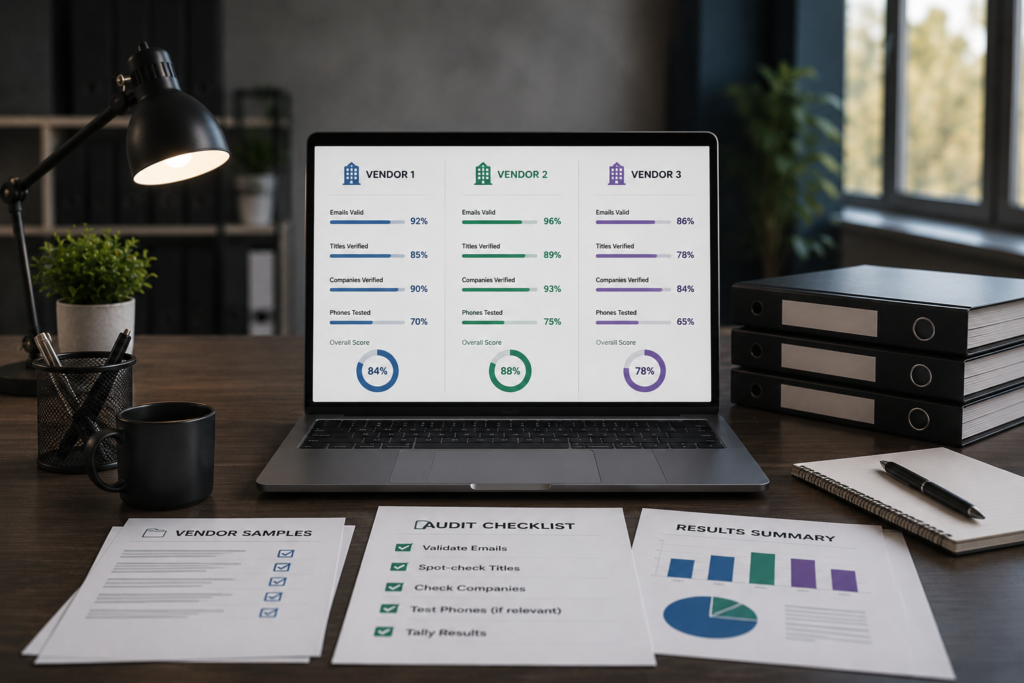
Score each vendor on the dimensions that matter: coverage (how many fitting records they returned), accuracy (how many are correct and current), fill rate (how complete the priority fields are), and deliverability (how many emails validate). Use the same audit method for each, and record concrete numbers rather than impressions.
Running the Comparison
Request the same sample from each vendor, then audit all samples identically — validate emails, spot-check titles and companies, test a few phones if relevant, and tally results per vendor. Keeping the audit consistent across vendors is what keeps the test fair. The vendor with the best real numbers on your target, not the best pitch, wins.
Interpreting the Results
Weigh the results by what matters most to you — a calling team prioritizes direct-dial accuracy; an email team prioritizes deliverability. The “winner” is the vendor that performs best on your priority dimensions for your target, at a fair price. Sometimes the answer is even a split, using different vendors for different segments.
Key Takeaways
A bake-off compares vendors head-to-head on the same brief and criteria, replacing marketing claims with real performance on your target. Make the test fair with identical, representative briefs, measure coverage, accuracy, fill rate, and deliverability consistently, and weigh results by your priorities. It’s the most objective way to choose the provider that actually performs for you.
Frequently Asked Questions
What is a B2B data vendor bake-off?
A controlled side-by-side test where competing vendors get the same brief and you evaluate their output against identical criteria for your target.
Why run a bake-off instead of comparing on paper?
Because vendors measure and market similarly, making paper comparison unreliable. A bake-off tests real data on a level playing field.
How do I make the test fair?
Give each vendor the same target criteria, volume, and fields, drawn from your real target, and don’t let any vendor cherry-pick an easier segment.
What should I measure in a bake-off?
Coverage, accuracy, fill rate on priority fields, and deliverability — scored with the same audit method for each vendor.
How do I run the comparison?
Request the same sample from each vendor, audit all samples identically, and tally concrete numbers per vendor rather than impressions.
How do I interpret the results?
Weigh them by your priorities — direct dials for callers, deliverability for emailers — and pick the best performer on your target at a fair price.
Can the result be a split decision?
Yes. Sometimes different vendors win for different segments, and using each where it’s strongest can be the right call.
How big should the test sample be?
Large enough to be representative — often around 50–100 records per vendor from your target — so differences are meaningful, not noise.
Will vendors agree to a bake-off?
Confident vendors usually welcome it. Reluctance to participate or provide a representative sample is itself informative.
Does the cheapest vendor win a bake-off?
Not automatically. The winner is the best performer on your priority dimensions at a fair price — value, not just the lowest cost.